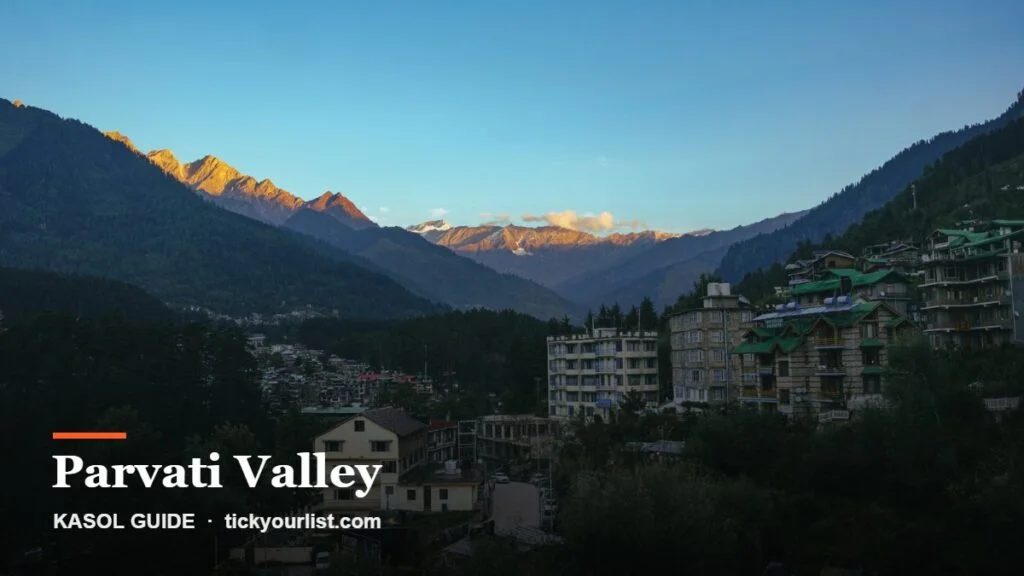
Kasol is a hamlet of about a third of a square kilometre, sitting at 1,580 metres on the banks of the Parvati River in Kullu district. That is genuinely all it is, which is why most lists of places to visit in Kasol quietly mean the whole Parvati Valley. And yet it has become the busiest backpacker base in Himachal Pradesh, with a nickname — the Mini Israel of India — that it earned from decades of Israeli travellers coming through.
So when people search for that phrase, what they actually want is the valley around it. In fact, Kasol itself you can walk end to end in fifteen minutes. The twenty-five entries below spread out from there: riverside walks you can do in trainers, villages an hour above the treeline, hot springs three and a half kilometres away, and treks that climb past four thousand metres.
Because the searches tell me what else you need, this also covers Kasol weather and temperature month by month with the actual figures, the Delhi to Kasol and Chandigarh routes including which bus to take, where to stay, and the cafe scene. Everything is sourced, and where the sources disagree — and on distances they disagree a lot — I have given you the range rather than a confident number.
Places To Visit In Kasol: The Village And The River

So start with the places to visit in Kasol you can reach on foot from wherever you drop your bag.
1. Kasol main market
A single short strip of cafes, bakeries, gear shops and travel desks. In short, it takes ten minutes to walk and most people walk it four times a day anyway. This is where you arrange onward transport, hire a sleeping bag, and work out who else is heading up to Kheerganga tomorrow.
2. The Parvati riverbank
Above all, the river is the reason Kasol works. It runs loud and cold right through the settlement, with flat boulders along the bank that function as the village living room. Mornings are quiet and the light comes down the valley late, so the best hour is usually mid-morning rather than dawn.
A caution worth taking seriously: the Parvati is fast, glacier-fed and genuinely dangerous. In fact, people get into trouble here every season. Sit on the rocks, do not swim.
3. Nature Park Kasol
A small green space on the edge of the village, listed among the local sights, and the easiest place to sit with a book when the market feels crowded. Overall: low effort, low drama, pleasant for an hour.
Chalal And The Easy Places To Visit In Kasol

Next, the short walks. In short, these are the easiest places to visit in Kasol on foot. Besides, these need no permits, no guide and no equipment beyond shoes with grip.
4. Chalal
The classic first walk, and the one almost every guide names. You cross the river from Kasol and follow a forest path upstream for roughly twenty to thirty minutes. Chalal is quieter than Kasol, cheaper to stay in, and has its own small run of cafes.
Naturally, plenty of travellers end up moving here after a night in Kasol. If you want the valley without the market noise, this is the easiest version of it.
5. Katagla
Next, a small settlement just along the road from Kasol, close enough to walk. It gets a fraction of the traffic and it is a useful fallback when Kasol is full in peak season. Admittedly, there is not a great deal to do, which for some people is the appeal.
6. The riverside path towards Manikaran
You can walk a good stretch of the Kasol to Manikaran route rather than taking the bus. The road follows the Parvati the whole way, the gradient is gentle, and the valley narrows as you go. Overall, three and a half kilometres is an easy hour at a wandering pace.
Do it in daylight and walk facing the traffic — this is a working road, not a footpath.
Manikaran: Hot Springs And The Gurudwara

Three and a half kilometres from Kasol, and the one trip nobody should skip.
7. Manikaran Sahib Gurudwara
A Sikh gurudwara built over natural hot springs, and a major pilgrimage site. The langar here is famous partly because the food is cooked using the spring water itself. Visitors are welcome, meals are free, and the atmosphere is completely different from anything else in the valley.
Above all, cover your head, remove your shoes, and dress respectfully. Of course, this is an active place of worship, not a viewpoint.
8. The Manikaran hot springs
Indeed, the springs are hot enough to cook in, which is not an exaggeration — rice is boiled in them. There are bathing pools within the gurudwara complex and at the temple nearby, separated by gender.
Still, test the water before you get in. That said, the temperature varies between pools and some of them are genuinely scalding. It is the most restorative thing you can do after a trek, and it costs nothing.
Manikaran is also a Hindu pilgrimage site, so the town holds two traditions side by side. Buses and shared taxis run from Kasol throughout the day, and the ride takes about fifteen minutes.
Kheerganga And The Big Treks From Kasol

Now the serious walking, and the most demanding places to visit in Kasol. Kasol is a recognised base for Himalayan treks, and these four are the ones people come for.
9. Kheerganga
The headline trek of the Parvati Valley, and the one most first-timers do. You drive or bus to Barshaini, then climb through forest and waterfalls to a meadow with hot springs at the top. Most people go up in a day, sleep in a camp, and come down the next morning.
It is a hard walk rather than a technical one. So go with decent shoes, carry water, and start early.
10. Sar Pass
A full multi-day trek crossing a pass at 4,220 metres — 13,850 feet. The name, meanwhile, comes from the local word for lake, after a small, usually frozen lake near the top. The camp sequence runs out of Kasol through Grahan, Padri, Minh Thatch, Nagaru and Biskeri.
Clearly, this is a booked, guided, organised trek, not something to improvise. Published duration and difficulty vary by operator, so compare before you commit. Our adventure travel booking guide covers when these trips are cheapest to book.
11. Chanderkhani Pass
A pass at 3,660 metres (12,010 feet) linking the Naggar side of the Kullu valley with Malana. From the top you can see Indrasan, Deo Tibba, the Pir Panjal and the Parvati Range. Moreover, it carries real religious weight locally, tied to the deity Jamlu of Malana.
12. Grahan
A village roughly a day’s walk from Kasol and the second camp on the Sar Pass route. You can do it as a standalone overnight rather than committing to the full pass, which makes it the best introduction to trekking here.
Villages: The Best Places To Visit In Kasol’s Upper Valley

These are the places to visit in Kasol that people mean when they say they are going up the valley. Equally, each has a different character and the differences matter.
13. Tosh
The end of the road and the most popular overnight away from Kasol. Guesthouses are stacked up a steep hillside facing a wall of mountains, and the view from almost any balcony is the reason people stay three nights instead of one.
14. Malana
An old village with its own traditions, its own governing council and its own language, built around the deity Jamlu. It is reached either on the trek over Chanderkhani or otherwise by road and a climb.
Read this part before you go. Malana has strict customs about outsiders touching people, buildings and objects, and visitors are expected to keep to marked paths and ask before anything else. Respect them. Still, people turn up treating the place as a curiosity and it causes real friction. So if you are not prepared to follow local rules, go somewhere else.
15. Rasol
A steep climb above the valley floor to a small village with big views and very little infrastructure. It is a harder walk than Chalal and a quieter place at the end of it.
16. Pulga
Near Barshaini, and known for the forest above it. By comparison, Pulga works well as a slower-paced alternative to Tosh, with a short walk in from the road.
17. Kalga
Pulga’s neighbour, reached from the same point, built among apple orchards. Together with Pulga and Tosh it forms the cluster most people pick between when they want to leave Kasol for a few nights.
Quieter Places To Visit In Kasol Worth The Walk

Four more that take effort to reach, which is exactly why they stay pleasant.
18. Kutla
Higher still, above Tosh, reached on a steep path that takes a couple of hours. Even so, there is very little up there beyond a handful of stone-and-wood guesthouses and an enormous view. As a result, people who find Tosh too busy keep walking to Kutla.
19. Waichin Valley
Also known locally as Magic Valley, reached on foot from the Kalga side. Equally, a wide grassy bowl ringed by peaks, with far fewer people than the main trekking routes. Overall, it is a long day walk or an easy overnight.
20. Barshaini
Technically a road head rather than a destination — this is where the bus stops and the Kheerganga, Tosh, Pulga and Kalga routes all begin. Worth knowing by name because every set of directions in the upper valley references it.
21. The Parvati Valley above Barshaini
Beyond the road head the valley keeps going, and the walking gets wilder quickly. Unless you are on an organised trek with a guide, treat the upper valley as a place to look at rather than wander into. Moreover, conditions change fast and help is a long way off.
Day Trips From Kasol

Finally, four places to visit in Kasol’s wider district that fit into a day.
22. Jari
Down the valley towards Bhuntar, and the junction where the Malana road turns off. Most people pass through it; a few stay, because rooms are cheaper and the river views are good.
23. Bhuntar
Thirty kilometres away and the practical hub for the whole valley — airport, bus stand and the junction with the main Kullu highway. Not a sightseeing destination, but you will pass through it coming and going, and it is worth building an hour of slack into your plans here.
24. Kullu
Finally, the district headquarters, thirty-six kilometres from Kasol. Bigger, busier and more ordinary than the Parvati Valley, but it is the place for anything you cannot buy in Kasol, and the Dussehra celebrations here are among the most famous in the Himalayas.
25. Naggar and the Kullu valley road
Naggar, finally, sits between Kullu and Manali and is the far end of the Chanderkhani trek. Going by road rather than over the pass turns it into a long but straightforward day, and it pairs naturally with heading onward to Manali rather than doubling back.
If you are building a bigger Himalayan route, our list of best places to visit in India with friends covers what else slots in around Kasol.
Cafes In Kasol

Clearly, the cafes in Kasol are not a sideshow — they are most of why people stay. The village runs on riverside places serving Israeli food — shakshuka, hummus, pita, falafel — alongside Himachali and standard traveller menus.
What the scene is actually like
In short: low tables, cushions, slow service and a river you can hear from every seat. Nobody is in a hurry. A meal takes an hour and a half because the kitchen is small and the staff are not pretending otherwise, which is either charming or maddening depending on your mood.
For example, Moondance Cafe is among the long-standing names people look up. Likewise, ATS Cafe is another that gets searched heavily.
An honest word on cafe recommendations
I am not going to hand you a ranked list with menu prices, because Kasol cafes open, close, change hands and change names constantly. A list written eighteen months ago is actively misleading here, and plenty of the ones you will find online are exactly that.
What works instead: walk the strip, look at which places have people in them at eight in the evening, and check recent reviews rather than old blog posts. Then again, in a village this small you can inspect every option in ten minutes.
Practical bits
- Carry cash — card acceptance is patchy and the network drops out
- Eat early if you have an early start, because kitchens are slow by design
- Chalal and Tosh have their own cafes, generally quieter and cheaper than Kasol’s
- Vegetarian and vegan options are everywhere, which is not true of much of Himachal
Kasol Weather And Temperature, Month By Month

More people search for Kasol temperature and Kasol weather than for anything else about the place, so here are the actual figures rather than adjectives. Kasol sits at 1,580 metres and the climate is classified humid subtropical.
| Month | Avg high | Avg low | Rainfall |
|---|---|---|---|
| January | 11.6 °C | 3.2 °C | 111 mm |
| February | 14.2 °C | 5.2 °C | 108 mm |
| March | 18.8 °C | 9.2 °C | 155 mm |
| April | 24.0 °C | 13.4 °C | 103 mm |
| May | 28.2 °C | 17.6 °C | 100 mm |
| June | 29.3 °C | 19.4 °C | 93 mm |
| July | 25.9 °C | 18.8 °C | 324 mm |
| August | 25.0 °C | 18.4 °C | 276 mm |
| September | 24.6 °C | 16.7 °C | 160 mm |
| October | 22.2 °C | 12.8 °C | 70 mm |
| November | 18.3 °C | 8.4 °C | 27 mm |
| December | 14.2 °C | 5.3 °C | 55 mm |
Across the year that averages out at a daily high of 21.4 °C and a daily low of 12.4 °C, with about 1,582 mm of rain.
What those numbers mean in practice
- June is the warmest month at 29.3 °C, and also the driest of the summer at 93 mm
- July and August are the monsoon — 324 mm and 276 mm, which is more than half the annual rainfall in two months
- November is the driest month by a distance, at just 27 mm
- January nights drop to around 3 °C and Kasol gets a fair amount of snowfall from late December through February
The thing the averages hide
Of course, these are valley-floor figures for 1,580 metres. Kheerganga, Sar Pass and the upper villages sit far higher and are much colder — Sar Pass crosses 4,220 metres. At the same time, a pleasant 24 °C afternoon in Kasol can be near freezing at a trekking camp the same night. Therefore, pack for the altitude you are climbing to, not the one you are reading this at.
For how Kasol fits into the wider Indian calendar, our month-by-month guide to the best time to visit India sets the context.
How To Reach Kasol From Delhi, Chandigarh And Manali

One structural fact first, because it explains everything else. In fact, no bus terminates at Kasol. Every service from Delhi runs to Bhuntar, and you cover the last 30 km on a local HRTC bus or a shared cab, which takes about an hour.
| From | Distance | Notes |
|---|---|---|
| Delhi | about 500 to 526 km | Overnight bus to Bhuntar, 10 to 13 hours |
| Chandigarh | roughly 260 to 275 km | Published figures vary; see the caution below |
| Bhuntar | about 30 km | Roughly an hour on a narrow road |
| Kullu | 36 km | Via Bhuntar |
| Manikaran | 3.5 km | Fifteen minutes |
| Bhuntar airport (KUU) | about 31 km | Nearest airport |
| Joginder Nagar station | about 143 to 145 km | Narrow gauge, nearest railhead |
Buses from Delhi to Kasol
HRTC and HPTDC run ordinary, semi-sleeper and Volvo AC services from ISBT Kashmere Gate. Private overnight sleepers — Zingbus, IntrCity SmartBus, Laxmi Holidays and Bedi Travels among them — board around Majnu Ka Tila and RK Ashram Metro.
Most departures cluster in the evening, though the last services leave around 23:55. Fares, meanwhile, run roughly ₹450 to ₹1,600 one way, with HRTC cheapest at about ₹450 to ₹900. Therefore, book a day or two ahead in summer.
By road, and by air
Self-driving follows NH44 north through Sonipat, Panipat, Karnal and Ambala, then Rupnagar, Bilaspur, Mandi and Bhuntar. By road, then, that is 500 to 540 km and 10 to 12 hours. The Mandi highway is good; the stretch after Bhuntar is narrow and slow, so drive that bit in daylight.
Flying, Alliance Air runs Delhi to Bhuntar in about 1.5 hours for roughly ₹4,000 to ₹8,000 one way. It is a small, seasonal airport and services get cancelled, so do not build a tight itinerary around it.
Two honest cautions
First, the Chandigarh figure is unreliable. One source gives 157 km but labels it as the distance to Chandigarh airport; others put the road distance nearer 260 to 275 km. Check a live map rather than trusting any article, including this one.
Second, no source I found publishes a Kasol to Manali road distance directly. The route runs Kasol to Bhuntar, then north up the Kullu valley. Measure it live rather than relying on a quoted number.
And in monsoon, July and August, landslides occasionally block the Mandi to Bhuntar stretch. Build slack into those dates.
Hotels In Kasol: Where To Stay

Accommodation here splits into four rough tiers, and the right one depends mostly on how much noise you can tolerate.
- Hostels and backpacker dorms in Kasol village — cheapest, most social, loudest
- Guesthouses and homestays in Chalal and Katagla — a twenty-minute walk out, quieter, usually cheaper
- Riverside hotels and camps along the Parvati — the view you are picturing, priced accordingly
- Village stays in Tosh, Pulga and Kalga — basic rooms, extraordinary views, no nightlife
Where to actually book
Stay in Kasol village for your first night, because arriving tired and then hunting for a room up a hillside in the dark is miserable. Move out to Chalal or Tosh afterwards once you know the geography.
One review-sourced warning worth passing on: some properties advertised as Kasol are well outside the main area. So check the actual walking distance to the market before booking, not just the name.
What to expect from the rooms
Similarly, hot water is often on a geyser and limited. Heating in winter is usually a blanket situation rather than a radiator situation. Wi-Fi exists but the mobile network drops out regularly across the valley, so download your maps and tickets before you arrive.
Peak season is tight. Weekends in May, June and around New Year sell out, partly because the Kasol Music Festival runs on New Year’s Eve. Book ahead for those dates and improvise the rest of the year — our budget trip planning guide covers the booking-window logic.
Best Time To Visit Kasol

Admittedly, sources split slightly on this. One recommends October to June, another suggests March to June and September to November. Still, both agree on what to avoid, and the rainfall table backs them up.
| Season | Months | Verdict |
|---|---|---|
| Spring | March to May | Best overall. Warming, green, treks opening up |
| Early summer | June | Warmest at 29.3 °C, and the driest summer month |
| Monsoon | July to August | Avoid. 324 mm and 276 mm, with landslide risk |
| Autumn | September to November | Excellent. November is the driest month at 27 mm |
| Winter | December to February | Cold, snowy, very quiet. Lows around 3 °C |
Picking by what you want
For trekking, then, take May to June or September to October. Kheerganga and the higher routes need settled weather and open paths, and the monsoon closes that window hard.
For quiet, go in November. By then it is the driest month of the year, the crowds have gone, and the valley is at its clearest.
For snow, late December to February delivers it, and the valley gets a fair amount. Accept that the upper villages become difficult to reach and some guesthouses shut.
The one date to know
Finally, the Kasol Music Festival runs on New Year’s Eve, which turns a quiet winter village into the busiest it gets all winter. So book months ahead if that is why you are coming, and pick different dates if it is not.
If an unplugged, slow trip is the point, our guide to off-grid destinations for a digital detox explains why patchy signal is a feature here rather than a problem.
Places To Visit In Kasol: Your Questions Answered

Best places to visit in Kasol
Manikaran Sahib and its hot springs 3.5 km away, Chalal on a 20 to 30 minute walk across the river, the Kheerganga trek, and the villages of Tosh, Malana, Pulga and Kalga. Within Kasol itself the main market, the Parvati riverbank and Nature Park Kasol fill a relaxed day.
In short, three to four days covers Kasol, Chalal, Manikaran and one overnight up the valley in Tosh or Kalga. Add two more if you want to trek to Kheerganga properly rather than rushing it. A weekend only really covers Kasol and Manikaran.
Yes, if you want mountains, cheap food and a slow pace rather than sights to tick off. Kasol is a hamlet of 0.36 square kilometres at 1,580 metres, and the appeal is the valley around it. Visitors expecting a resort town are usually disappointed.
Being the Himalayan backpacker base of Himachal Pradesh, its riverside Israeli cafes and the nickname Mini Israel of India, the hot springs at Manikaran, and as the starting point for the Kheerganga, Sar Pass and Malana treks.
Kasol weather, temperature and best time
Overall it ranges from an average high of 29.3 °C in June to 11.6 °C in January, with lows from 19.4 °C in June down to 3.2 °C in January. Across the year the average daily high is 21.4 °C and the average daily low 12.4 °C. Kasol sits at 1,580 metres.
Humid subtropical, then, with about 1,582 mm of rain a year. July and August are the monsoon, bringing 324 mm and 276 mm. November is driest at 27 mm. Kasol gets a fair amount of snowfall from late December to February.
Yes. Indeed, the area receives a fair amount of snowfall from late December through February, when average lows sit around 3 to 5 °C. Higher villages and trekking routes get considerably more and become hard to reach.
In general, March to June and September to November are the two good windows. November is the driest month of the year. Avoid July and August, when the monsoon brings over half the annual rainfall and landslides can block the road. Winter is cold, snowy and very quiet.
Getting to Kasol, hotels and cafes
Admittedly, published figures range from about 500 km to 526 km, with aggregators quoting anywhere from 485 to 540 km. An overnight bus takes 10 to 13 hours to Bhuntar, and self-driving takes 10 to 12 hours.
No. In fact, no bus terminates at Kasol. Every service runs to Bhuntar, about 30 km short, and you finish the journey on a local HRTC bus or shared cab in roughly an hour. HRTC, HPTDC and private operators leave from ISBT Kashmere Gate, Majnu Ka Tila and near RK Ashram Metro, with the last departures around 23:55 and fares of about ₹450 to ₹1,600.
No source checked publishes a direct Kasol to Manali road distance. The route runs Kasol to Bhuntar, about 30 km, then north up the Kullu valley to Manali. Check a live map rather than relying on a quoted figure.
Sources disagree. One gives 157 km but labels it as the distance to Chandigarh airport, while others put the road distance nearer 260 to 275 km. Treat the shorter figure with suspicion and verify before planning around it.
Stay in Kasol village on your first night so you are not hunting for a room in the dark, then move to Chalal for quiet or Tosh for views. Some properties advertised as Kasol sit well outside the main area, so check the walking distance to the market before booking.
The Bottom Line On Places To Visit In Kasol

Kasol itself is tiny, and that keeps surprising people looking up places to visit in Kasol. Indeed, the village takes fifteen minutes to walk. Everything on the list above is the valley around it, and the trip works best when you treat Kasol as a base rather than a destination.
A four-day shape that works: arrive and sleep in Kasol, walk to Chalal on day two, take the bus to Manikaran for the hot springs and the langar, then go up to Tosh or Kalga for a night. Then add two days if Kheerganga is the point, and a week if you are doing Sar Pass.
Four things to get right
- Go in spring or autumn. November is the driest month at 27 mm; July and August bring over half the year’s rain
- Pack for the altitude you are climbing to, not the 1,580 metres you start at
- Carry cash and download your maps, because the network drops out across the valley
- Respect Malana’s customs about touching people and buildings, or skip it entirely
And treat the Parvati with respect. It is fast and glacier-fed, and it is the one genuine danger in an otherwise gentle place.
Building a longer India route? Our things to do in India guide, the best places to visit with friends list and the ultimate travel checklist cover what to pair with Kasol and what to pack.
Figures here come from the Kasol entry for altitude, climate and local distances, the Sar Pass and Chanderkhani entries for pass altitudes, and travel guides including Holidify for transport. Those sources disagree on the Delhi, Chandigarh and railway distances, so I have given ranges and flagged the figure I think is wrong rather than picking a favourite.