Here is a thing that sounds made up but is not. The man who wrote 1984 was born in a small town in north Bihar. Not near it, not passing through — born there, in a colonial bungalow on the eastern edge of Motihari Bihar, on 25 June 1903. And about twenty minutes down the road from that bungalow is the courtroom site where Gandhi launched the Champaran Satyagraha in 1917, the movement that more or less started his career in Indian politics.
Two world-historical things, in one district, and almost nobody goes. That is the strange and slightly maddening fact about this place. Motihari is the headquarters of East Champaran district, roughly 165 km northwest of Patna, and it has a lake running through the middle of it, the largest Buddhist stupa in the country sitting about an hour away, and a temple under construction nearby that is meant to end up taller than Angkor Wat.
This guide covers all of it. Every place to visit in Motihari and the wider district, what each one is actually like rather than what the brochures claim, the Motihari weather month by month, how to reach it, where to sleep, and a two-day plan that fits the lot in. I will also be straight with you about the one site that everybody writes about and almost nobody checks on — because what you will find at Orwell’s birthplace in 2027 is not quite what most articles promise.
Why Motihari Bihar Is Worth Your Time

Let me set expectations honestly, because that matters more here than in most destinations.
First, Motihari is not a polished tourist town. There is no promenade, no cluster of boutique hotels, no English-speaking guide waiting at the station. It is a working district headquarters of a couple of lakh people, dusty in summer, green and waterlogged in monsoon, with traffic that does what it likes. If you want a frictionless holiday, this is not it.
Instead, what it has is a density of history. Within one district you get a Mauryan-era stupa, an Ashokan pillar still standing where Ashoka put it, the ground where Gandhi’s first mass campaign in India began, and the birthplace of one of the most-quoted writers in the English language. That is a remarkable concentration for a place with almost no tourist infrastructure.
Who should come to Motihari Bihar
- History travellers who want sites without crowds, and do not mind that the signage is poor
- Literature people making the Orwell pilgrimage — just read the honest section below first
- Buddhist circuit travellers adding Kesaria to a Bodh Gaya and Vaishali itinerary
- Pilgrims heading to Areraj for Shravani Mela, or to the new temple complex near Chakia
- Anyone passing through to Nepal via Raxaul, which is in this district
Who should probably skip it
Anyone who needs comfort, anyone travelling with very small children in summer, and anyone expecting curated museums. If that is you, the better-known spots near Patna will suit you more, and you can always add Motihari later.
Gandhi Sangrahalaya And The Champaran Satyagraha

Start here, because everything else in town makes more sense afterwards.
On 15 April 1917, Gandhi arrived in Motihari with a farmer named Raj Kumar Shukla. Shukla had been following him around for months, essentially refusing to let Gandhi brush him off, trying to get him to come and look at what the indigo planting system was doing to the cultivators of Champaran. Gandhi came. The administration told him to leave the district. He declined, and was summoned to court — and that refusal, and the enquiry that followed, became the Champaran Satyagraha.
It matters because it was his first real mass campaign on Indian soil. Everything people associate with Gandhi — the method, the moral framing, the willingness to face arrest — got its first full workout in this district.
What the Sangrahalaya actually holds
The Gandhi Sangrahalaya is the district’s main museum and, according to the official East Champaran district site, a leading centre of educational and cultural activity locally. The collection is relics and photographs from the Satyagraha — documents, images, objects from 1917 and the years around it.
Still, be realistic about scale. This is a district museum, not a national one. So allow an hour, read everything, and do not expect interactive displays. What you get is the primary material, in the town where it happened, which is worth more than slick presentation.
Getting there
It sits in town, about 2.3 km from the Orwell bungalow, so the two pair easily in one morning. Gandhi also set up schools and ashrams across the district during and after the campaign, several of which still carry his name.
The Gandhi Memorial Pillar And Satyagraha Park

Next, two linked stops, both in town and both quick.
Gandhi Memorial Stambh
A 48-foot stone pillar marking the spot where Gandhi faced the court in 1917. Nand Lal Bose of Shantiniketan designed it, and the then Governor laid the foundation stone on 10 June 1972. It is a plain, tall, slightly austere thing, and it suits the event it marks far better than something ornate would.
Admittedly, there is not much to do here beyond standing in front of it and reading the inscription. Ten minutes. But it is the actual legal site of the confrontation, and standing on it does something that reading about it does not.
Champaran Satyagraha Shatabdi Park
The state’s Urban Development and Housing department built this park to mark the centenary of the Satyagraha, at a reported cost of around ₹2 crore. It sits at the district headquarters, roughly 550 metres from the Orwell bungalow, which makes it the easiest thing in town to combine with anything else.
So treat it as a park rather than a monument. Locals use it in the evenings, the upkeep is reasonable, and it gives you somewhere shaded to sit between stops. In a Motihari May, that is not a small consideration. If you are travelling with family and want a break from history, this and the NREGA Park are the two places in town designed for exactly that.
George Orwell’s Birthplace: The Honest Truth

Eric Arthur Blair was born here on 25 June 1903. His father, Richard Walmesley Blair, worked in the Opium Department of the Indian Civil Service, which is why the family was in Motihari at all. Eric left for England as an infant and never came back. He took the pen name George Orwell, wrote Animal Farm and Nineteen Eighty-Four, and gave the English language the word “Orwellian”.
The bungalow where that happened still stands on the eastern outskirts of town, roughly 2 km from Bapudham Motihari railway station. Now here is the part most articles leave out.
What you will actually find
In 2014 the Bihar government announced it would restore the house and build a museum, and a budget of around ₹59 lakh was provisioned. Some sources report the site was inaugurated as a museum in May 2015, and at least one travel article still states that the museum “remains open throughout the week”.
But the most recent on-the-ground reporting I could find tells a different story. A Deccan Herald report from November 2025 describes a site slipping into ruin: peeling walls, broken gates, a cracked and faded “protected site” board, and no signboard at the entrance at all. It reports no permanent guard — locals said nobody had been given the duty for a couple of years — and that anyone can walk in, dump rubbish, or graze cattle in the compound. The rooms, it says, you enter at your own risk. There is an open well, and a snake risk.
So should you go?
Yes, but go with the right expectations. In the backyard there is a bust of Orwell and a six-foot stone inscription, and those are real, and standing beside them in the town where he was born is genuinely moving. A tea seller quoted in that same report said people turn up every day, foreigners among them.
What you should not do is travel to Motihari expecting a functioning literary museum, because as of late 2025 that is not what is there. Go for the ground and the stone, not for exhibits. And if a local tells you it is locked, believe them rather than the internet.
Moti Jheel, The Lake That Splits Motihari Bihar

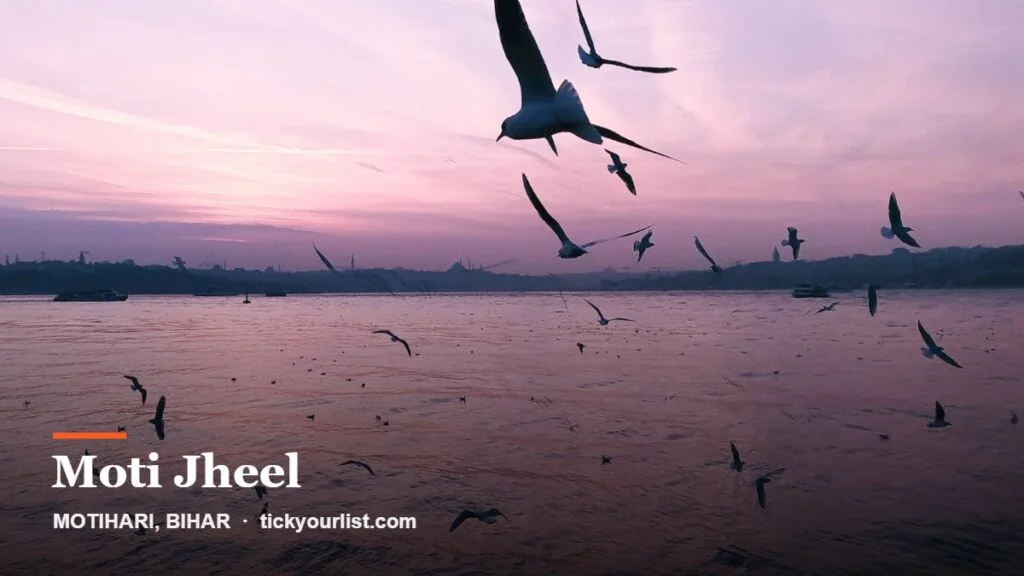
Moti Jheel is the reason Motihari is sometimes called a lake city, and it is the most straightforwardly pleasant thing in town. The lake runs through the middle of the settlement and effectively divides it in two, with the older part of town sitting along the eastern bank.
I could not find a reliable published figure for its size, and I am not going to invent one. What I can tell you is that it is big enough to walk a decent stretch of and small enough that you can see across it, and that at dawn and in the hour before sunset it is the best light you will get anywhere in the district.
What to do there
First, walk the bank. That is genuinely it, and it is enough. Early morning brings walkers, birds on the water, and mist off the surface in winter. Evenings bring families, chai stalls and a lot of noise. Both are worth seeing and they feel like completely different places.
Migratory and resident waterbirds use the jheel, so bring binoculars if that is your thing — the district as a whole has decent birdlife, and the forest patch near Mehsi further south is specifically known for it.
A caveat
Water bodies in small Indian towns take a beating, and parts of the bank get used as informal dumping ground. Stretches of it are lovely and stretches of it are not. Walk the better-kept sections near the parks rather than striking out along the whole perimeter, and you will have a much nicer time.
Kesaria Stupa: The Biggest Thing Near Motihari Bihar

If you only make one trip out of Motihari town, make it this one. Kesaria Stupa sits on the eastern bank of the Gandak, and the distance from Motihari depends on which source you trust — one travel guide puts it at about 60 km, another measures 52 km from the Orwell bungalow. Either way, allow an hour and a half each way on Bihar roads.
Essentially it is a vast brick mound rising in terraces, and standing at the base of it beats anything else in East Champaran. Nothing else here comes close.
How big, honestly
This is where you need to be careful with what you read. The district administration’s own site calls it “the largest Buddha Stupa in the world”. Other sources describe it as 104 feet tall and the tallest Buddhist stupa, and note that archaeologists believe it once stood closer to 150 feet before centuries of erosion and an earthquake took the top off.
My honest read: it is almost certainly the tallest in India and among the largest anywhere, but “largest in the world” is a claim that depends entirely on whether you are measuring height, diameter or volume, and Borobudur exists. Do not go for the superlative. Go because it is enormous, ancient, and you will probably have it nearly to yourself.
Practical notes
One source reports the stupa was brought to light in 1998, which gives you a sense of how recently it was properly excavated. There is minimal shade, no real facilities, and the surface gets brutally hot by mid-morning. Go at opening or late afternoon, carry water, and wear something on your feet you can climb terraces in. It slots neatly onto a Buddhist circuit with Vaishali and Bodh Gaya if you are already doing India’s major monuments.
Virat Ramayan Mandir And The Giant Shivling

This is the newest reason to come, and over the next few years it may well become the main one.
At the twin villages of Kaithawalia and Bahuara, near Chakia and about 31 km south of Motihari, the Mahavir Mandir Trust of Patna is building the Virat Ramayan Mandir. The planned numbers are not modest: 123 metres tall, 850 metres long, 430 metres wide, 18 shrines, a hall seating 20,000 people, and a reported budget of around ₹500 crore. Published figures for the site area differ between 125 and 161 acres.
The Shivling
In January 2026 the project installed what it describes as one of the largest Shivlings in the world. It was carved from a single block of black granite by sculptors at Mahabalipuram in Tamil Nadu, stands about 33 feet tall, and weighs somewhere around 210 tonnes — though one source puts it at 231. It travelled over 2,500 km to Bihar on heavy-load transport, and it carries 1,008 smaller lingams carved across its surface.
The installation happened on 17 January 2026 and drew thousands. Whatever you think of the scale of the project, a single 210-tonne stone moved across the subcontinent is a genuinely extraordinary object to stand in front of.
Is it open? Check first
Here is the honest caveat. Completion was expected in 2026, but the most recent reporting still described the complex as under construction and “taking shape”, and none of the sources I read confirmed whether it is open to general visitors. The Shivling is installed and has been consecrated. The temple around it may not be finished.
So before you build a trip around it, check the project’s own site or ring ahead. The original plan, incidentally, was to build it at Hajipur as a near-copy of Angkor Wat, until the Cambodian government objected in 2012 and the design and site were changed.
Areraj Temple And The Ashokan Pillar

This is the district’s main pilgrimage town, and it holds two very different things that happen to sit close together.
Someshwar Nath Mahadev Mandir
A long-established Shiva temple that draws pilgrims from across Bihar and from Nepal. Its big moment is the Shravani Mela, held through the month of Shravan — roughly July and August — when the crowds become enormous and the whole town reorganises itself around the queue.
Go during the mela if you want the spectacle and do not mind crowds, heat and rain all at once. Go in winter if you want to actually see the temple. Those are two completely different trips and you should pick deliberately.
The Ashokan pillar at Lauriya Areraj
A 36-foot pillar carrying an edict of Emperor Ashoka, standing where it was raised more than two thousand years ago. The district administration lists it as a declared protected monument. Pillars like this are the oldest surviving written records in the subcontinent, and there is something quietly astonishing about one of them sitting in a field in East Champaran with nobody looking at it.
Do not confuse the two Lauriyas
This trips people up constantly, so here it is plainly. Lauriya Areraj is in East Champaran, near Areraj, and is the one covered above. Lauriya Nandangarh is a separate site in West Champaran — a different district — roughly 14 km from Narkatiaganj and 28 km from Bettiah, near the Budhi Gandak, with its own pillar and burial mounds. Both are Ashokan, both are called Lauriya, and they are about two hours apart. Check which one your driver thinks you mean.
Temples, Parks And Quiet Corners In Motihari Bihar

The district administration lists a handful of smaller places worth a look. It names them without describing them, so I will not pretend to more detail than exists — but they are the local picks, and local picks are usually right.
- Gayatri Mandir — a temple in town, and one of the named places of interest
- Sitakund — a kund site listed among the district’s spots of interest
- NREGA Park — described officially as a cool and pleasant recreation spot suited to all ages
- Navyuvak Pustakalay — a local library, listed among places worth visiting
- The Urdu Library — the district’s other listed library
The opium godown
Worth knowing if you are doing the Orwell trail properly: Richard Blair worked for the Opium Department, and the old opium godown he was posted to has been written about by journalists visiting the town. It is not on any official list of attractions and it is not set up for visitors, but it is part of the same story and locals can point you at it.
What town days are actually like
Motihari rewards wandering more than ticking off. The market streets, the chai stalls around the jheel, the stretch near the station in the early evening — none of it is an attraction and all of it is the reason to come to a town like this rather than only its monuments. Give yourself an unplanned half day, and you will come away with more than the list gave you.
Bhimalpur Forest, Mehsi And Raxaul

Three stops at the edges of the district, each for a different kind of traveller.
Bhimalpur Forest
An eco-tourism and biodiversity site at Bhimalpur village in Mehsi block, near the Burhi Gandak river and about 7 km from Mehsi town. Reported wildlife includes nilgai, peafowl and jackals, plus migratory birds in season. Boating, trails and a biodiversity park have been proposed for the site.
But note that word: proposed. Go expecting a forest patch with good birdlife, not a developed reserve with a visitor centre. For birders that is fine, and arguably better.
Mehsi
A town in the south of the district on NH 27, about 40 km from Motihari. It has a longer history than its size suggests — it appears in the Ain-i-Akbari as the pargana of Mihsī. It is mainly useful as the access point for Bhimalpur, and as a stop if you are driving the Motihari–Muzaffarpur road.
Raxaul
Raxaul sits in this district on the Nepal frontier, and it is one of the busiest land crossings between the two countries — across the border is Birgunj. If Nepal is on your itinerary, this is how you get there overland, and Bapudham Motihari station connects directly to Raxaul.
It is a border town and behaves like one: lorries, money changers, queues, bustle. If you are mapping out a longer route, our wider guide to things to do in India covers what else is worth building in. Still, not somewhere to linger for sightseeing. But if you are combining Motihari with onward travel, it makes the whole trip make sense geographically, and it is worth knowing the district reaches that far north.
Motihari Bihar Weather, Season By Season

A lot of people searching for Motihari Bihar weather are really asking one question: when will this be bearable? So here are the actual recorded numbers rather than vague adjectives.
The climate is humid subtropical — Köppen Cwa — with the monsoon running June through September. Figures below come from the India Meteorological Department records for the town.
| Measure | Recorded figure |
|---|---|
| Annual mean maximum | 30.5 °C |
| Annual mean minimum | 18.5 °C |
| Average annual rainfall | 1,290.4 mm (50.8 in) |
| Rainy days per year | 53.3 |
| Mean relative humidity | 66% (measured 17:30 IST) |
| Highest ever recorded | 44.4 °C on 24 May 1903 |
| Lowest ever recorded | 0.0 °C on 3 February 1905 |
| Heaviest 24-hour rainfall | 520 mm on 25 August 2005 |
Where the rain actually falls
Almost all of it lands in four months. July is the wettest at 366.4 mm, followed by August at 289.6 mm, September at 247.6 mm and June at 215.0 mm. Add those four and you have well over a metre of the roughly 1,290 mm annual total.
One honest note on the figures: the East Champaran district page gives average annual precipitation as 1,241 mm rather than 1,290.4 mm. The two are measuring different things — a district average versus the town’s own station — and neither source explains the gap. Treat both as approximately “about 1.25 metres a year” and you will not be misled.
What each season feels like
- Winter, November to February — the good season. Cool mornings, mist off the jheel, comfortable days. The record low of 0 °C tells you it can genuinely get cold at night, so pack a layer
- Spring, March to April — warming fast, still manageable, fewer visitors anywhere
- Summer, May to early June — avoid it. The all-time high of 44.4 °C was set in May, and Kesaria Stupa has no shade whatsoever
- Monsoon, June to September — green, dramatic, and difficult. Rural roads suffer, and a single day once delivered 520 mm
The Best Time To Visit Motihari

Short answer: October to March, and within that, November to February if you can choose freely. That is the window travel guides recommend and it matches the weather data exactly.
| Months | Verdict | Why |
|---|---|---|
| November to February | Best | Cool, dry, clear. Mist on the jheel at dawn |
| October | Very good | Monsoon has pulled back, countryside still green |
| March | Good | Warming but fine. Quiet everywhere |
| April | Acceptable | Hot by afternoon. Start early, rest at midday |
| May to early June | Avoid | Record 44.4 °C was set in May. No shade at Kesaria |
| Late June to September | Difficult | Monsoon. Green and dramatic, but roads suffer |
| July to August | Mela season | Crowded Areraj, heavy rain — a deliberate choice, not a default |
The one exception
If the Shravani Mela at Areraj is the thing you want, you have to come in July or August, and you accept the rain and the crowds as part of the deal. That is a pilgrimage trip rather than a sightseeing trip, and it is a completely legitimate reason to ignore everything above.
Planning around the wider region
Motihari’s good season lines up with most of north India, so it slots easily into a longer trip. If you are building one, our month-by-month guide to the best time to visit India covers how the regions differ, and the places near Patna list gives you the obvious additions on the way in or out.
How To Reach Motihari Bihar

By train to Motihari Bihar
Bapudham Motihari is the principal station serving the district headquarters, and rail is how most people should arrive. It connects to Muzaffarpur and Raxaul within Bihar, and travel guides list direct services to Delhi, Kolkata, Gorakhpur and Patna. The station sits roughly 2 km from the Orwell bungalow, so you are in the middle of things as soon as you step off. Mehsi has its own station further south if that suits your plans better.
By air to Motihari Bihar
There is no airport at Motihari, so you fly to one of two places and drive.
| Airport | Distance to Motihari | Notes |
|---|---|---|
| Patna (Jay Prakash Narayan Intl) | 153 to 170 km depending on source | Roughly 3 to 5 hours by road |
| Gorakhpur, Uttar Pradesh | around 140 km | Closer, fewer flights |
Published distances disagree — one source gives Patna as 153 km and about a three-hour drive, another as 160 to 170 km and four to five hours. Assume the longer figure when planning and you will not be caught out.
By road to Motihari Bihar
The district is served by NH 27 plus NH 527C and NH 527D. The NH 27 stretch from Motihari through Mehsi to Muzaffarpur is about 80 km. Buses and private taxis run to Patna, Muzaffarpur and Raxaul.
| From | Distance |
|---|---|
| Patna | 152 to 165 km |
| Muzaffarpur | 72 to 80 km |
| Bettiah | 40 to 45 km |
| Sitamarhi | 75 km |
| Mehsi | 40 km |
| Chakia | 32 km |
Those ranges are not me hedging — published sources genuinely give two different figures for Patna, Muzaffarpur and Bettiah, and nobody reconciles them. Road distance and straight-line distance are probably the explanation.
Getting around Motihari Bihar
Meanwhile, autos and local taxis cover the town easily and cheaply, and attractions near you in India is a useful cross-check if you are already travelling in the region. For Kesaria, Areraj and the temple site near Chakia you want a car for the day — these are 30 to 60 km runs on roads where a shared auto is a poor idea.
Where To Stay And What To Eat In Motihari

Hotels in Motihari Bihar
Overall, expect simple. This is a district town with business and pilgrim traffic, not a leisure market, so you are choosing between clean-and-basic and clean-and-slightly-less-basic. Properties that travel guides name include Hotel Rudra Regency as the mid-range option with larger rooms, Siddhi Vinayak Hotel & Banquet near the bus stand, and Hotel Bhagirath Palace at the budget end. Guesthouses and dharamshalas handle groups and pilgrim parties.
A caveat worth stating: those are third-party listings, not personal recommendations, and small-town hotels change hands and standards fast. Check recent reviews and ring to confirm before you rely on any of them. There is no booking aggregator coverage here like you would get in a metro.
The food, which is the real reason to be pleased
You are in Champaran, and Champaran lent its name to one of the best-known meat dishes in eastern India — the slow-cooked Champaran mutton, sealed in a clay handi with mustard oil, garlic and whole spices and cooked in its own steam. If you eat meat, eat this, here, where it comes from.
Beyond that it is Bihari food at its most straightforward: litti chokha, sattu in every form including as a drink in summer, and sweets like thekua and khaja. Travel guides name Annapurna & Daughters, The Amirlal’s and Annapurna Sweets Chiraiya among the vegetarian options and sweet shops in town.
Practical food advice
Also, eat where there is turnover. In a town this size the busy places are busy for good reasons, and the quiet ones are quiet for good reasons too. Carry bottled or filtered water, and if you are visiting in monsoon be more careful than usual about street food that has been sitting out.
A Two-Day Motihari Itinerary That Works

Two days covers the district properly if you split it into one town day and one road day. So hire a car for day two.
Day one — the town, on foot and by auto
| When | What |
|---|---|
| Early morning | Moti Jheel at dawn. Mist, birds, best light of the day |
| Mid-morning | Gandhi Sangrahalaya. Give it an hour and read everything |
| Late morning | Gandhi Memorial Stambh, then Champaran Satyagraha Shatabdi Park next door |
| Lunch | Champaran mutton, or litti chokha if you would rather not |
| Afternoon | George Orwell’s birthplace — the bust and the stone inscription |
| Evening | Market streets, chai by the jheel, NREGA Park if you want to sit |
Day two — the road day
| When | What |
|---|---|
| 6.30 am | Leave for Kesaria Stupa. Beat the heat, arrive to an empty site |
| Mid-morning | Climb the terraces, then back on the road |
| Midday | Virat Ramayan Mandir site near Chakia — check first that visitors are admitted |
| Afternoon | Areraj: Someshwar Nath temple and the 36-foot Ashokan pillar at Lauriya Areraj |
| Evening | Back in Motihari for dinner |
If you have a third day in Motihari Bihar
Push north to Raxaul and look across to Nepal, or south to Mehsi for Bhimalpur Forest and its birdlife. Alternatively use day three to go slowly — a second unplanned morning in town is more rewarding than most people expect, and there is no pressure to fill it.
Travelling with a group rather than solo? The pace above works, but build in more time per stop than you think you need, because nothing here runs to a schedule. Our list of places to visit in India with friends has other north India stops that pair well on a longer loop.
Motihari Bihar: Your Questions Answered

Places to visit in Motihari Bihar
The main ones are Kesaria Stupa, the Gandhi Sangrahalaya and Gandhi Memorial Stambh, George Orwell’s birthplace, Moti Jheel, the Virat Ramayan Mandir site near Chakia, Areraj Someshwar Nath temple and the Ashokan pillar at Lauriya Areraj. In town you also have Champaran Satyagraha Shatabdi Park, NREGA Park, Gayatri Mandir and Sitakund.
Yes, if you care about history more than comfort. One district holds a Mauryan stupa, an Ashokan pillar, the ground where Gandhi began the Champaran Satyagraha in 1917, and George Orwell’s birthplace. There is almost no tourist infrastructure, so come prepared for a working district town rather than a polished destination.
The compound can generally be walked into, and the bust of Orwell and a six-foot stone inscription are in the backyard. But do not expect a working museum. A November 2025 report described peeling walls, broken gates, no signboard, no permanent caretaker and rooms you enter at your own risk. A ₹59 lakh restoration was announced in 2014 and some work was done around 2021-22.
Between about 52 and 60 km depending on which source and route you use. Allow around 90 minutes each way. Go early in the morning, because the site has no shade.
Motihari Bihar weather and best time
Humid subtropical, classified Köppen Cwa. The annual mean maximum is 30.5 °C and the annual mean minimum 18.5 °C, with mean relative humidity around 66%. Monsoon itself runs from June to September. The highest temperature ever recorded was 44.4 °C in May 1903 and the lowest was 0.0 °C in February 1905.
October to March, and ideally November to February. Those months are cool, dry and clear, with mist over Moti Jheel at dawn. Avoid May and early June for heat, and late June to September for monsoon rain unless you are specifically coming for the Shravani Mela at Areraj.
About 1,290 mm a year across roughly 53 rainy days, almost all of it between June and September. July is wettest at 366.4 mm, then August at 289.6 mm, September at 247.6 mm and June at 215.0 mm. The heaviest single day on record delivered 520 mm, on 25 August 2005.
Winter nights can be genuinely cold for north Bihar. The record low is 0.0 °C, set in February 1905, and December and January mornings are chilly enough that you will want a jacket. Days through winter are comfortable.
Getting to Motihari Bihar, staying and eating
By train to Bapudham Motihari, the main station for the district headquarters, with connections to Muzaffarpur, Raxaul, Patna, Gorakhpur, Delhi and Kolkata. By road, NH 27 links Motihari to Muzaffarpur, about 80 km away, and Patna is 152 to 165 km depending on the source. There is no airport in Motihari.
Gorakhpur in Uttar Pradesh is the closest at around 140 km, though it has fewer flights. Patna’s Jay Prakash Narayan International Airport is 153 to 170 km away, roughly three to five hours by road, and has far better connectivity.
Two is enough for the district: one day in town for the Gandhi sites, Orwell’s birthplace and Moti Jheel, and one day on the road for Kesaria Stupa, Areraj and the temple site near Chakia. Add a third day if you want Raxaul, Bhimalpur Forest, or simply a slower pace.
Not confirmed. The giant Shivling was installed on 17 January 2026, but the temple complex was still described as under construction in reporting after that, and completion was originally expected during 2026. Check the project’s own website or call ahead before planning a trip around it.
Champaran mutton, slow-cooked and sealed in a clay handi, takes its name from this region and is the local speciality. Otherwise expect Bihari staples: litti chokha, sattu in various forms, and sweets like thekua and khaja.
The Bottom Line On Motihari Bihar

Come in winter, give it two days, hire a car for the second one, and arrive knowing what this place is. Motihari does not perform for visitors. It has no infrastructure built to impress you and no interest in doing so. What it has is a density of history that very few towns of its size anywhere can match.
In fact, Kesaria Stupa alone would justify the trip. Add the ground where Gandhi’s first Indian campaign started, a two-thousand-year-old Ashokan pillar still standing in a field, a lake running through the middle of town, and the bungalow where the author of Nineteen Eighty-Four was born, and you have something genuinely unusual. The fact that you will often be the only person looking at any of it is either the problem or the point, depending on your temperament.
Two things to be realistic about
Be realistic about two things and you will have a good trip. The Orwell site is neglected rather than curated, so go for the stone and the bust and not for a museum. And the Virat Ramayan Mandir is a construction site with a consecrated Shivling in it, so check before you build a day around it.
Planning a wider Bihar or north India route? The best places near Patna covers the obvious stops on the way in, things to do in India gives the broader picture, attractions near you in India helps if you are already in the region, and India’s most haunted places is there if your taste runs stranger.
Sources for this guide: the East Champaran district administration’s own places of interest list, the Motihari entry and East Champaran district entry for the IMD climate records and distances, and contemporary news reporting for the current condition of the Orwell site. Where those sources gave different numbers — and on population, rainfall and road distances they did — I have given you the range rather than picking a favourite.