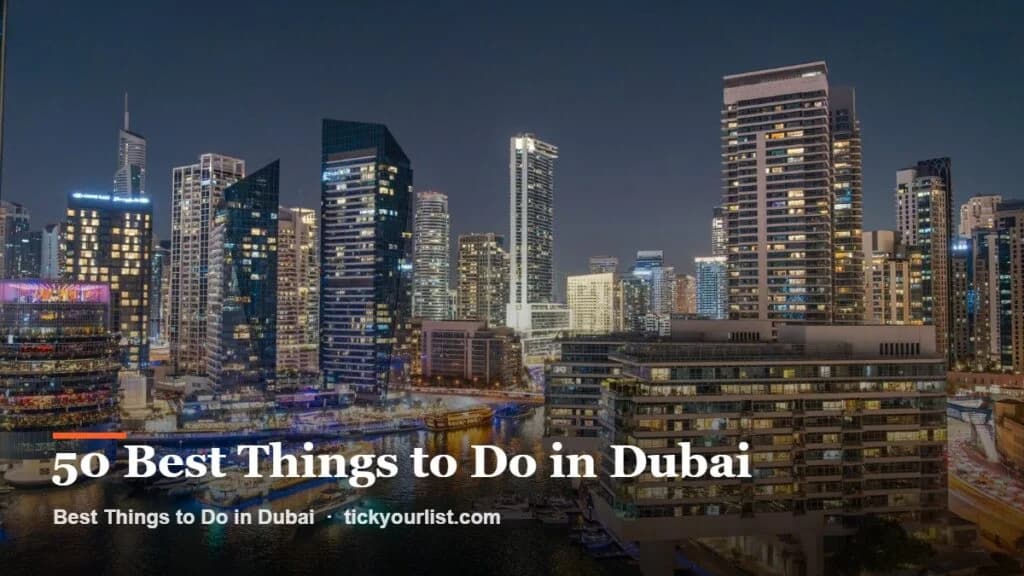
Everybody has an opinion about Dubai before they get there, and the opinion is usually that the whole place is shopping malls and showing off, delivered with great confidence by somebody who spent two nights on a layover and never left the airport hotel. I have been back something like a dozen times now, partly for work and partly because it keeps turning out to be more interesting than its reputation allows, and the version of the city I keep returning to has a lot more creek, souk and desert in it than skyline.
What this list tries to do is cover both. The best things to do in Dubai genuinely do include standing on the 148th floor of the tallest building ever constructed, because that is extraordinary and pretending otherwise is just snobbery. They also include a one-dirham boat across the creek that has been running in essentially the same form since long before any of those towers were drawn, costing roughly nothing at all and telling you considerably more about how this place actually works than the observation deck manages to.
So here are fifty of them, grouped by area rather than by category, because the single most useful thing anybody can do with a Dubai itinerary is stop criss-crossing the city in taxis all week. You will find a map section immediately below, along with prices and timings where they are actually useful, and a note on what you need to book in advance near the bottom, because Dubai punishes turning up on spec more than most places.
Best things to do in Dubai: the map and how to use this list

The shape of the city catches people out more than anything else, because Dubai is long and thin and strung out along roughly fifty kilometres of coast, and treating it as one walkable place is the single most expensive assumption you can make here. Downtown to the Marina will take you forty minutes in traffic on a normal afternoon, and getting from Old Dubai out to Palm Jumeirah can swallow the better part of an hour. Grouping your days by geography rather than by whatever you are most excited about will quietly save you several hours and a meaningful amount of taxi money over a week.
The six zones, and the map that goes with them
What follows is the city broken into the six zones this list works through, which doubles as a rough Dubai highlights map you can plan around. Pin yourself to one zone per day and you should never spend more than about fifteen minutes in a taxi between stops, which over a week adds up to most of an extra day.
- Downtown Dubai holds the Burj Khalifa, Dubai Mall, the Fountain, Museum of the Future and the Dubai Frame, and you reach all of it from Burj Khalifa or Dubai Mall station on the Red Line.
- Further down the same Red Line, getting off at DMCC or Sobha Realty drops you into Dubai Marina and JBR, which is where Marina Walk, The Beach, Ain Dubai, the zipline and most of the yacht cruises are.
- Out on Palm Jumeirah you have got Atlantis, Aquaventure, The View at the Palm and Nakheel Mall, though be aware the metro does not go there and you want the Palm Monorail from Gateway Station instead.
- Take the Green Line to Al Ras or Al Fahidi for Old Dubai, Deira and Bur Dubai, a compact area holding the Gold Souk, the Spice Souk, the abra crossings, Al Fahidi and the whole length of the creek.
- The one awkward zone is Jumeirah and the coast, home to the Burj Al Arab, Jumeirah Beach, Madinat, Wild Wadi and La Mer, because the metro reaches none of it and you will be paying for taxis all day.
- Finally there is the desert and beyond, covering the safaris, the hot air balloons and the Abu Dhabi day trips, none of which require any planning on your part because they all collect you from your hotel.
Building your own map as you go
Anyone who would rather build a live map they can pin as they go can drop each of the fifty into Google Maps while reading, or alternatively browse our full Dubai catalogue, where everything is already sorted by area and category.
Downtown Dubai: the icons everybody comes for

Ask anybody what to do in Dubai on a first visit and they will describe this one square kilometre, which tells you how completely it dominates any Dubai must see list. The saving grace is that almost all of it sits within walking distance of Dubai Mall metro station, which makes this the single most efficient day anybody can plan here.
- Go up the Burj Khalifa and do not let anyone talk you out of it on grounds of taste. It has held the record for the tallest building on earth since 2010 at 828 metres, and the ticket most people buy is the At The Top deck spanning levels 124 and 125, while level 148 costs considerably more and buys you a lounge and a much shorter queue. Sunset slots sell out first and cost the most, so decide early whether you are paying for the light.
- The Dubai Fountain performs on the lake outside the mall every half hour through the evening, it is completely free, and it is genuinely one of the better free spectacles anywhere. Watch the first one from the bridge for the wide view and the second from the waterfront terraces where you can hear the water land.
The five you cannot skip downtown
Inside Dubai Mall and beyond
- Set aside real time for Dubai Mall, which has well over a thousand shops and is less a shopping centre than a small municipality. Even if the idea of shopping leaves you cold, the aquarium tunnel and the waterfall sculpture and the ice rink between them justify an hour of aimless wandering.
- The Dubai Aquarium and Underwater Zoo sits inside the mall behind a ten-million-litre tank you can see from the walkway for nothing, though the ticket gets you into the tunnel and the Underwater Zoo upstairs, which is where the penguins and the king croc live.
- You will need to book the Museum of the Future a good while ahead, since it has been selling out days in advance consistently ever since it opened back in 2022. The building itself, a steel torus covered in Arabic calligraphy with no internal columns, is arguably better than anything inside it.
A little further out from the fountain
- The Dubai Frame in Zabeel Park is a 150-metre gilded rectangle you walk across at the top, old Dubai on one side and the new skyline on the other, and the glass floor panel halfway over is the bit everyone remembers.
- For a view with your pulse involved, Sky Views Observatory has a glass slide between floors and an Edge Walk where you lean out over the city on a harness, which is a very different proposition from standing behind glass at the Burj.
- The Museum of Illusions is a reliable hour of nonsense with children or a hangover, and the 3D World Trick Art museum nearby does much the same job.
If you are stacking several of these, the Burj Khalifa ticket collection and the Burj Khalifa and Dubai Aquarium combo usually work out cheaper than buying each separately, and the combo savings calculator will tell you whether that is true for your particular set.
On shopping, which is unavoidable here, the split is simple enough. Dubai Mall and Mall of the Emirates are where the international brands and the attractions sit, Ibn Battuta Mall is worth seeing purely as a building because each wing is themed on a region the explorer visited, and the Dubai Outlet Mall out on the Al Ain road is where last season ends up at sixty or seventy per cent off. The souks are a different activity altogether, and you should treat them as sightseeing that happens to involve a transaction.
Dubai Marina and JBR: the waterfront half of the city

The Marina is where Dubai feels least like a theme park and most like somewhere people actually live, which is faint praise but means something after two days downtown. It is the best area in the city for an aimless evening walk, and most of the activities in Dubai that involve water start from here.
- Walk the Marina Walk end to end at dusk, roughly seven kilometres of promenade with towers leaning over you on both sides and the yachts tied up alongside. Costs nothing and takes about ninety minutes with stops.
- Ride Ain Dubai on Bluewaters Island if it is operating when you visit, since the 250-metre observation wheel has had extended closures and the status genuinely changes. Worth checking rather than planning around.
- Take a shared yacht tour of the Marina for the view the walkway cannot give you, or upgrade to the Lotus mega yacht dinner cruise if you want the evening to be the event rather than the transport.
- Throw yourself down the XLine Dubai Marina zipline, the longest urban zipline in the world at roughly a kilometre, launching from 170 metres up and running at eighty kilometres an hour straight over the water.
- Spend a morning at JBR and The Beach, which is free, has decent swimming, and is the one stretch of Dubai sand where the surrounding cafés are not attached to a hotel you have to be staying in.
- Get out on the water properly with jet skiing in Dubai past the Marina skyline, or the jetpack experience if you would rather hover above it than ride across it.
Palm Jumeirah and Atlantis

The Palm is the artificial island you have seen from space photographs, and the odd thing about visiting is that from ground level you cannot perceive the shape at all. What you get instead is a monorail, a very large resort at the end of it, and some of the best water-based things to do in Dubai anywhere on the map.
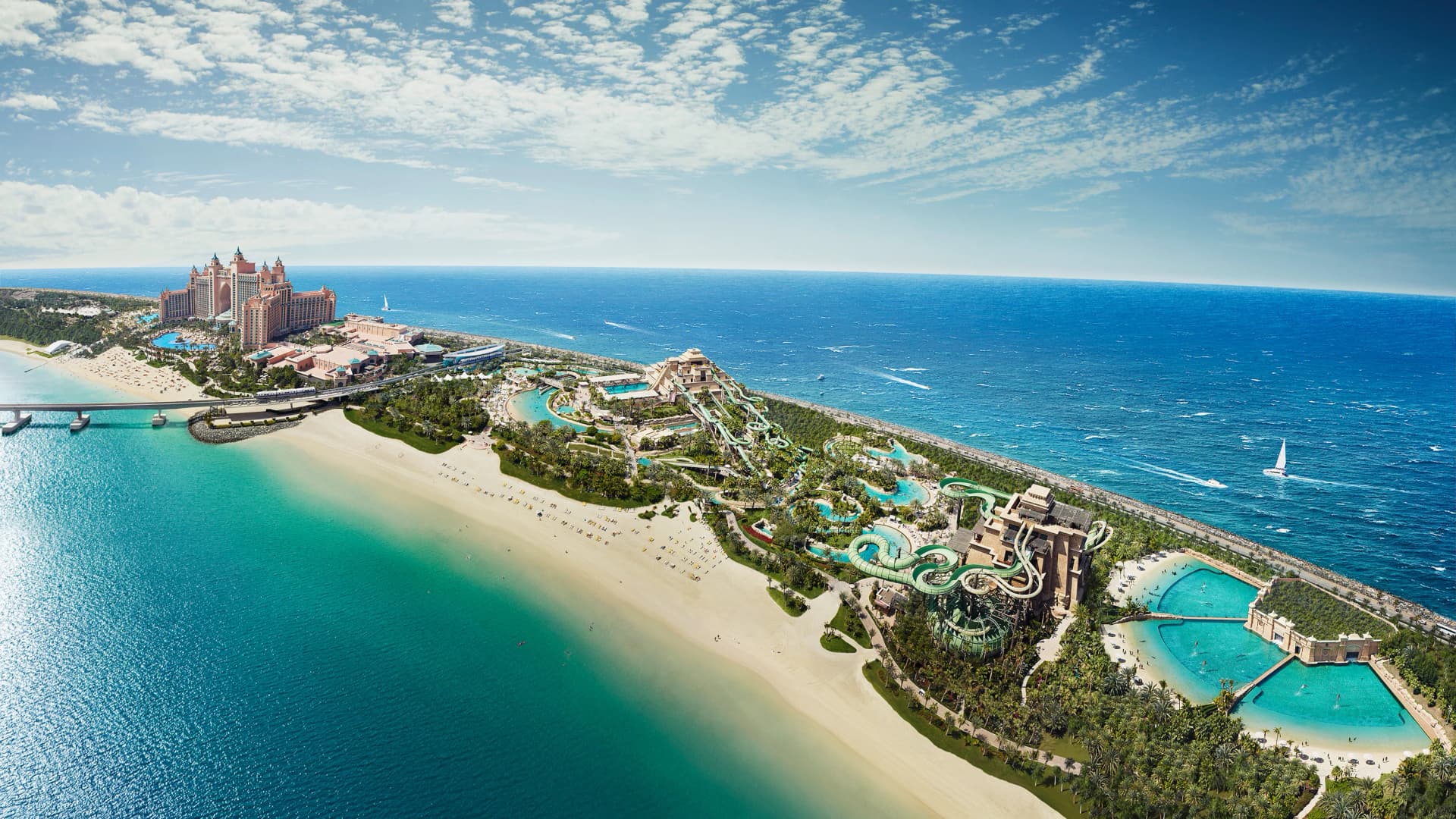
- Spend a full day at Aquaventure Waterpark, which is among the largest water parks on earth and has record-holding slides including one that fires you through a shark-filled lagoon. Go on a weekday and arrive at opening.
- Visit The Lost Chambers Aquarium underneath Atlantis, where sixty-five thousand marine animals live in a set of tanks built around a faux-Atlantean ruin, which is exactly as daft and as enjoyable as it sounds.
- Dive it rather than look at it with scuba diving at Atlantis Aquaventure, which requires no certification for the introductory version and puts you in the tank with the rays.
- Ride The Dubai Balloon at Atlantis, a tethered helium balloon that lifts you three hundred metres for a view back along the whole Palm and the skyline behind it.
- Take the Palm Monorail from Gateway Station to Atlantis rather than a taxi, because it runs along the trunk of the island above the traffic and costs a fraction of the fare.
- If you have a serious head for depth, Deep Dive Dubai is the deepest swimming pool in the world at sixty metres, built as a sunken city, and you can do a discover scuba session in it with no prior qualification.
Old Dubai: Deira, Bur Dubai and the creek

This is the part people skip and then regret skipping. Before the oil and the towers, Dubai was a pearl-diving and trading settlement along this creek, and a surprising amount of that city is still standing and still working. Give it a full morning. It is also, by a wide margin, the cheapest half-day on this entire list.
- Cross the water on an abra, the little wooden boats that have been ferrying people across Dubai Creek for decades. The fare is one dirham, there is no timetable, they leave when full, and it remains the single best value experience in the United Arab Emirates.
- Walk the Gold Souk in Deira, where something in the region of ten tonnes of gold sits in the windows at any given moment. You are not obliged to buy anything, haggling is expected if you do, and the sheer density of it is the spectacle.
- Carry on into the Spice Souk next door for saffron, frankincense, dried lemons and a smell you will remember longer than most of the skyline.
- Wander Al Fahidi Historical Neighbourhood in Bur Dubai, a restored quarter of wind-tower houses and narrow sand-coloured lanes that is the closest thing the city has to a preserved old town.
- Sit down at the Sheikh Mohammed Centre for Cultural Understanding in Al Fahidi for one of their open meals, where the whole point is that you ask Emirati hosts the questions you would otherwise be too polite to ask. Book ahead; it is small.
- Take a dhow cruise on Dubai Creek in the evening, which is the old-city counterpart to the Marina yacht trips and considerably more atmospheric for being surrounded by working boats rather than apartment towers.
Six things to do along the creek
Theme parks and family days out

Dubai does theme parks at a scale that makes sense only once you realise summer temperatures force most of the year indoors. If you are travelling with children this section is probably your to do list in Dubai more or less in full.
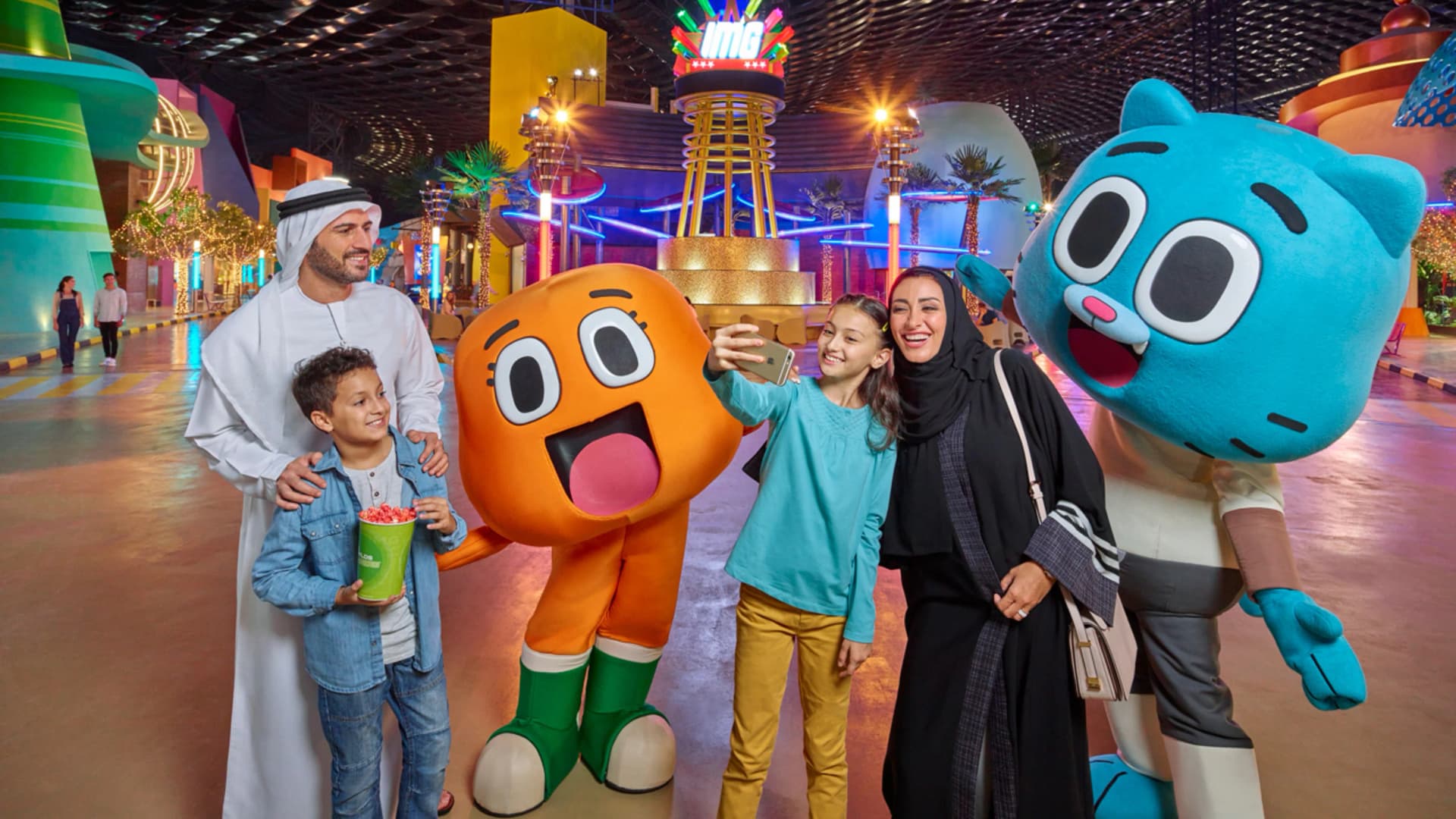
- The IMG Worlds of Adventure is the largest indoor theme park in the world, with Marvel and Cartoon Network zones and a dinosaur section, and being entirely air conditioned it is the obvious August answer.
- LEGOLAND Dubai is pitched squarely at two to twelve year olds and does that job very well, with the adjoining LEGOLAND Waterpark usually bought as a pair.
- Motiongate Dubai is the Hollywood one, built around DreamWorks, Sony and Lionsgate properties, and it has the best rollercoasters in the country.
- Buy the Dubai Parks and Resorts 2-park pass rather than separate tickets if you are doing more than one of the above, since they sit on the same site and the saving is substantial.
- Real Madrid World is the football-themed park within the same complex and worth an afternoon if there is a fan in the group.
- Ski Dubai puts an actual ski slope and a penguin colony inside the Mall of the Emirates, which is absurd and completely brilliant when it is forty-five degrees outside.
- KidZania Dubai lets children run a miniature city as firefighters, surgeons and pilots, and tends to hold them far longer than a conventional park does.
The seven parks, and who each suits
A word on which park suits whom, since the cluster is genuinely confusing. IMG Worlds is the all-weather one and the best choice in summer, Motiongate has the rides for teenagers, LEGOLAND skews young, and Real Madrid World only makes sense with a football obsessive in the party. If the group spans several ages, the two-park pass across Dubai Parks and Resorts is almost always the right call because everything sits on one site and you can split up for the afternoon.
Desert safaris and the dunes

If there is one must do in Dubai that people consistently underrate, this is it. Forty minutes inland the city simply stops and the Arabian Desert starts, and getting out into it is the one thing I would insist on even for a short trip. Most safaris follow the same shape, which is dune bashing in a four-by-four, a camel ride, sandboarding, then a camp with dinner and performances, and the differences are in the quality of the camp and the size of the group.
- Book a premium Dubai desert safari if you can stretch to it, because the smaller vehicle groups and better camps genuinely change the evening from a coach outing into something you remember.
- The standard version, the desert safari with unlimited BBQ buffet and live shows, is the volume option and perfectly good value if you accept there will be a few hundred other people at the camp.
- For something gentler, a half-day safari with a camel ride skips the stomach-churning dune bashing and still gets you out among the sand.
- Go up instead with a hot air balloon flight over the desert at sunrise, which is the single most beautiful hour available anywhere near this city and worth the four in the morning alarm.
- The monster bus dune ride is the silly option and children find it hilarious.
Water parks, beaches and getting in the sea

Between October and April the water sits at a temperature that makes swimming the obvious default, and the city has built accordingly. Even in high summer the water parks stay busy because shade and spray beat air conditioning.
- Wild Wadi Waterpark sits in the shadow of the Burj Al Arab and is smaller and more manageable than Aquaventure, which with younger children is a feature rather than a limitation.
- Spend an afternoon at Kite Beach or La Mer, both free public stretches with proper facilities, food trucks and views back to the Burj Al Arab.
- Try the banana boat ride or get out on a kayaking experience through the Marina, which at sunrise is startlingly quiet.
- See the Burj Al Arab properly. You cannot wander in without a booking, so either reserve afternoon tea, book the inside tour, or do what most people do and photograph it from Jumeirah Beach, which is free and honestly the better angle.
- Walk the Madinat Jumeirah waterways, a recreated souk and canal network beside the Burj Al Arab, where entry costs nothing and the abra rides through it cost very little.
Adrenaline: the sky over Dubai

A city with this much coastline, this much empty desert and this little rainfall turns out to be close to ideal for throwing yourself out of things, and the aerial operators here are among the busiest anywhere.
- Skydive Dubai over the Palm is the photograph everybody has seen, a tandem jump from four thousand metres directly above the island, and it is expensive and completely worth it.
- A gyrocopter flight is the cheaper way to get airborne with an open cockpit and a far better view than a sealed helicopter cabin gives you.
- The paramotor tour straps you under a powered wing over the desert fringe, which is slower, quieter and considerably stranger.
Museums, shows and indoor Dubai

When it is too hot to be outdoors, and for a good four months of the year it genuinely is, this is where the city keeps its stuff to do in Dubai that does not involve a mall.
- La Perle by Dragone is a permanent aqua theatre show with a stage that floods, divers falling from the roof and motorbikes, and it is the best single piece of live entertainment in the city.
- AYA Universe is an immersive digital art park of light rooms and projection spaces, and it photographs ludicrously well.
- Madame Tussauds Dubai sits on Bluewaters beside Ain Dubai and does precisely what you expect.
- Take the Dubai Opera House tour, a dhow-shaped building downtown with a genuinely good backstage tour, which is the most un-Dubai thing on this list and all the better for it.
Gardens, wildlife and seasonal Dubai

A few of the best things in this city only exist for part of the year, which catches people out badly. The flower gardens and the winter festival grounds shut through the summer because nothing survives outdoors in July, so check dates before you build a day around them.
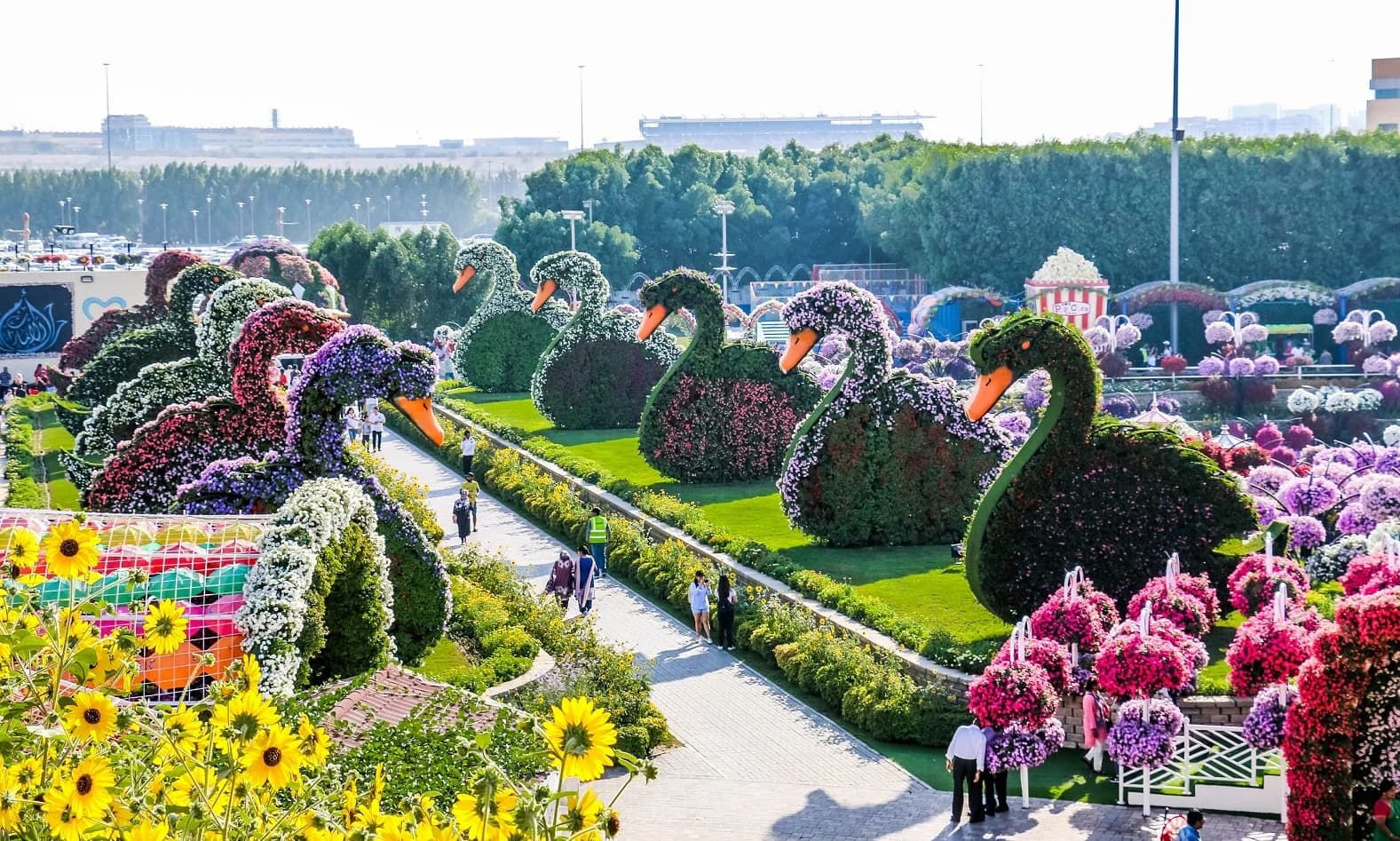
Dubai Miracle Garden holds something like 150 million flowers arranged into arches, houses and a full-size Airbus, and it runs roughly November to May only. Global Village is the winter culture-and-shopping park with pavilions for dozens of countries, also seasonal, and it is the one place in Dubai where the crowd is overwhelmingly local. Dubai Garden Glow does illuminated sculptures across the same winter window.
Year-round, The Green Planet is an indoor rainforest biodome in City Walk with a genuine canopy layer you climb through, Dubai Safari Park is a serious 119-hectare wildlife park out towards Al Warqa, and Dubai Butterfly Garden and the Dubai Crocodile Park both make good short stops with children. Browse nature and wildlife in Dubai and Dubai parks for the full set.
Free things to do in Dubai

Dubai has a reputation for being punishingly expensive and it is, if you let it be. It is also perfectly possible to fill several days without paying for anything beyond transport and food, which is not the version of the city that gets written about.
- The Dubai Fountain show runs every half hour each evening and costs nothing from any point around the lake.
- The abra across Dubai Creek is one dirham, which is close enough to free to count.
- Walking the Gold Souk and Spice Souk, where looking is expected and nobody minds if you buy nothing at all.
- Al Fahidi Historical Neighbourhood, open lanes you can wander freely at any hour.
- Kite Beach, JBR and La Mer, all free public beaches with showers and food nearby.
- Marina Walk and the JBR promenade after dark, which is the best free evening in the city.
- The aquarium wall at Dubai Mall, visible in full from the public walkway without a ticket.
- Madinat Jumeirah, where entry to the souk and waterways costs nothing and the Burj Al Arab views are the best in Dubai.
- The Palm Jumeirah boardwalk, eleven kilometres along the crescent with skyline views the whole way.
Nine that cost nothing at all
Worth adding that a good deal of the city is free to look at even when it is not free to enter. The Burj Al Arab is best photographed from the public beach rather than from inside, the Museum of the Future is arguably more impressive from the pavement on Sheikh Zayed Road than from within, and the Dubai Frame reads well from Zabeel Park without a ticket. Building a half-day around photographing the architecture costs nothing but a metro fare, and in the cooler months it is one of the more enjoyable ways to spend a morning. Current opening hours for most public attractions are listed on Visit Dubai, which is the one source I would trust over a search result.
Day trips from Dubai

Abu Dhabi is ninety minutes down the road and holds several attractions that genuinely outclass their Dubai equivalents, so if you have more than four days it is worth giving one of them to the capital. Most operators run a free shuttle, which removes the only real friction.
Ferrari World Abu Dhabi has Formula Rossa, still the fastest rollercoaster on earth at 240 kilometres an hour, and you will want the goggles they hand you. Louvre Abu Dhabi is the more serious proposition, a Jean Nouvel building under a perforated dome that drops a rain of light across the galleries, and it is the best museum in the Gulf by some distance.
Warner Bros World and SeaWorld Abu Dhabi both run with free shuttles from Dubai, Qasr Al Watan opens the presidential palace to visitors, and teamLab Phenomena is the newest of them. The Sheikh Zayed Grand Mosque is free to enter, requires modest dress including a headscarf for women, and is the single most beautiful building in the UAE.
What to do in Dubai after dark

Several of the best things to do in Dubai only make sense once the sun is down. Evening is when this city is at its best and most comfortable, and for four months of the year it is the only time being outdoors is pleasant at all. A surprising number of the top things to do in Dubai are actually night-time propositions that guidebooks file under daytime sightseeing.
The Dubai Fountain runs every half hour from six until eleven and the later shows are better because the crowd thins and the skyline behind is fully lit. Marina Walk and the JBR promenade come alive around nine, with the whole district out walking, and it is free. A dhow dinner cruise in the Marina or the sightseeing yacht cruise both put you on the water with the towers lit up on either side, which is the view the city was designed for.
For something programmed, La Perle runs most evenings and is the best show in the Emirates, while a desert safari with dinner and live shows is effectively a night out that happens to involve dunes. Global Village between November and May is where Dubai actually goes on a Thursday night, loud and cheap and overwhelmingly local. Drinking is confined to licensed hotels and restaurants, which is worth knowing before you go looking for a street-corner bar that does not exist.
One underrated option: the souks of Deira stay open late, often until ten or eleven, and wandering the Gold Souk after dark with the windows lit is considerably better than doing it in forty-degree afternoon heat.
Where and what to eat in Dubai

Eating is one of the genuinely great things to see in Dubai that nobody puts on a sightseeing list, largely because around ninety per cent of the population came from somewhere else and brought their cooking with them. The result is that you can eat extremely well across an enormous range for very little, provided you are willing to leave the hotel.
Start with Emirati food, which is harder to find than it should be. Look for machboos, a spiced rice and meat dish, harees, and luqaimat, the syrup-soaked dumplings that end every meal. Al Fahidi and the cultural centre in Bur Dubai are the most reliable places to try it properly rather than in a hotel approximation.
The real strength, though, is the South Asian and Levantine food in Deira, Karama and Al Satwa, where a proper biryani or a mixed grill costs a fraction of what the Marina charges and is usually better. Al Dhiyafah Road and the lanes behind Karama Market are where to go hungry. For the other extreme, Dubai now holds a serious collection of Michelin-starred restaurants, and booking those is a weeks-ahead exercise.
Two practical notes. Friday brunch is a Dubai institution rather than a meal, usually running several hours at a hotel for a fixed price, and it books out. And during Ramadan many restaurants close during daylight hours while others serve behind screens, so check before you plan a lunch around one. Browse Dubai dining cruises if you would rather eat while moving.
Best time to visit Dubai

This matters more in Dubai than almost anywhere, because the difference between the good months and the bad ones is not a question of preference but of whether you can be outside at all.
November to March is the season, with daytime temperatures in the mid-twenties, warm evenings and every outdoor attraction operating. It is also when prices peak and the beaches fill, and December and January in particular want booking well ahead. April and October are the shoulder months and are my own preference, hot but survivable, with noticeably lower rates.
May to September regularly passes forty-five degrees and humidity along the coast makes it feel worse. The city does not shut, it simply moves indoors, so if you come in summer you will find hotel rates at their lowest and the malls, indoor parks and aquariums at their busiest. Ramadan shifts each year and changes the rhythm of the day considerably, with daytime eating restricted in public and a late, lively evening once the fast breaks.
| Season | Months | What to expect |
|---|---|---|
| Peak | November to March | Mid-20s, everything open, highest prices |
| Shoulder | April and October | Hot but manageable, better rates, thinner crowds |
| Summer | May to September | Over 45C, indoor attractions only, cheapest hotels |
Getting around Dubai

The Dubai Metro is clean, driverless, air conditioned and cheap, and the Red Line in particular threads most of what you came to see onto a single route, running from the airport through Deira and Downtown out to the Marina. Buy a Nol card at any station the moment you arrive, load it with fifty dirhams or so, and use it on the metro, trams and buses alike. Gold Class carriages cost double and are worth it at rush hour.
Route planning and current fares sit on the official Visit Dubai getting-around guide. What the metro does not reach is Jumeirah, the Burj Al Arab stretch and the theme park cluster, so budget for taxis there. Cream-coloured official taxis are metered and reasonable, ride-hailing apps work normally, and both are far cheaper than equivalents in Europe. Pink-roofed taxis have female drivers and are available to women and families on request.
Two practical things. The Palm Monorail is a separate system and your Nol card will not work on it. And Dubai traffic between roughly seven and nine in the morning and four and seven in the evening is genuinely bad on Sheikh Zayed Road, so plan cross-city moves around it or take the metro and walk the last stretch.
What to book in advance in Dubai

Dubai is less forgiving about walk-ups than most cities, partly because so much of what you want is timed entry and partly because the volume of visitors is enormous relative to capacity. These are the ones where leaving it to the day genuinely costs you.
- Museum of the Future — sells out days ahead, every week, with no realistic walk-up option.
- Burj Khalifa At The Top — sunset slots go first and cost most, so pick your time when you book rather than at the door.
- Desert safaris — fixed pickups and limited vehicles, and the good camps fill in peak season.
- Hot air balloon flights — weather-dependent with small capacity, so book early and keep a spare morning.
- La Perle — a theatre with fixed performance dates and real sell-outs.
- Skydive Dubai — frequently booked out weeks ahead over the Palm drop zone.
- Aquaventure and the Dubai Parks 2-park pass — cheaper online than at the gate, every time.
- Abu Dhabi attractions with free shuttle transfers — the shuttle seats run out before the tickets do.
Everything else, including the souks, the beaches, the fountain and most of the malls, needs nothing at all. For anything you are weighing up, Dubai tickets, observation decks and current deals are the places to compare, and the attraction pass calculator will tell you whether a multi-attraction pass actually pays for your itinerary.
Dress code, laws and the etiquette nobody explains

Dubai is far more relaxed than its reputation in some respects and considerably stricter in others, and the gap between those two things is where visitors get into trouble. None of this is onerous, but it is worth knowing before you arrive rather than afterwards.
On dress, beachwear belongs on the beach and at the pool, and everywhere else shoulders and knees covered is the safe default, particularly in malls, souks and government buildings. Mosques require modest dress and a headscarf for women, which Sheikh Zayed Grand Mosque will lend you. Nobody will stop you wearing a sundress in the Marina, but Deira is more conservative than Downtown and dressing accordingly is simple courtesy.
On behaviour, public displays of affection beyond hand-holding are genuinely not acceptable, drinking is legal in licensed hotels and restaurants but being visibly drunk in public is not, and photographing people, especially local women and government buildings, without permission can cause real problems. During Ramadan, eating, drinking and smoking in public during daylight is restricted for everyone, visitors included. Swearing and rude gestures are treated far more seriously than you would expect, and that extends to online posts and to arguments with taxi drivers. None of this should put anybody off, because Dubai is among the safest cities in the world to walk around at any hour and violent crime is close to nonexistent, but the rules are enforced consistently rather than selectively and visitors are not exempt from them.
Dubai in three, five or seven days

Fifty things is a list to choose from rather than a programme to execute, so here is how I would actually spend the time depending on how long you have.
Three days. If you only have a long weekend, these are the best things to do in Dubai in order. Day one downtown: Burj Khalifa in the late afternoon, Dubai Mall and the aquarium wall, then the fountain after dark. Day two old Dubai in the morning, the souks and an abra and Al Fahidi, then across to the Marina for the evening walk. Day three a desert safari, with the morning free for a beach.
Five days. Keep the three above and add a full day on the Palm for Aquaventure and the Lost Chambers, then a day that mixes Museum of the Future with Sky Views and La Perle in the evening. That is the whole city in its proper proportions.
Seven days. Add Abu Dhabi for a day, almost certainly Louvre Abu Dhabi and the Grand Mosque. Give another day to whichever obsession applies, meaning theme parks with children, skydiving or a balloon if you want the altitude, or Global Village and Miracle Garden if you are visiting between November and May. Leave one day genuinely empty, because the heat makes everything take longer than you planned.
Best things to do in Dubai: FAQ

Burj Khalifa At The Top, the free Dubai Fountain show, an abra ride across Dubai Creek, the Gold and Spice Souks, a desert safari and a Dubai Marina cruise. Those six cover the new city, the old city and the desert in about three days.
Three days covers the icons, five is comfortable and lets you add the Palm and a show, and seven allows an Abu Dhabi day trip plus whatever your particular interest is. Summer visits need an extra day because the heat slows everything down.
The Dubai Fountain show every half hour, the one-dirham abra across the creek, the Gold and Spice Souks, Al Fahidi Historical Neighbourhood, Kite Beach and JBR, Marina Walk, the Dubai Mall aquarium wall and the Palm Jumeirah boardwalk.
November to March, when daytime temperatures sit in the mid-twenties and every outdoor attraction is open. April and October are warmer but cheaper and quieter. May to September regularly exceeds 45C and pushes everything indoors.
Costs, booking and timing
Yes for Museum of the Future, Burj Khalifa sunset slots, desert safaris, hot air balloons, La Perle and Skydive Dubai, all of which sell out. Souks, beaches, the fountain and malls need nothing at all.
Prices vary by time slot rather than being fixed, with At The Top on levels 124 and 125 as the standard ticket and level 148 costing considerably more. Sunset slots are the most expensive and sell out first, so book your time rather than turning up.
It can be, but it does not have to be. Accommodation and attractions are where the money goes, while the metro, the souks, the beaches and the fountain cost little or nothing. Travelling in April, May or October rather than December cuts hotel rates sharply.
Dress code, desert and day trips
Beachwear at the beach and pool only. Elsewhere, covered shoulders and knees is the safe default, particularly in malls, souks and Deira. Mosques require modest dress and a headscarf for women, which the Grand Mosque lends to visitors.
Yes, and I would do it even on a short trip. Standard safaris include dune bashing, a camel ride, sandboarding and a camp dinner with shows. Premium versions use smaller groups and better camps, and a sunrise hot air balloon is the calmer alternative.
Yes, it is about ninety minutes each way and many attractions including SeaWorld and Warner Bros World run free shuttles from Dubai. Louvre Abu Dhabi and Sheikh Zayed Grand Mosque are the two I would prioritise.
The bottom line on the best things to do in Dubai

The city is better than the cliché and it rewards you for not treating it as a stopover. Spend one day among the towers, by all means, because the scale of them is a genuine achievement and standing on the 124th floor at sunset is not something you will be bored by. Then spend the next morning on a one-dirham boat across the creek, in a souk that smells of cardamom, in lanes that were here long before the oil, and the whole place reorganises itself in your head.
If I had to compress the whole Dubai bucket list into five things, it would be the Burj Khalifa at sunset, a desert safari with a decent camp, the abra and the souks together as one morning, an evening on the Marina or the creek by boat, and one long day at Aquaventure or in Abu Dhabi depending on who you are travelling with. Everything else on this list is a bonus rather than a gap.
When you are ready to start pinning things down, the Dubai attractions hub has the full catalogue, with Dubai landmarks, desert safaris, Dubai cruises and theme parks as the four most useful places to begin.