Knossos Palace is not just another pile of old stones outside Heraklion. It is the centre of Europe’s oldest advanced civilisation, where myth and archaeology tangle so thoroughly you can barely tell where one ends and the other begins.
More than a million visitors pass through each year. That puts it in Greece’s top tier of archaeological places. It ranks second, behind the Acropolis. If you plan a trip, here are the points to keep in mind before you go.
Quick Facts

| Location | 5 km south of Heraklion |
| Official adult entry | €20 year-round |
| Summer hours | 08:00–20:00, April to August |
| Winter hours | 08:30–17:00, November to March |
| Last admission | About 30 minutes before closing |
| Closed | 1 Jan, 25 March, 1 May, Orthodox Easter Sunday, 25–26 Dec |
| Visit length | 1.5–2 hours |
| Bags | Max 30 × 25 × 15 cm — free lockers on site |
| Frescoes | Every one on site is a reproduction |
The Story

People lived on this hillside long before anyone built a palace. Settlement traces back to the Neolithic, roughly 7000–6000 BC, when huts stood where the central court is now. By around 1900 BC the Minoans had built their first major palace.
It didn’t last. An earthquake destroyed it, and what you walk through today is the second palace, rebuilt around 1700 BC on a grander scale — a complex covering some 22,000 square metres with an estimated 1,300 rooms across multiple storeys, early plumbing, painted frescoes, and enough administrative machinery to run the island from one address.
For roughly four centuries Knossos was the political, economic and religious centre of Minoan Crete, with a population scholars put in the tens of thousands.
It’s also the palace of King Minos, the Minotaur and the labyrinth Theseus unravelled with a ball of thread. Whether the myth grew from the site’s genuinely disorientating layout of corridors and light wells, or simply attached itself to a real place, nobody knows. Standing in it, you can see why it stuck.
Evans, and why Knossos looks like this

The modern chapter starts in 1900, when Sir Arthur Evans began excavating. He’s the reason Knossos looks the way it does — and the reason historians still argue about it.
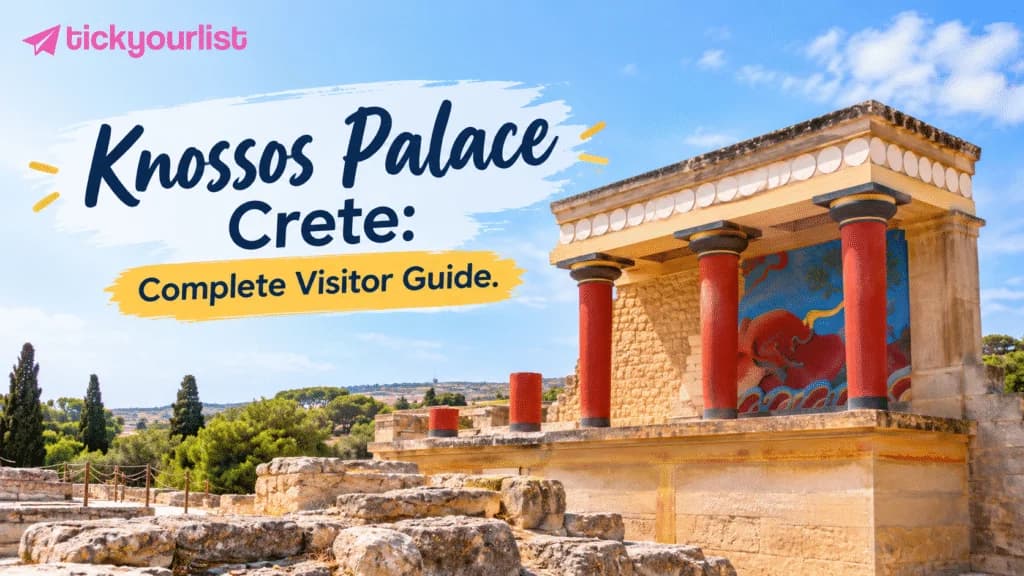
Evans didn’t just uncover the palace. He rebuilt large parts in concrete based on his own theories, commissioning the Swiss painters Émile and Édouard Gilliéron to reconstruct frescoes from often tiny fragments, with considerable creative licence.
Much of that is disputed. What isn’t is that it gives Knossos a presence few archaeological sites have. You’re not squinting at foundations trying to imagine a building — you’re standing in rooms with colour, height and shape, even if some of it is Evans’s best guess.
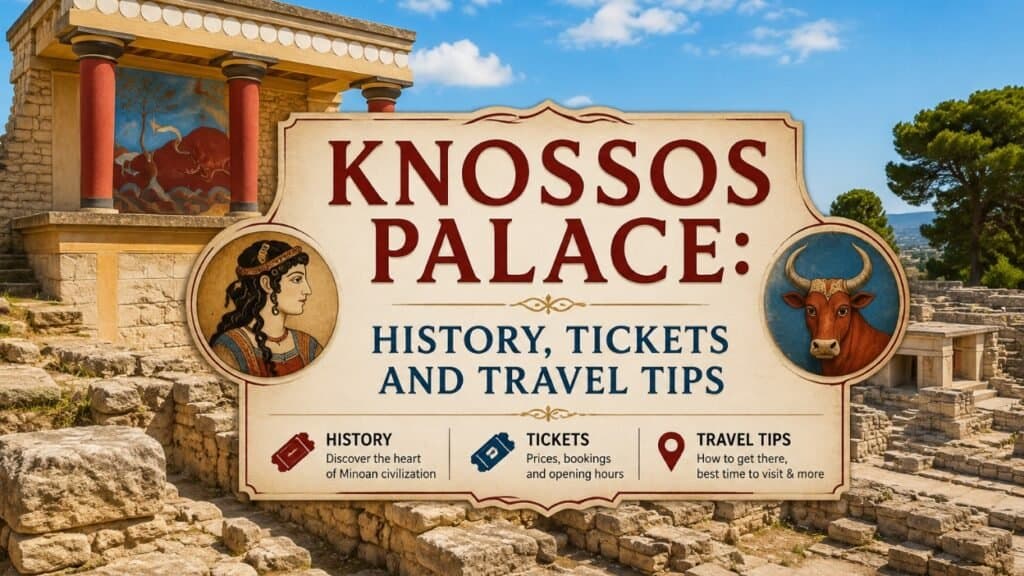
Every fresco you see on site is a copy. The originals, or what survives of them, are in the Heraklion Archaeological Museum. This matters more than it sounds, and it’s the single strongest argument for visiting both.
What You’ll See

Everything radiates from the central courtyard.
The Throne Room tops most lists — a gypsum throne, among the oldest still in its original position anywhere in Europe, flanked by griffin frescoes.
The Queen’s Megaron, visible from the central court, carries the Dolphin Fresco and what may be the world’s earliest flushing toilet.
The Hall of Double Axes, thought to be a royal reception space.
The Grand Staircase, winding around its own light well in four flights — the most photographed corner of the site.
The North Entrance, where the Charging Bull Fresco greets you, probably the most recognisable image in Minoan art.
The west magazines, narrow storage rooms still holding rows of pithoi, the huge clay jars that held oil, wine and grain for the whole settlement.
Two things rushed visitors skip: the Theatre area, shallow stone steps that may have seated a few hundred, and the Royal Road leading from it — among the oldest paved roads in Europe, once lined with houses and workshops now vanished into the landscape.
Most people cover the main loop in about ninety minutes, or closer to two hours with an audio guide.
Why the Audio Guide Matters Here

On-site signage is minimal. Without context, Knossos reads as a confusing jumble of low walls, half-rebuilt columns and the occasional fresco.
An audio guide walks you through the throne room, courtyards and storage halls in a logical order, weaving mythology and archaeology together so the site makes sense. You move at your own pace, skip what doesn’t interest you, and never strain to hear over forty other people in a small room.
One practical note: if you rent an audio guide at the gate rather than booking one with your ticket, bring cash. Card payment works at the ticket booth but guide rental often doesn’t.
Tickets and Prices

Official adult entry is €20, charged year-round — the old 50% winter discount no longer applies. EU residents under 18, and full-time EU students, enter free with valid ID.
Tickets are sold at the gate and online. Queues reach 30 to 40 minutes by 10am on peak days in July and August, which is the main argument for booking ahead.
Skip-the-line entry with an audio guide removes both the queue and the cash-only guide rental. Third-party tickets carry a service premium over the €20 official rate, so compare against that figure rather than assuming any listing is a discount.
Pair It With the Heraklion Museum

If one pairing makes complete sense, it’s this one.
Almost everything excavated at Knossos — the original frescoes, pottery, jewellery, figurines and the Linear B tablets that gave historians their first window into Minoan administration — now sits in the Heraklion Archaeological Museum, fifteen minutes away.
Visit only the site and you’re looking at reconstructions. Visit only the museum and you get beautiful objects with no sense of where they stood. Together, the story clicks: you walk the rooms, then stand in front of the real dolphin fresco, the real bull-leaper, the real tablets.
Some guides suggest the museum first, so you know what’s original before you see Evans’s version of it.
A combined Knossos and Heraklion Museum ticket with audio guides covers both. Note that the official government combined ticket has been reported as discontinued for 2026, so check whether your booking is issued as one combined ticket or two separate entries — it affects what you show at each gate.
Best Time to Visit

The site sits almost entirely in the open with very little shade, so timing matters more than at most attractions.
| Season | Months | What to expect |
| Spring | March–May | Mild, green, manageable crowds |
| Early summer | June | Warm, busy by mid-morning |
| Peak summer | July–August | Hot, crowded, cruise groups in waves |
| Autumn | September–October | Warm but comfortable, good light |
| Winter | November–February | Cool, quiet, shorter hours |
Shoulder season — April to May or September to October — is the sweet spot. Stuck with summer? Take the first hour after opening or the last two before closing, dodging both the heat and the cruise rush.
Hours taper through autumn: 08:00 to 20:00 April through August, easing to around 19:00 in September and 18:00 by late October, then 08:30 to 17:00 for winter.
Getting There

Bus Line 2 runs from the Heraklion terminal opposite the ferry port every 20 minutes from 07:30, taking about 20 minutes for €1.70 each way. Buses run until 22:30 in summer. Cheapest option by a wide margin.
Taxi is €12 to €15 from the centre or port, about 15 minutes. Traffic builds after 09:00.
Rental car — free parking at the entrance, though the lot fills between 10:00 and 14:00 in summer.
Accessibility

Worth being straight about: Knossos is difficult for visitors with mobility challenges. Uneven gravel paths, worn stone and staircases throughout, with large sections of the lower levels unreachable by wheelchair.
A paved path near the entrance reaches the main courtyard and a few key viewpoints, so a shortened visit works. Plan for a partial route and allow extra time.
Practical Tips

- Proper walking shoes. Uneven stone and steps throughout.
- Water, hat, sunscreen between May and September. Shade is scarce and the sun is brutal by late morning.
- Bags over 30 × 25 × 15 cm aren’t allowed inside — but free lockers are provided, so you don’t need to leave luggage at your hotel.
- Bring cash if you plan to rent an audio guide on site.
- A small café and gift shop sit near the entrance, though water costs more there than in Heraklion.
- Photography is allowed throughout; tripods and flash are discouraged near the frescoes.
Booking
Book ahead for July and August, go early or late, bring water, and pair it with the museum if you possibly can.
The wider list of things to do in Heraklion covers the old town, the Venetian fortress and the rest of the coast.
FAQs
What is Knossos Palace?
The biggest Bronze Age place on Crete was a main ceremonial area for Minoan life. Around 1700 BC, people rebuilt it after an earthquake had ruined an older palace. The palace later spread over about 22,000 square metres and is thought to have had close to 1,300 rooms on multiple levels.
Where is Knossos Palace in Crete?
Sure. Knossos is on Crete, about five kilometres south of Heraklion, along the north shore. It is one of the easier archaeology spots to reach in Greece. You can take the city bus from near the centre, and in roughly twenty minutes you are there.
Can you visit Knossos Palace?
It is open to the public on most days through the year. You can buy tickets right at the gate or online. The visit follows a set path as you move through the excavated parts and the sections that have been put back in place. You do not need a permit, and there is no need to join a guided tour.
What are Knossos Palace hours?
08:00 to 20:00 from April to August, tapering through September and October, then 08:30 to 17:00 November to March. Last admission is about thirty minutes before closing. Closed 1 January, 25 March, 1 May, Orthodox Easter Sunday and 25–26 December.
How much does Knossos Palace cost?
Official adult entry is €20, charged year-round since the winter discount was removed. EU residents under 18 and full-time EU students enter free with valid ID. Third-party skip-the-line tickets add a service premium on top.
Is Knossos Palace expensive?
At €20 it sits mid-range for a major European heritage site, and it’s the second most visited archaeological site in Greece. Resellers typically add €10 to €15 for skip-the-line access, so compare against the official rate.
What do Knossos Palace reviews say?
Visitors consistently praise how Evans’s reconstruction gives the site real presence, unlike foundation-only ruins. The recurring complaints are minimal signage, heavy crowds from mid-morning, almost no shade, and disappointment that every fresco on site is a copy.
Are the frescoes at Knossos real?
No — every fresco on site is a reproduction, reconstructed by the Gilliéron brothers from surviving fragments with considerable creative licence. The originals are in the Heraklion Archaeological Museum, fifteen minutes away, which is why pairing the two makes sense.
How long do you need at Knossos Palace?
About 1.5 hours for the main route, closer to two with an audio guide. A brisk walk-through takes 45 to 60 minutes. Add another two hours if you’re pairing it with the Heraklion Archaeological Museum.
How do you get to Knossos from Heraklion?
City bus Line 2 leaves the terminal opposite the ferry port every twenty minutes from 07:30, taking twenty minutes for €1.70 each way. A taxi costs €12 to €15. Free parking sits at the site entrance.