Most tourists visit Tokyo and make a quick stop in Kyoto and Osaka before leaving — which leaves some of the best things to do in Japan completely unvisited. Few realise that Hyogo Prefecture is a stone’s throw away to the west of Osaka and has coastlines along the Seto Inland Sea and Sea of Japan.
You will find some amazing places to visit including a UNESCO-listed castle, a renowned port city with amazing beef, a collection of relaxing hot-spring towns and a castle ruin floating above the clouds on a nice autumn day!
When looking for great things to do in Hyogo, Japan, make sure you visit Himeji Castle, spend a day in Kobe, relax in Arima or Kinosaki, visit Awaji Island and, if you are able to get an early start, take a look at Takeda Castle Ruins.
This Hyogo Prefecture travel guide gives you an overview of what each place costs to visit, how long they are open for and how long it takes to get there from Osaka. You will also find itinerary suggestions.
Top Things to Do in Hyogo, in Brief

- Himeji Castle: UNESCO World Heritage Site, ¥2,500 for non-resident adults
- Kobe: Kitano’s old foreign houses, Chinatown, Kobe beef, the harbour
- Arima Onsen: one of Japan’s three ancient hot springs
- Kinosaki Onsen: seven public baths and, in winter, crab
- Awaji Island: reached across the Akashi Kaikyo Bridge
- Takeda Castle Ruins: the Castle in the Sky, best on cold autumn mornings
Why Hyogo Deserves a Place on Your Japan Trip

Located within the Kansai region, Hyogo’s capital is Kobe. You can enjoy breakfast in this coastal city followed by a tour of a feudal castle. In the evening, you’ll be able to stay in one of the wooden onsen towns, which will feel far removed from the fast pace of Tokyo.
The area is also less busy. While Tokyo, Kyoto and Osaka attract most tourist visitors, you will see far fewer people at Hyogo’s major attractions. Many top attractions can be found within an hour of Osaka, meaning you can easily use the city as your base.
Tourist boards usually split the prefecture into five regions, and knowing which is which makes planning much easier:
- Settsu (southeast): Kobe, Mount Rokko and Arima Onsen
- Harima (southwest): Himeji Castle and the castle-town sights
- Tajima (north): Kinosaki Onsen and the Takeda Castle Ruins
- Tamba (northeast): forests, pottery villages and sake country
- Awaji: the big island joined to Kobe by the Akashi Kaikyo Bridge
Hyogo Prefecture Travel Guide: Quick Facts

| Quick fact | Detail |
| Region | Kansai, west of Osaka |
| Capital | Kobe |
| Osaka to Kobe | About 25 minutes by JR train; about 12 minutes by Shinkansen to Shin-Kobe |
| Osaka to Himeji | About 30 minutes by Shinkansen; about 1 hour by JR Special Rapid |
| Nearest international airport | Kansai International (KIX). Kobe Airport has no international flights |
| Suggested stay | 2 nights for the main sights, 3 to 5 to include the north |
| Average temperature | About 6°C in January, about 29°C in August |
One thing worth knowing: Hyogo is bigger than it looks on a map. The south is easy by train, but Kinosaki and Takeda in the north are genuinely far, which is why they sit in their own itinerary below.
1. Himeji Castle and Koko-en Garden

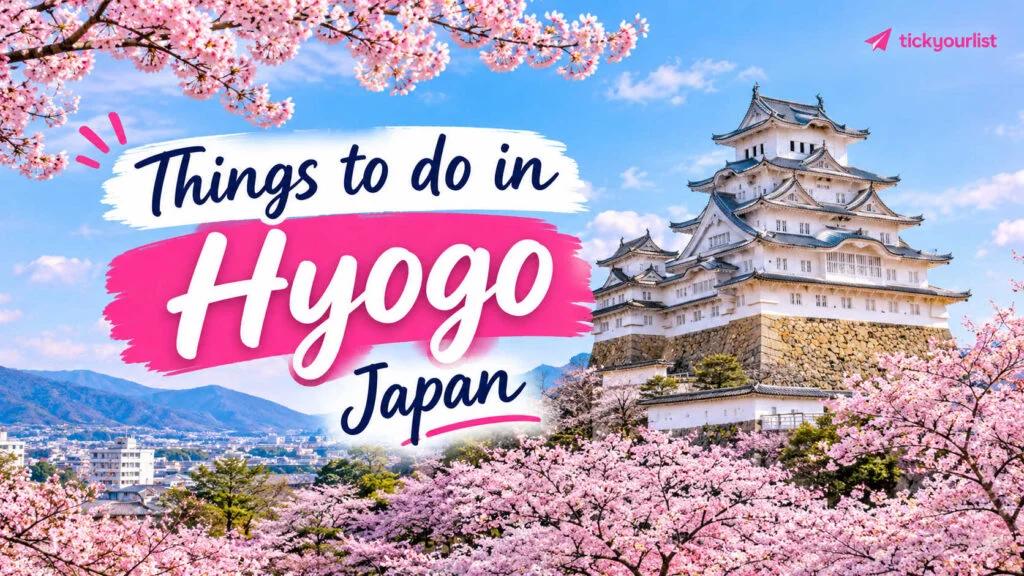
If you’re only able to visit one place in Hyogo, you should definitely visit Himeji Castle. Known locally as the White Heron Castle due to its bright white plaster exterior, this castle is a UNESCO World Heritage Site and National Treasure. Most of the main tower was built in the early 1600s and has miraculously survived many conflicts, earthquakes and bombing attacks. It feels like you are really stepping back in time.
The castle is much more active than expected. You will climb steep wooden stairs through the six floors of the main tower. There are plenty of gun ports, holes in the floor that look out over rocks and original beams that have been worn down over the years. The official site says you will be climbing up a small mountain, so wear comfortable clothing!
What to know before you go
- Hours: 9:00 to 17:00, last entry 16:00
- Closed: 29 and 30 December
- Admission (from 1 March 2026): ¥2,500 for adults aged 18 and over without a registered address in Himeji city; ¥1,000 for city residents. Under-18s enter free
- Groups of 30 or more: ¥2,000 per non-resident adult
- Combined ticket with Koko-en Garden: ¥2,600
- Annual pass: ¥5,000
- Footwear: shoes come off inside, so bring thick socks. A bag for your shoes is handed out past the ticket gate
- Accessibility: there are no lifts, and wheelchairs can’t enter the main keep
Here’s the bit most guides miss. If you’re visiting from overseas you’re paying ¥2,500 anyway — and the combined ticket is ¥2,600. That means Koko-en Garden costs you ¥100. Take it.
You’ll want to leave 2–3 hours for this one. It’s well worth buying the combined ticket, as Koko-en is located right next to the castle grounds. It has nine walled Edo-style gardens, lovely koi ponds, waterfalls and a tea house. It is a peaceful place to relax after the busy crowds and stairs of the keep.
A couple of tips: arrive at opening time to avoid queues. If you can, try to visit in late March or early April, when the cherry blossom is beautiful around the white walls. From Himeji Station it is a 15–20 minute walk straight down the main avenue. This is also the best place to get your first look at the castle.
2. Kobe: Harbour Views, Western Houses and Great Food

Kobe is the best place to start. It is only around 20–25 minutes from Osaka by train. Due to the port opening to trade with foreign nations in 1868, Kobe has quite an international feel. There are many Western-style houses on the hilltops and the port is very lively.
Things to do:
- Kitano Ijinkan-gai: a hilltop area of foreign merchants’ Western-style homes. Around 30 remain and 16 are open to the public. Look out for verandas, painted wood and red-brick chimneys.
- Nankinmachi: a small Chinatown with over 100 Chinese restaurants and food stalls. Arrive hungry and enjoy steamed pork buns and gyoza with miso sauce.
- Harborland and Meriken Park: the port area. Walk along the waterfront at sunset, shop and catch glimpses of Kobe Port Tower. A memorial part of the waterfront was preserved after the Great Hanshin earthquake in 1995.
- Mount Rokko: ride up to the viewing areas using the Rokko Cable, which opened in 1932. This is one of Japan’s best night skylines. The Mt. Maya Kikuseidai platform is 702 metres high.
Kobe beef and Nada sake

Kobe beef should be good, but research is needed to ensure you are getting the real deal. Real Kobe beef has to come from Hyogo Tajima cattle and be properly graded. Find a place that shows the correct certification. Usually, the best way to try Kobe beef is at a lunch set.
Nada-Gogo is a large sake-producing area of Japan. There are five coastal districts between Kobe and Nishinomiya. Many breweries allow visits to sample their sake and have small museums. The area can be explored in half a day.
If visiting for the first time, it is best to stay around Sannomiya Station, the main transport hub in the city. This gives you the best choice of restaurants. In a tight timeframe, you can complete Kitano, Chinatown and the Harbour in half a day and finish with the night view from Rokko.
3. Arima Onsen and Mount Rokko

One of Japan’s three ancient hot springs (the others are Dogo in Ehime and Shirahama in Wakayama), Arima Onsen has been famed for its waters for more than a thousand years. It is now a very walkable place consisting of small lanes, ryokans (inns) and public baths, located within the hills behind Kobe.
It is famous for having two types of waters:
- Kin no Yu (Gold Water): an iron-rich, red-brown spring. Opening times: 8:00–22:00. Adults: 800 yen (weekday rate: 650 yen).
- Gin no Yu (Silver Water): a clear spring containing carbonated and radium elements. There is also a mist sauna. Opening times: 9:00–21:00. Adults: 700 yen (weekday rate: 550 yen).
- Combination ticket: 1,200 yen.
Kin no Yu is closed on the second and fourth Tuesdays, and Gin no Yu is closed on the first and third Tuesdays. While there, try carbonated rice crackers (tansan senbei) and Arima cider, both made using spring water from the area.
There is also a small museum called Taiko no Yudono-kan, which outlines Hideyoshi’s connection with the town. You can use the free foot bath outside Kin no Yu. Zuiho-ji Park is most famous for autumn colours in mid-November.
Pair it with Mount Rokko

The ropeway ride to Arima takes around 12 minutes and links well with Mount Rokko. The most popular option is to take the Rokko Cable from Kobe. Take your time enjoying the views and gardens at Rokko Garden Terrace, then relax in Arima. This way you won’t be stuck driving back and forth and can finish with relaxed muscles.
Getting there: Arima can be reached from Kobe in around 30 minutes by Kobe Electric Railway, or around 1 hour 20 minutes from Osaka via Sannomiya. Direct buses from Umeda in Osaka take around an hour. Visit on a weekday for cheaper and more relaxing baths.
4. Awaji Island: Whirlpools, Art and Ocean Views

The biggest island in the Seto Inland Sea, Awaji can be reached from Kobe using the Akashi Kaikyo Bridge. The bridge is almost 4 km long, making it the second longest suspension bridge in the world. It will make an impression even if you are just looking out of the bus window.
Top things to see and do
| Place | What it is |
| Awaji Yumebutai | Hilltop complex by architect Tadao Ando, including the Hundred Stepped Gardens — a tiered series of staircase gardens packed with flowering plants |
| Honpuku-ji (the Water Temple) | A Shingon Buddhist temple, also by Tadao Ando, entered by walking across a lotus pond |
| Naruto Strait whirlpool cruises | Boat trips out to the swirling tidal whirlpools. Strength varies with the tide, so check the charts before booking |
| Nijigen no Mori | An anime theme park with Naruto, Boruto and Crayon Shin-chan zones. A reliable family win |
| Izanagi Jingu | One of the oldest Shinto shrines in Japan, in a notably peaceful setting |
| Goshiki Beach | A pebble beach on the west coast, known for its coloured stones and sunsets |
| Sumoto Castle ruins | Hilltop ruins with a restored tower and wide views |
Awaji can be tricky to get around without a car. There are no trains and many sights. Buses come from Kobe over the bridge. A good starting place is Maiko Station. The ferry service gets you from Akashi to Iwaya in the north.
If you’re coming from Osaka and aren’t driving, plan just two or three stops (Yumebutai and the Water Temple, for example). It’s well known for its food—onions, beef and seafood—so save some room to eat. A day here is a great way to slow things down after the castles and city sights elsewhere in Hyogo!
5. Kinosaki Onsen and GenbudoPark

If Tokyo is fast-paced Japan, Kinosaki Onsen is the opposite: a quiet hot-spring town on the Sea of Japan coast, built around a canal lined with willow trees. The ritual here is changing into a yukata and geta sandals and padding between the wooden bath houses.
There are seven public baths (soto-yu), each with its own character:
- Goshono-yu
- Ichino-yu, with a cave-style entrance
- Satono-yu, with an outdoor bath
- Yanagi-yu, with a classic wooden front
- Jizo-yu, which opens early at 7:00
- Kono-yu
- Mandara-yu
Most visitors stay at a ryokan, which usually includes free entry to all seven. Without a pass, expect around ¥800 to ¥900 per bath. Dinner is typically a multi-course kaiseki meal served between about 6:00 and 7:30pm.
Autumn and winter are the best times to come. The river maples peak in October and November, and crab season runs November to March along this coast, when local ryokan build entire dinners around it. If seafood is the draw, that’s when to book. Summer is the weakest season here — too humid for comfortable bathing.
For a view over the town, there’s a ropeway up Mount Daishi, stopping at Onsenji Temple partway and finishing at an observation deck. Allow about 90 minutes in total.
Getting there from Osaka
The Kounotori limited express runs from Shin-Osaka to Kinosaki Onsen in about 2 hours 40 minutes, with more than ten services a day. It’s covered by the Japan Rail Pass and the Kansai area passes, though you’ll still need a reserved seat ticket. That makes it a long day trip — we’d stay overnight.
Genbudo Park: rock columns from a volcano

Ten minutes by taxi from Kinosaki Onsen Station, Genbudo is a cave of basalt columns roughly 1.6 million years old, part of the San’in Kaigan UNESCO Global Geopark. It reopened after renovation in 2022.
Open 9:00 to 17:00, with adult entry at ¥500 — and the entrance takes cash only. There are steps to climb. The free 30-minute guided tour is worth booking ahead if you want the geology explained properly.
6. Takeda Castle Ruins: Japan’s Castle in the Sky

Takeda Castle is the image that makes you want to fly out there. Located on a mountain ridge at an altitude of around 350 metres, this 15th-century castle sits above a sea of clouds in the early morning, hence its nickname, Castle in the Sky (or the Machu Picchu of Japan). The castle consists only of stone foundations, but this makes for a stunning backdrop.
However, there is no guarantee of seeing the clouds. A realistic approach will help avoid disappointment. The best time to go is October and November around sunrise, giving you around a one-in-three chance of seeing a sea of clouds (Japan Guide). The best-known viewpoint is Ritsuunkyo, which has a 300-yen environmental charge.
Practical details
- Entrance fee: ¥500
- Hours: seasonal — 5:00 to 17:00 from mid-September to early December, then 10:00 to 15:00 until 3 January
- Closed: 4 January through February
- Nearest station: Takeda, at the foot of the hill. The hike up takes about 40 minutes and gets slippery after rain
- Shortcut: a seasonal bus covers the lower stretch in about 20 minutes for ¥300, or a taxi does it in roughly 15
- From Himeji: the JR Bantan Line takes 90 to 110 minutes and costs around ¥1,170
Thanks to its distance from Osaka, most people spend at least one night in the area. It is also often combined with a visit to the Ikuno Silver Mine. Mid-October to November is peak time, so plan around this.
7. More Places to Visit in Hyogo Beyond the Big Names
Shoshazan Engyoji Temple, Himeji

This temple complex is traditionally dated to 966, and its wooden halls stood in for feudal Japan in The Last Samurai in 2003. Take a bus from Himeji Station for about 30 minutes to the ropeway station, then a four-minute ride up.
Admission is ¥800, open 8:30 to 17:00 every day of the year. Allow around two hours, because the forest walk between the buildings takes longer than you’d think. It pairs well with the castle on the same day.
Ikuno Silver Mine, Asago

Established in 807 and later controlled in turn by Oda Nobunaga, Toyotomi Hideyoshi and Tokugawa Ieyasu. You walk a small section of a tunnel system that runs to roughly 350 km in total, past chisel marks left by Edo-period miners. The temperature holds at a constant 13°C year-round, so bring a layer even in August.
Adult admission ¥1,200. Take the Hamakaze limited express from Himeji to Ikuno Station, about 45 minutes, then a short bus ride and a walk. Allow about 40 minutes underground.
Akashi: time, octopus and a bridge

A handy stop on the way to or from Himeji, about 20 minutes from Kobe by train. This is where Japan’s standard time meridian — 135 degrees east — runs through. The town is also known for its octopus, which you’ll see in the fish market and eat as akashiyaki: soft egg-batter dumplings served with a dashi broth for dipping.
Day Trips from Osaka to Hyogo: What’s Realistic

Southern Hyogo is so close to Osaka that it works as an easy day trip. The north is different, because the journeys are long enough that an overnight stay makes far more sense. The table below sorts the main places by travel time so you can choose quickly.
| Destination | Approx. travel from Osaka | Day trip or overnight? | Best for |
| Kobe | 20 to 25 min by JR | Easy day trip | Harbour, Kitano, Chinatown, beef |
| Akashi | 40 to 45 min by JR | Easy stop | Octopus, fish market, time meridian |
| Himeji | 30 min by Shinkansen, about 1 hr by JR Special Rapid | Easy day trip | Himeji Castle, Koko-en |
| Arima Onsen | About 1 hr by direct bus, or 1 hr 20 min by train | Half day | Hot springs, Mount Rokko |
| Awaji Island | Roughly 1.5 to 2 hrs by train and bus | Day trip, with planning | Yumebutai, Water Temple, whirlpools |
| Ikuno Silver Mine | About 2.5 hrs via Himeji | Long day or overnight | Mine tunnels, rural scenery |
| Takeda Castle Ruins | About 3 hrs via Himeji | Overnight recommended | Sunrise sea of clouds |
| Kinosaki Onsen | 2 hrs 40 min by Kounotori | Overnight strongly recommended | Seven baths, crab season |
The timings are approximate and refer to the normal JR schedule. Check a live timetable for the exact time on the day of your visit. If you want to fit two or three places into one day, the best option is Himeji Castle in the morning and Kobe in the late afternoon. Both are on the same JR line, and the evening view from Kobe is well worth seeing.
Hyogo Attractions: Entry Fees and Opening Hours at a Glance

Adult entry in Japanese yen, checked in November 2026 against official or tourism-board pages.
| Attraction | Adult entry (¥) | Opening hours | Time to allow |
| Himeji Castle | 2,500 non-resident / 1,000 Himeji resident (under 18 free) | 9:00 to 17:00, last entry 16:00 | 2 to 3 hrs |
| Himeji Castle + Koko-en combined | 2,600 | Castle hours as above | 3 to 4 hrs |
| Shoshazan Engyoji Temple | 800, ropeway extra | 8:30 to 17:00 | About 2 hrs |
| Arima Onsen, Kin no Yu + Gin no Yu set | 1,200 | 8:00–22:00 (Kin no Yu), 9:00–21:00 (Gin no Yu) | 1 to 2 hrs |
| Genbudo Park | 500, cash only | 9:00 to 17:00, last entry 16:30 | 1 hr |
| Ikuno Silver Mine | 1,200 | Changes by month; 9:10 to 17:20 April to October | 40 min to 1 hr |
| Takeda Castle Ruins | 500 | Seasonal; closed 4 January to February | 1.5 to 2 hrs |
| Kinosaki Onsen public baths | About 800 to 900 per bath without a pass | Varies by bath | An evening |
Ropeway, bus and train fares are extra. Hours and prices change, so check the official site before you go.
Hyogo Itinerary: 3 Days and 5 Days

Both plans start from Osaka or Kobe and keep each day geographically tight, so you spend more time looking at things and less time on trains.
3-day itinerary: southern Hyogo highlights
Day 1 — Himeji and Akashi. Be at Himeji Castle for the 9:00 opening, add Koko-en on the combined ticket, then stop in Akashi for akashiyaki and finish in Kobe.
Day 2 — Kobe, Rokko and Arima. Kitano and Nankinmachi in the morning, a Kobe beef lunch, the Rokko Cable up the mountain, the ropeway down into Arima, and a soak before heading back.
Day 3 — Awaji Island. Bus across the Akashi Kaikyo Bridge, visit Yumebutai and the Water Temple, and add a Naruto whirlpool cruise if the tide cooperates.
5-day itinerary: add the north
Day 1 — Himeji. Castle and Koko-en, Engyoji Temple in the afternoon, then dinner in Kobe.
Day 2 — Kobe and Arima. Kitano, Chinatown, then either the Rokko night view or an Arima soak.
Day 3 — Ikuno and Takeda. Reach the Ikuno Silver Mine by morning, then stay overnight near Takeda.
Day 4 — Takeda and Kinosaki. Climb to Takeda Castle for sunrise, then continue by train to Kinosaki Onsen for bath-hopping and a ryokan dinner.
Day 5 — Genbudo and home. Genbudo Park in the morning, then the Kounotori back to Osaka in about 2 hours 40 minutes.
Prefer Awaji to the north? Swap it into Day 3 and leave the rest as it is.
Best Time to Visit and How to Get Around

When to come depends on what you’re here for:
- Spring (late March to April): cherry blossom around Himeji Castle and spring flowers on Awaji
- Autumn (October to November): maple colour at Kinosaki and Arima, plus the best odds of a sea of clouds at Takeda
- Winter (November to March): crab season in Kinosaki, though Takeda Castle closes from 4 January through February
- Summer: hot and humid, with August averaging about 29°C, which makes it the weakest season for onsen towns
Getting around the southern attractions is easy with JR lines, Kobe local trains and buses. You’ll need the Kounotori limited express to get to Kinosaki, and Awaji is easiest by bus across the bridge. Most overseas visitors will fly into Kansai International Airport, as there are no international flights available at Kobe Airport. It takes approximately 1 hour 30 minutes to reach Kobe from KIX.
Those coming from Tokyo can travel by Shinkansen to Shin-Kobe in approximately 3 hours 10 minutes (around 15,000 yen one way). Flights from Haneda to Kobe Airport take approximately 1 hour 10 minutes. Hyogo fits easily into trips to Tokyo, Kyoto and Osaka.
If you’re taking a number of long journeys, the JR Kansai Wide Area Pass can be a good way to save money. It includes Himeji, Kobe, Kounotori to Kinosaki (with a reserved seat) and the Shinkansen between Shin-Osaka and Okayama. It doesn’t include private railways or JR highway buses.
Where to Stay, What to Eat and Events Worth Timing

Where to base yourself
- Kobe (Sannomiya): the best base for the south, with Shin-Kobe on the Shinkansen line and easy trains to Himeji and Arima
- Osaka: ideal if you’d rather day-trip to every southern sight
- Kinosaki Onsen: stay in a ryokan — the overnight is the experience
- Asago or the Takeda area: the practical choice for a Takeda sunrise
What to eat
- Kobe beef: from Tajima cattle raised in Hyogo, usually best value at lunch
- Akashiyaki: octopus dumplings from Akashi, dipped in light dashi
- Sobameshi: a Kobe street-food mash-up of fried noodles and rice
- Matsuba crab: the winter speciality around Kinosaki, November to March
- Nada sake: brewed across the five coastal districts between Kobe and Nishinomiya
- Tamba specialities: matsutake mushrooms and black soybeans, plus the Tamba ware pottery villages if you have a spare day
Two events worth planning around

MINATO HANABI runs for five days in mid-October at Meriken Park in Kobe.
The 32nd Kobe Luminarie runs 29 January to 7 February 2027, across Meriken Park, Higashi Yuenchi Park and the former foreign settlement. It commemorates the 1995 Great Hanshin-Awaji Earthquake.
Plan Your Hyogo Trip
Hyogo is great for those who like to dig a little deeper. Combine the castle of Himeji, the stylish city of Kobe, an onsen night in Arima or Kinosaki and a sunrise break at Takeda to see this unique side of Japan.
Opening times and prices here were verified in November 2026, so do check them before you travel — and when you’re ready to lock in the big-ticket sights, browse things to do in Japan and book ahead, because the popular ones go first.
FAQs
What are the best things to do in Hyogo, Japan?
Top things to do include visiting Himeji Castle, exploring Kobe’s Kitano area and Chinatown, relaxing in Arima or Kinosaki onsens, taking a trip to Awaji Island and viewing sunrise at Takeda Castle Ruins.
Is Hyogo worth visiting?
Yes. It has a UNESCO-listed castle, a major port city, old hot-spring areas and mountainous scenery. There are generally fewer visitors than in Kyoto or Tokyo, and most southern sights are within an hour of Osaka.
How far is Hyogo from Osaka?
Kobe is about 20 to 25 minutes by JR train and Himeji about 30 minutes by Shinkansen. Kinosaki Onsen in the north is roughly 2 hours 40 minutes by limited express.
Can you visit Himeji Castle as a day trip from Osaka?
Easily. It’s about 30 minutes from Shin-Osaka by Shinkansen, or an hour by JR Special Rapid. Allow two to three hours for the castle, plus an hour for Koko-en Garden.
How much does Himeji Castle cost?
Since 1 March 2026, ¥2,500 for adults without a registered address in Himeji city and ¥1,000 for residents, with under-18s free. The combined ticket with Koko-en Garden is ¥2,600 — so for most overseas visitors the garden adds only ¥100.
How many days do you need in Hyogo?
Two to three days covers Himeji, Kobe, Arima and Awaji. Add two more for the north, including Takeda Castle and Kinosaki Onsen, since those journeys are long enough to want an overnight.
When is the best time to see Takeda Castle’s sea of clouds?
Sunrise in October or November, when roughly one morning in three delivers it. Staying locally overnight improves your odds considerably. The castle closes from 4 January through February.
Is the Akashi Kaikyo Bridge the longest suspension bridge in the world?
Not any more. It held the title from 1998 until March 2022, when Turkey’s 1915 Çanakkale Bridge opened with a longer central span. Akashi Kaikyo is now second in the world and still the longest in Japan.
What is Hyogo known for?
Himeji Castle, Kobe beef, the hot-spring towns of Arima and Kinosaki, Nada sake and Awaji Island. Its capital, Kobe, is one of Japan’s best-known port cities.
Is Kobe in Hyogo Prefecture?
Yes — Kobe is the capital and largest city, about 20 to 25 minutes from Osaka by JR train. Most first-time visitors use it as their base for southern Hyogo.
Is Kinosaki Onsen worth visiting?
Yes. It is a great place to stay overnight. There are seven public baths to walk between while wearing a yukata. Crab season is also a highlight in winter (November–March). It is approximately 2 hours 40 minutes from Osaka.
How do you get to Hyogo from Tokyo?
The Shinkansen to Shin-Kobe takes about 3 hours 10 minutes, or you can fly from Haneda to Kobe Airport in about 1 hour 10 minutes. Both connect easily to Himeji and Arima.