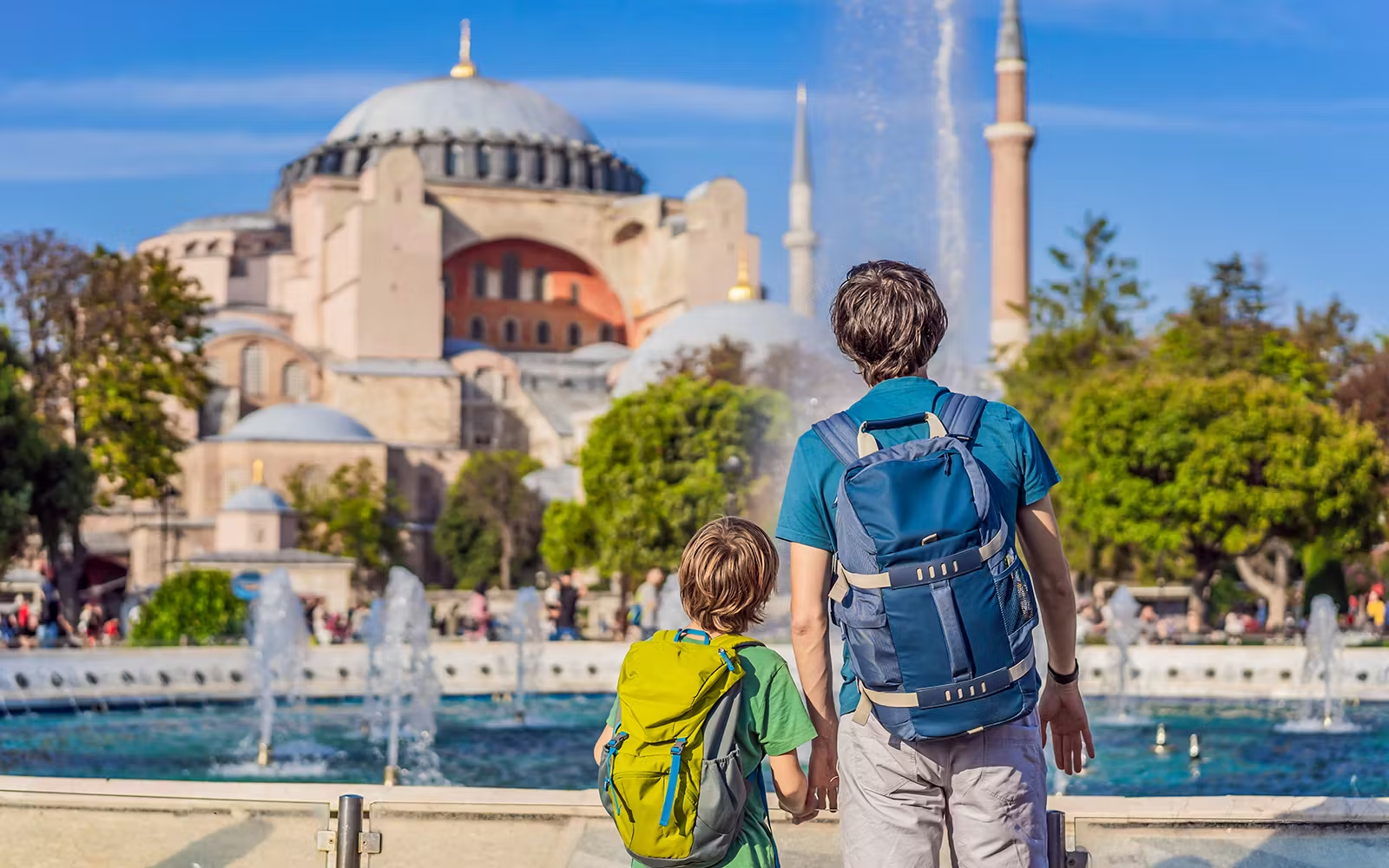
If you are going to Turkey, chances are you already have the Blue Mosque Istanbul on your list. You should go see it. Six tall minarets rise over the open yard. People slow down there, even if they are chatting.
Walk in and look around. The walls are covered with more than 20,000 hand-painted tiles. They have sat in place for roughly 400 years, like quiet watchers over the city.
There’s one catch: it’s still a working mosque, not a museum with fixed hours and a ticket booth. Visiting it well takes more thought than most stops on an Istanbul itinerary — and the thing that catches people out isn’t the dress code, it’s the timing.
Quick answer: entry is free. The mosque opens to visitors around 08:30 and closes roughly five times a day for prayer, with each closure running about 90 minutes. On Fridays it stays shut to tourists all morning until about 14:30. Shoulders and knees covered for everyone; women cover their hair.
Quick Snapshot
| What you need to know | Details |
| Official name | Sultan Ahmed Mosque (Sultanahmet Camii) |
| Built | 1609–1617, under Sultan Ahmed I |
| Architect | Sedefkar Mehmed Ağa, a student of Mimar Sinan |
| Entry fee | Free — no ticket, no booking |
| Istanbul Museum Pass | Not valid and not needed |
| Typical visiting windows | Roughly 08:30–12:15, 13:45–16:30, 17:30–18:30 |
| Friday | Closed to tourists until about 14:30 |
| Dress code | Shoulders and knees covered; women cover their hair |
| Time needed | 30–45 minutes |
| Nearest transport | Sultanahmet T1 tram stop |
Blue Mosque Istanbul Opening Hours
First timers often get stuck here. Since it is an active mosque, the visiting times follow five prayers a day. Those prayer times move each day as the sun changes.
Most days you will see blocks like 08:30 to 12:15. Then there is another block from 13:45 to 16:30. After that, a shorter one usually runs from 17:30 to 18:30.
When a prayer starts, the doors close to people who are not worshipping. That usually lasts about 90 minutes each time.
Seasonal swing is significant. In summer the last slot can run to about 18:30. In deep winter, with sunset-based prayers falling much earlier, the mosque can close for the day around 16:45. That’s nearly two hours of difference, so a late-afternoon plan that works in July fails in January.
Friday is the one to plan around. The mosque is closed to tourists all Friday morning until approximately 14:30 for the Jumu’ah congregational prayer. This is the single biggest scheduling pitfall — people arrive on a Friday morning and are turned away. If Friday is your only day in Sultanahmet, save the mosque for after 14:30 and use the morning for Hagia Sophia or the Basilica Cistern.
Three things worth knowing:
- Prayer times change daily, so don’t rely on any fixed schedule you find online, including this one. A prayer-times chart is posted in the courtyard, and the official site publishes daily windows. Check the day before.
- On weekdays, the first hour after opening feels the most relaxed. The security line is usually the shortest then.
- During Ramadan, evenings may end earlier or be more limited. If your trip falls in that month, leave some extra room in your plan.
Best Time to Visit
| Time | What to expect |
| 08:30–09:30 | Quietest window, best light, shortest security line |
| 10:00–12:15 | Busiest stretch, tour groups stack up |
| 13:45–16:30 | Moderate crowds, good after Topkapı Palace |
| Late afternoon | Golden light on the tiles, but you’re racing closing |
| Friday morning | Closed to tourists until about 14:30 |
Getting There
The mosque is on Istanbul’s old peninsula, in Sultanahmet. Reaching it is usually not the tough part.
Most people ride the T1 tram to Sultanahmet. Then it is a short walk of about four minutes. The same tram line also goes past the Grand Bazaar and toward the Kabataş ferry area. So it is easy to keep moving and plan the rest of your day around it. A few buses stop near Çatladıkapı as well, and that walk is around six minutes.
If you are already close by, just walk. Hagia Sophia, the Basilica Cistern, and the mosque are all within a short stroll, roughly five to ten minutes between each one.
From the airport, it depends on which one you use. If you start at Istanbul Airport (IST), take the M11 metro first. Then change to the M2 line. Finish with the T1 tram. Expect about 60 to 75 minutes from door to door. If you land at Sabiha Gökçen (SAW) on the Asian side, a taxi or airport shuttle tends to work better than buses and trains.
Quick note for your route. Come in from the Hippodrome side, near Sultanahmet Square. That way you get the usual view of all six minarets first, before you reach the gate.
Why It’s Called the Blue Mosque
Its real name is the Sultan Ahmed Mosque, after the young sultan who commissioned it as a deliberate answer to the Hagia Sophia standing across the square. Construction ran 1609 to 1617 under Sedefkar Mehmed Ağa, a student of Mimar Sinan.
The nickname came later and earned itself. Inside, the walls disappear under more than 20,000 handmade İznik tiles in blue, green and turquoise, in floral and geometric patterns that shift with the light through the day.
That mosque was also the first one in the empire to have six minarets. At the time, it created a diplomatic problem, because it looked like Mecca’s Grand Mosque. The sultan fixed the issue by paying for a seventh minaret in Mecca.
A bit of context, since people often mix these up. Even with its fame, it is not the biggest Ottoman mosque in Istanbul. The largest is the Süleymaniye, made by Mimar Sinan. The Blue Mosque stands out in a different way. It sits in a place that is easy to reach, so it gets more visitors than the others.
What to Wear
The dress code is straightforward but strictly enforced, and it applies to everyone.
Shoulders and knees covered, men and women both. Shorts and sleeveless tops won’t get you through the door regardless of the heat.
Women cover their hair. Scarves and covering gowns are provided free at the entrance if you arrive without one, but bringing your own light scarf is faster and more comfortable.
Shoes come off before the carpets. Plastic bags are provided so you can carry them. Skip flip-flops — you’ll be walking barefoot on stone and carpet for a while.
None of this is aimed at making life difficult for tourists. It’s a functioning place of worship, and a bit of modesty goes a long way.
Security
Every visitor passes through a security check — bag scan and metal detector — before reaching the shoe area. This is where most of your wait actually happens, and at busy times it runs 30 to 60 minutes.
Booking a tour doesn’t skip it. Screening is mandatory for everyone, guided or not. Arriving right at opening, or during the mid-afternoon window, is what actually cuts the wait.
What You’ll See Inside
The central dome measures 23.5 m across and reaches 43 m high. Four very large columns, called elephant feet, hold it in place, with several smaller half-domes around them. More than 200 stained-glass windows let in a lot of light, and toward late afternoon the tile surface starts to glow.
Find the mihrab next. This carved niche shows the direction of Mecca. It is cut from one block of marble.
Look up for the ostrich egg chandeliers — historically hung to repel spiders, which is the kind of detail that stays with you longer than the dimensions.
Outside, the same complex holds Sultan Ahmed I’s tomb, a madrasa and a hospice, all part of the original design.
Work on the mosque started in 2015 and it has taken a long time. After that restoration, the inside looks much lighter than it did in the old pictures. Even so, not every spot is open all the time. On the day you visit, part of the site may be off limits.
Photography is allowed for personal use without flash. Keep your voice down out of respect for anyone praying. Tripods are not permitted inside.
Most visitors spend 30 to 45 minutes, which is enough without feeling rushed.
Best Photo Spots
Sultanahmet Square on the Hippodrome side captures all six minarets and the full cascade of domes in one frame. The courtyard gate works shot from inside looking back toward the entrance arch. Directly beneath the main dome looking straight up is the shot everyone comes for, and it’s least crowded right after opening. Hagia Sophia’s upper terrace gives you a wide skyline shot with the Blue Mosque behind.
What Else Is Nearby
Sultanahmet does you a favour here — nearly every major sight is within five to ten minutes on foot.
Hagia Sophia is two minutes across the square. Byzantine cathedral, then mosque, then museum, and an active mosque again now. Note that tourist entry now costs around €25, so the free-morning framing stops applying once you add it.
The Basilica Cistern is a short walk further — a sixth-century underground reservoir on 336 columns, two carved with Medusa heads, and a cool change of pace.
Topkapı Palace is about ten minutes northeast. Home to Ottoman sultans for nearly 400 years; the Imperial Treasury and Harem alone justify a couple of hours.
Sultanahmet Square itself sits on the old Roman Hippodrome — worth a slow lap for the Egyptian Obelisk and the German Fountain.
You can walk to the Grand Bazaar in about fifteen minutes. It is among the oldest covered markets in the world.
The Turkish and Islamic Arts Museum sits on the square. You can see it as you pass by, and it is not hard to reach. It has a top carpet collection.
Here is a calm way to do it. Start with the Blue Mosque, then go to Hagia Sophia. After that, visit the Basilica Cistern. Do this in the morning without rushing. In the afternoon, move on to Topkapı and then spend time at the Grand Bazaar.
The wider list of things to do in Istanbul covers the Bosphorus cruises and the Asian side once you’ve finished with Sultanahmet.
Eating Nearby
Sultanahmet isn’t where locals eat, but there are decent options. Balıkçı Sabahattin is a long-running seafood spot on a quiet side street. Deraliye Ottoman Cuisine serves dishes based on palace recipes. Sultanahmet Köftecisi is the no-frills local institution for grilled köfte. Several rooftop cafés on the square do tea and coffee with direct mosque views if you just need twenty minutes off your feet.
Accessibility
The main courtyard and the prayer hall are step-free. There are ramps at the main entrance. Some parts of the courtyard have rough, uneven stone. If you need help, staff can usually assist you at security. Just ask them.
Should You Book a Guided Tour?
You can visit alone — entry is free and the layout is simple. A guide earns their keep, since the story behind the tilework, the work in the dome, and the old rivalry with Hagia Sophia are not laid out inside. A guided tour of the Blue Mosque covers the architecture, the history and the etiquette of visiting an active mosque.
Also, be clear about what a tour handles and what it does not. It gives context, not a fast lane. Security screening applies to everyone. And guided commentary isn’t permitted inside during prayer.
Final Thoughts
The Blue Mosque often feels better when you plan ahead, more than many other spots in Istanbul. If you get the time right and wear the right clothes, you can leave with one of the best parts of your day, and you will not pay for entry.
Look up the prayer hours the same morning you plan to go. Try not to show up on Friday before 14:30. Then link it with Hagia Sophia and the Basilica Cistern. Do it as one loop, and you will see a lot of old Istanbul without making the day too hard.
FAQs
What are the Blue Mosque Istanbul opening hours?
The mosque opens at about 8:30 AM. It shuts around 60 minutes before evening gets dark. Each day, there are five prayer times. During those prayers, the mosque stays closed to visitors for about 60 to 90 minutes. On Fridays, the morning is different. People cannot enter until 2:30 PM.
Where is the Blue Mosque in Turkey?
You can see the Blue Mosque in Istanbul’s Sultanahmet area. It sits right across the plaza from Hagia Sophia. Take the T1 tram to Sultanahmet station. After that, you are in the center of the old town.
What is the Blue Mosque in Turkey?
People call it the Sultan Ahmed Mosque. It is an active mosque built in the Ottoman era for Sultan Ahmed I. The place is easy to spot. You can see six tall minarets and several domes that sit over one another. Inside, the walls are covered in thousands of hand painted blue İznik tiles.
What’s the Blue Mosque Istanbul ticket price?
You do not need a ticket. Everyone can enter without paying. This is a place of worship, not a paid stop. People may offer donations, but they are not required. That part is different from Hagia Sophia across the square.
What are some interesting Blue Mosque Istanbul facts?
Construction ran from 1609 to 1617, and the mosque ended up with six minarets, unusual for the time, plus over 20,000 blue İznik tiles. Its main dome towers 43 meters above the prayer hall floor.
Is Blue Mosque Istanbul free?
Yes, entry is completely free, no ticket needed at all. Since it’s an active mosque rather than a museum, visitors just need to dress modestly and plan their visit around the five daily prayer closures.
Where is Blue Mosque Istanbul located exactly?
It stands in Sultanahmet Square on Istanbul’s historic peninsula, with Hagia Sophia facing it across a small park. Hop off at the Sultanahmet tram stop, and you’re just a short walk from the entrance gate.
How old is Blue Mosque Istanbul?
Work on the mosque began in 1609 and finished in 1617 during Sultan Ahmed I. That means it is more than 400 years old. Even so, it remains in strong condition. Today people still use it, and it is often seen as one of the best kept examples of classical Ottoman design.
How much does it cost to enter Blue Mosque Istanbul?
The Blue Mosque has no ticket price. It is still a working mosque, so it is not run like a paid site. Near the exit, there are donation boxes if you want to give something. Nobody tries to collect money from visitors.
When to visit Blue Mosque Istanbul?
Get there at 8:30 AM so you do not run into the tour groups. If that time does not work, plan your stop in between the morning prayer and the midday prayer. Try not to go on Friday morning. The mosque does not open to visitors until after the sermon.