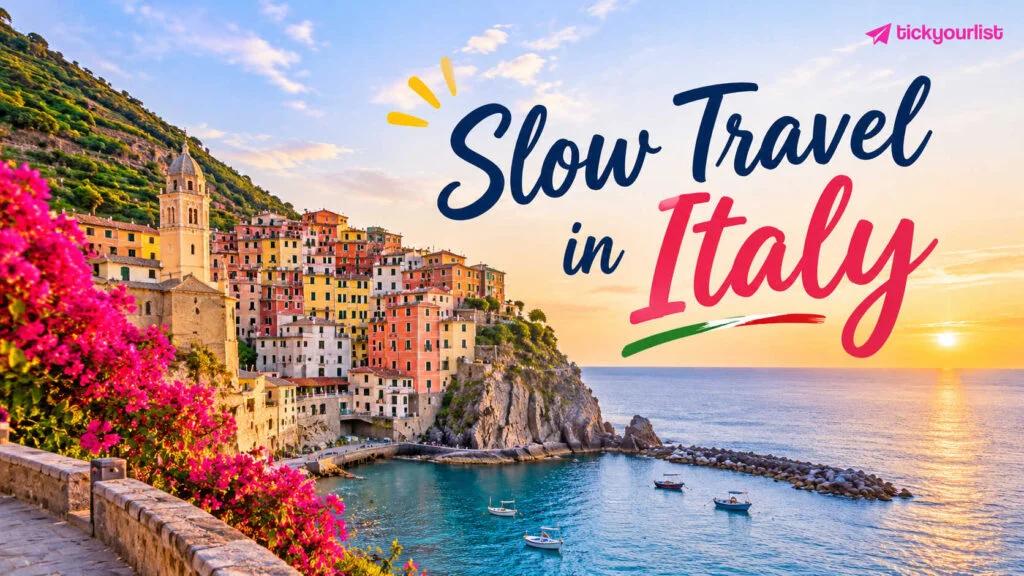
It is easy to make an extensive Italian itinerary. Upon arriving in Rome, you realise that you should also visit Florence and then Venice and perhaps even the Amalfi Coast. Soon you will be researching train timetables, packing and having lunch with your suitcase beside you.
Slower travelling involves choosing two or three main locations. Spend sufficient time in each place to discover the best coffee. And allow yourself an afternoon which is not rushed. It is also about becoming familiar with a town instead of just visiting it.
This does not imply that well known attractions should be ignored. However, they do need to be allowed time and space. For example, viewing a cathedral after a good breakfast, ambling round a hill top town or allowing a meal to last for three relaxed hours, can often provide a more enjoyable experience than cramming five places into one week.
This guide looks at towns that suit that kind of trip: places with history, good food, walkable centres, and enough calm to make a longer stay worthwhile. Some are well known. Others are quieter, less obvious choices. None require you to rush.
What Slow Travel Actually Means

While slow travel doesn’t mean you restrict the amount you visit in Italy, it does mean you can explore areas in greater depth. Stay in one town for three nights, rather than one. Rather than visiting many museums, visit one or two which are of real interest to you. Even walk along the same street. Take time to sit in a piazza and visit a market (even where you have no shopping requirements).
A slow Italy trip might look like this:
- Two or three nights in each base, rather than one-night stops.
- One major activity a day, with the rest left open.
- Regional trains, buses, ferries, or walking where they make sense.
- Meals that are not rushed.
- A few local experiences, rather than a long list of attractions.
- Time to revisit a favourite café, viewpoint, or neighbourhood.
Furthermore, it also means accepting that you cannot see everything. Italy has been visited, photographed, written about, and romanticised for centuries. You do not need to cover it all in one trip.
Why Italy Suits Slow Travel

Italy is a country which appreciates ‘slow’. As well as recognisably different regions, there is also often variation in the food available in different valleys. Many ‘hidden gem’ locations are pretty, old fashioned towns, bordered by countryside, hills, sea or mountains.
Furthermore, it is often possible to get to a smaller town by train. Then, again, you can usually walk from the station to the town centre. It is even possible to see quite a lot of Italy without needing to drive a car. Italy’s government travel information emphasises that – as well as major cities – many smaller towns are also covered by both intra-regional and between-region train networks. Thus, it is feasible to enjoy a coastal or alpine break in Italy without driving.
In addition, Italy is rich in beautiful old villages (borghi). These typically include cobbled streets, little plazas, churches and village events. Unlike surrounding roads, villages tend to have retained their original appearance for longer. Italy’s tourism body highlights the strong relationship between villages and ‘slow’ travel within the country.
How to Plan Without Overloading the Trip

Often people over-plan, even when aiming for a relaxing holiday. There must be downtime on a relaxed holiday.
Number of locations: Generally two or three locations will suffice for between seven and ten days. For two weeks, three or four is ideal. Don’t feel the need to include an extra town simply because it is close by.
Travel days: Avoid turning your travel day into another day out. Upon arrival at a new area, check in and then explore, have a meal and that is it.
Central but not always in the centre: Although it is convenient to be able to easily walk to both places to eat and see, properties with a view onto the main piazza can sometimes be busy. Often a slightly quieter road just a five minute walk away is a more favourable option.
Inclusion of free days: Every three or four days, plan an unbusy day. This may involve washing, reading, exploring, shopping or having a lengthy lunch. Far from being unproductive, these are in fact hugely important days which allow the rest of your holiday to feel well-earned.
Only pre-book where necessary: While it is not essential to pre-book everything, it is advisable to book into museums, cave tours, cookery classes and boats as well as attractions with restricted entry. This ensures you make the most of your time and stops your holiday becoming a waiting game.
Here are ten towns that work particularly well for a relaxed trip.
| If you want… | Good bases | Suggested stay |
| Hill towns, art, and food | Orvieto, Spello, San Ginesio | 2–3 nights each |
| Medieval villages and countryside | Brisighella, San Ginesio | 2–3 nights each |
| Coast without a resort feel | Noli, Isola del Giglio | 2–4 nights |
| Ancient history and dramatic scenery | Matera | 2–3 nights |
| Whitewashed towns and Puglian food | Alberobello, Locorotondo, Ostuni | 3–5 nights |
| Baroque architecture and mild winter sun | Noto, Ragusa, Modica | 3–5 nights |
| Mountains, forests, and quiet | Sauris-Zahre | 2–4 nights |
Orvieto, Umbria

Orvieto can also be a good place to stay for a more extended period. Set atop a volcanic hilltop, the town has a different atmosphere; with tighter streets and a more refreshing climate and beautiful vistas of the Umbrian landscape.
Stay for at least two nights. Firstly visit the cathedral when there are still fewer people about. The town’s subterranean passages and grottos are fascinating and although they have their own appeal, it is nice to return to the historic town centre and enjoy a meal in one of the cafés.
While the restaurants around the town square are fine, it is advisable to seek recommendations from your hotel, host or even shop staff as to where best to dine. As mentioned above, Umbrian cuisine is usually quite substantial. Typical dishes include lentils, pecorino cheese, wild boar and regional wines. This is much more appropriate for an evening meal on an extended timescale.
- Good for: First-time slow travellers, history lovers, and anyone who wants an easy base with plenty to see.
- Stay: Two or three nights.
- Do not miss: The cathedral, the underground sites, and the views from the town’s edges.
- Book ahead: Cathedral or underground tours during busier periods.
Spello, Umbria

Smaller than Orvieto, Spello is also more tempting. Along with the cobbled streets, there are many charming features which cannot be seen from a car such as colourful archways, geranium plants, stone stairs and panoramic valley views.
Although there are beautiful frescos within the Basilica of Santa Maria Maggiore, Spello is equally enjoyable without set plans. Explore upwards, become slightly disorientated and then stop for lunch.
Ideal for ‘doing less’, spend the morning buying bread and cheese. Then sit in a peaceful square with a book. Finally, allow yourself free reign for the afternoon.
- Good for: Couples, solo travellers, photographers, and anyone who enjoys walking.
- Stay: Two or three nights.
- Best time: Spring, when the flowers are at their best.
- A useful note: The town is compact, but its hills mean comfortable shoes matter.
Brisighella, Emilia-Romagna

The medieval village of Brisighella is located within the Vena del Gesso Romagnola Park in the hills of the region of Emilia-Romagna. With its cobbled streets, colourful buildings and little piazzas, Brisighella is a good example of ‘slow’ tourism.
In addition, Brisighella is listed as one of ‘Italy’s Borghi più Belli d’Italia’, which is Italy’s association of ‘Most Beautiful Villages’. And while this is most definitely an accolade that Brisighella deserves, it has even more to offer as a home base for tourists than as a short 20 minute photo spot.
Unlike many Italian hill-top villages, the nearby park adds a new element to life in Brisighella. As well as being a pleasant area to walk and cycle in, the natural environment is integral to the village experience.
- Good for: Food-focused travellers, walkers, and people who want a quieter alternative to Bologna or Florence.
- Stay: Two or three nights.
- Do not miss: The medieval centre, local olive oil, and a walk or ride in the surrounding countryside.
- A practical point: Public transport can be less frequent than in larger towns, so check timetables before relying on it.
Noli, Liguria

Noli is a pleasant ‘slow travel’ location in Liguria. Alongside its old town, it also has a waterfront, some impressive buildings and a fishing village atmosphere which is arguably not as refined as in some more famous locations on the Riviera.
Noli is often said to maintain its fishing village nature. Local fishermen still catch fish and in some cases sell their freshly caught produce on the beach. Even if you don’t happen to visit during one of these beach sales, this industry aspect is still what sets Noli apart from a dedicated tourist resort.
Rather than cramming your day with things to do, spend mornings exploring the old town. In the afternoon enjoy some time at, or in view of, the water. Then whilst the light fades, take your time over a meal.
- Good for: Sea lovers, couples, and travellers who want a coastal base without choosing one of the busiest Riviera towns.
- Stay: Two to four nights.
- Do not miss: The historic centre, the seafront, and a long seafood dinner.
- A caveat: Summer weekends can still be busy, especially in good weather.
Sauris-Zahre, Friuli Venezia Giulia

Sauris-Zahre is an Alpine village in northeastern Italy and one of the country’s recognised examples of exceptional rural tourism. Italy’s official tourism site notes that it was selected among the UNWTO Best Tourism Villages, alongside Isola del Giglio.
This is not a Mediterranean hill town. It is a place for mountain air, forests, traditional culture, and quiet. If your idea of Italy is strictly sun, sea, and pasta, Sauris may feel unexpected. That is part of the appeal.
It works especially well in late spring, summer, and early autumn, when walking trails, local food, and outdoor experiences are at their best. It is also a useful contrast if your itinerary includes Venice or Trieste and you want a few days away from cities.
- Good for: Nature lovers, hikers, and travellers seeking a quieter mountain break.
- Stay: Two to four nights.
- Do not miss: Forest walks, local food, and the village’s Alpine character.
- Plan carefully: Mountain transport and seasonal opening hours can be limited outside peak periods.
Matera, Basilicata

Whilst Matera is by no means a conventional Italian town, this is part of its appeal. The Sassi (the ancient stone areas) can resemble a piece of art work and this is particularly noticeable at dawn and dusk.
Although Matera is popular, it is key not to just visit as a tourist ‘day out’. Extend your stay so that you can explore the Sassi when day-trippers have departed. Also, take the opportunity to visit one of the cave churches.
As well as the town itself, the surrounding area is also significant. Matera is built on top of a gorge and the striking difference between the stone town and the more spacious rural area is highly distinctive. UNESCO recognise both the Sassi and the Park of the Rupestrian Churches as having an exclusive record of human activity.
- Good for: History lovers, photographers, and travellers who want a dramatic change of scenery.
- Stay: Two or three nights.
- Do not miss: The Sassi, cave churches, viewpoints, and local Basilicata food.
- A useful warning: Do not try to combine Matera with too many other southern destinations in one day.
Alberobello, Puglia

Alberobello is famous for its trulli—traditional dry-stone houses with distinctive conical roofs. The town is home to more than 1,500 of them and has been a UNESCO World Heritage site since 1996.
Because it is famous, it can get busy. That does not make it a bad slow-travel base; it just means timing matters. Visit the main trulli districts early, then spend the rest of the day in a quieter part of town or use Alberobello as a base for the wider Itria Valley.
Puglia is a good region for a relaxing trip. Its food, olive groves, whitewashed towns, and relatively compact geography make it easy to explore without trying to cover the whole region in a few days.
- Good for: Food lovers, first-time visitors to Puglia, and travellers who want a distinctive base in the Itria Valley.
- Stay: One or two nights, or use it as part of a longer Puglia stay.
- Do not miss: The trulli districts, local food, and nearby towns such as Locorotondo, Martina Franca, and Ostuni.
- Best approach: Stay overnight rather than visiting only as a day trip.
San Ginesio, Marche

San Ginesio is a hill town in the Marche and is an excellent example of a ‘slow town’ in central Italy. It has been recognised as such on the official Italian tourism website and was also recognised by the UNWTO Best Tourism Villages.
Although perhaps less recognised than Tuscany and Amalfi, the Marche region has plenty to offer. Alongside its history, hills and cuisine, it also boasts beautiful scenery. These aspects are all well represented by San Ginesio including its medieval architecture, rural views, culture and peaceful atmosphere which can encourage people to extend their visits here.
This is an ideal option if you are looking to experience something more ‘authentic’ after having visited Italy’s main cities.
- Good for: Repeat visitors to Italy, food and culture lovers, and travellers who want fewer crowds.
- Stay: Two or three nights.
- Do not miss: The medieval centre, hill views, and the surrounding Marche countryside.
- Best for: A slower central-Italy itinerary rather than a first trip focused on the biggest names.
Noto, Sicily

Noto is a beautifully baroque town in Sicily and has been recognised by UNESCO as part of the Late Baroque Towns of the Val di Noto. It is an ideal slow travel destination offering stunning architecture, great food and a laid-back Mediterranean feel.
Walking is a great way to experience Noto. The town has attractive golden limestone buildings, wide streets, churches and both balconies and piazzas. It is also an ideal centre for exploring other areas of south eastern Sicily such as Ragusa and Modica.
As Sicily is such a big island, slow travel works well as it allows a more in depth experience of just one area. South east Sicily especially benefits from this approach. People enjoy the opportunity to dine for longer, visit local markets, and observe the differing appearance of towns at both day and night, alongside the region’s lemon trees.
- Good for: Architecture lovers, food-focused travellers, and anyone visiting Sicily outside the hottest months.
- Stay: Two or three nights.
- Do not miss: The baroque centre, local sweets, and nearby Val di Noto towns.
- Best time: Late autumn, winter, and spring can be especially pleasant.
Isola del Giglio, Tuscany

Isola del Giglio has a relaxed atmosphere. As well as fresh sea air, there are walking areas, small ports and a relaxed lifestyle which is influenced by ferry timetables rather than road traffic. The Italian tourism website recognises the island’s natural beauty and also emphasises that it is a great destination for those wanting to experience more relaxed village living.
It is in the Tuscan Archipelago. Those wishing to ‘unplug’ and enjoy walking, swimming and boating, as well as sampling local seafood, will particularly appreciate this island.
As ferry services are used to travel to and from Isola del Giglio, good transport planning is important. Again, this is a necessary element of the island experience. Having arrived, the island then promotes a laid back way of living.
- Good for: Island lovers, walkers, swimmers, and travellers who want a proper break from mainland sightseeing.
- Stay: Two to four nights.
- Do not miss: Coastal walks, small harbours, boat trips, and fresh seafood.
- A practical point: Ferry schedules and weather can affect plans, particularly outside summer.
A 7-Day Slow Italy Itinerary

This is a good first slow-travel itinerary if you want culture, food, and countryside without changing hotels every night.
Days 1–3: Orvieto
Arrive in Rome, but do not treat the capital as the main focus of the trip. Spend one night there if you need to, then travel to Orvieto and settle into Umbria.
- Day 1: Arrive, transfer to Orvieto, take an evening walk, and have dinner.
- Day 2: See the cathedral, explore the underground sites, and find a viewpoint.
- Day 3: Take a slow day trip, visit a local producer, or simply spend the day in Orvieto.
Days 4–6: Spello
Move from Orvieto to Spello. Use the journey as a transition rather than trying to squeeze in another major sight.
- Day 4: Travel to Spello, explore the historic centre, and walk uphill before dinner.
- Day 5: Visit the churches, walk to viewpoints, and eat locally.
- Day 6: Leave the day open. Take an optional excursion only if you genuinely feel like it.
Day 7: Return
Travel back to Rome, Florence, or your departure airport. Do not schedule a major activity for the final morning unless your flight time makes it unavoidable.
A 10-Day Slow Italy Itinerary

This route adds Emilia-Romagna and the Ligurian coast. It gives you hills, food, medieval streets, and sea without trying to cover the whole country.
Days 1–3: Orvieto
Use Orvieto as your Umbrian base. Arrive, settle in, and give yourself a full day to explore without a fixed schedule.
Days 4–6: Spello
Move to Spello for a quieter stretch. Walk, visit the churches, eat well, and take one optional countryside excursion.
Days 7–8: Brisighella
Travel north to Brisighella. This is a good point in the trip to slow down further: medieval lanes, local food, olive oil, and countryside walks.
Days 9–10: Noli
End at the Ligurian coast. Stroll round a historic town centre, relax on the beach and then enjoy a final long Italian lunch. This is not a list of things to experience in Italy. It is more of a guideline. If you discover an enjoyable village market then extend your stay there. Likewise, if the weather changes, replace your stroll with a long meal. The plan should be moulded to fit your holiday.
A Two-Week Southern Italy Itinerary

For travellers with more time, southern Italy offers an excellent slow route through Puglia, Basilicata, and Sicily.
Days 1–4: Puglia
Base yourself in the Itria Valley, with Alberobello as one possible stop.
- Day 1: Arrive in Bari and transfer to Alberobello or a nearby town.
- Day 2: Explore Alberobello’s trulli districts.
- Day 3: Visit Locorotondo, Martina Franca, or Ostuni.
- Day 4: Take a food experience, countryside walk, or market day.
Days 5–7: Matera
Travel inland to Matera for a complete change of atmosphere.
- Day 5: Travel to Matera and explore the Sassi at sunset.
- Day 6: Visit cave churches, viewpoints, and historic sites.
- Day 7: Keep the day light: food, walking, photography, and a long dinner.
Days 8–14: Southeastern Sicily
Continue to Sicily, but focus on the Val di Noto rather than attempting to see the whole island.
- Day 8: Travel to Noto and settle in.
- Day 9: Explore Noto’s baroque centre.
- Day 10: Day trip to Ragusa or Modica.
- Day 11: Visit a local food producer, market, or vineyard.
- Day 12: Take a coastal or countryside excursion.
- Day 13: Return to Noto for a final slow day.
- Day 14: Depart from Catania or another convenient airport.
Sicily deserves more than a rushed circuit. Pick one region, stay longer, and save the rest for another trip.
Best Time to Visit

There is no perfect month for all of Italy. The best time depends on where you are going and what you want from the trip.
| Season | Best for | Things to consider |
| Spring | Flowers, walking, mild weather, fewer crowds than summer | Weather can vary, especially in the north and mountains |
| Early summer | Coast, long evenings, outdoor dining | Popular destinations become busier |
| Late summer | Warm sea, festivals, mountain escapes | Heat and crowds can be intense in cities and coastal hotspots |
| Autumn | Food, wine, harvest season, comfortable walking weather | Some coastal businesses reduce hours after summer |
| Winter | Cities, art, food, southern Italy, quieter travel | Alpine villages and some coastal services may be limited |
For a first slow trip, late spring and early autumn are usually comfortable choices. They offer decent walking weather, good food, and a less intense atmosphere than peak summer.
Travelling Without a Car

You do not need to avoid cars completely. In rural Puglia, parts of Sicily, and some mountain areas, a car can make life easier. But it is not necessary for every slow-travel itinerary.
Trains work well between major cities and many regional towns. Italy’s official travel guidance notes that regional and intercity services reach smaller towns as well as larger destinations.
If you want to cycle, check the rules before travelling. A folding bicycle can be carried free on regional trains if it is properly folded or bagged and meets the size limit.
An assembled bicycle can be taken on regional trains marked with the bicycle symbol, subject to available space; Trenitalia states that the daily supplement is €3.50 and that the bicycle may be up to two metres long.
That makes cycling-and-train travel possible in some regions, but it is not universally straightforward. Check the specific route, especially if you are travelling with luggage or planning a longer ride.
How to Avoid Turning Slow Travel Into Another Checklist

A slow itinerary fails when it becomes another form of over-scheduling. These habits help.
- Plan one anchor activity per day, not three.
- Leave at least one afternoon completely unplanned.
- Do not book a tour simply because it is available.
- Choose accommodation within walking distance of the places you will actually use.
- Eat where locals eat, not only where the reviews are highest.
- Ask people who live there for recommendations.
- Let weather, energy levels, and curiosity change the plan.
Some of the best travel moments are unplanned: a village festival, a conversation with a shop owner, a viewpoint found by accident, or a meal that lasts much longer than expected.
Travelling Respectfully

Alongside being sustainable, slow tourism should also be respectful. Many small Italian towns are resourceally constrained and have both fragile buildings and people that experience tourism throughout the year.
- Encourage local businesses (such as restaurants, stores and markets) and local tour guides.
- Try to avoid visiting at busy times.
- Respect local guidelines within places of worship, heritage and in nature.
- Avoid using people’s houses and private paths as backdrops for photographs.
- Make use of public transport where appropriate.
- Book visits to popular sites in advance to help to manage demand.
- While learning a few Italian words will not make you fluent, even simple language can change how you communicate.
Italian tourism bodies describe slow tourism as a means of engaging with genuine locations and culture and to travel in a more sustainable manner. Extending your stay in fewer destinations is a straightforward way of achieving this.
What to Book Before You Go

Even on a slow trip, a few advance bookings can make the journey smoother.
- Major museums, archaeological sites, and cathedral complexes.
- Guided walking tours in historic centres.
- Cooking classes, wine tastings, and food experiences.
- Boat trips, especially around islands and coastal towns.
- Cave, underground, or archaeological tours.
- Transport-heavy day trips where availability is limited.
TickYourList lets you browse and book tickets for attractions, tours, and experiences across Italy. Whether you are planning entry to a major cultural site, a guided food experience, or a scenic excursion, booking ahead helps protect your time and keep the itinerary relaxed.
A Few Honest Recommendations

If this is your first slow trip to Italy, do not try to include every town in this guide. Pick a theme.
For a first trip, choose Orvieto, Spello, and Brisighella. For food, choose Brisighella, Spello, Alberobello, and Noto. Those interested in history, choose Matera, Orvieto, Noto, and Alberobello. For nature, choose Sauris-Zahre, Isola del Giglio, and the hills around San Ginesio.
If you only have a week, resist the urge to add a fourth base. Two or three well-chosen towns, with enough time to breathe between them, will almost always make a better trip than six destinations seen through a train window.
When you are ready to add structure to the trip, explore Italy tours, attraction tickets, and local experiences on TickYourList. Booking the right experiences in advance lets you keep the freedom of slow travel while making sure the things you care about are secured.
FAQs
What is slow travel in Italy?
Slow travel in Italy means visiting fewer places and staying longer in each one. Instead of rushing between major cities, you build a trip around walkable towns, local food, regional transport, and time to explore without a fixed schedule.
How many towns should I visit on a slow Italy trip?
For a 7- to 10-day trip, choose two or three bases. For a two-week trip, three or four is usually enough. Staying two to four nights in each place gives you time to settle in rather than spending most of your holiday in transit.
Which part of Italy is best for slow travel?
Umbria, Emilia-Romagna, Marche, Puglia, Basilicata, and southeastern Sicily are especially rewarding. They offer historic towns, strong food traditions, varied landscapes, and a generally more relaxed pace than Italy’s most crowded tourist hubs.
Is Italy suitable for a car-free slow-travel trip?
Yes, particularly if you base yourself in towns with good rail or bus connections. Italy’s official tourism guidance highlights trains, buses, metros, and trams as practical ways to get around, and notes that rail connections serve many smaller towns as well as major cities.[1]
What is the best time of year for slow travel in Italy?
Late spring and early autumn are usually the most comfortable times for walking, sightseeing, and outdoor meals. Winter can be excellent for southern Italy and cultural city breaks, while summer is better for mountains and coastal stays if you are prepared for heat and more visitors.
Do I need to rent a car in Italy?
Not always. A car is useful for rural Puglia, parts of Sicily, and some mountain or coastal areas, but it is unnecessary for itineraries based around Orvieto, Spello, Matera, Noto, and many other walkable towns. Check local transport before committing to a car-free route.
Should I book tickets and tours in advance?
Yes, for popular museums, archaeological sites, guided tours, cooking classes, boat trips, and limited-capacity experiences. Booking ahead protects your time and helps keep the trip relaxed. Trenitalia also notes that base train tickets can be purchased up to a few minutes before boarding, though advance planning is still sensible for popular routes and peak travel periods.
Is slow travel more expensive than a normal Italy trip?
It can be, but not necessarily. Fewer hotel changes can reduce transport and packing costs, while longer stays may make apartment rentals or agriturismo accommodation more practical. The main cost is usually time: slow travel works best when you have at least a week.