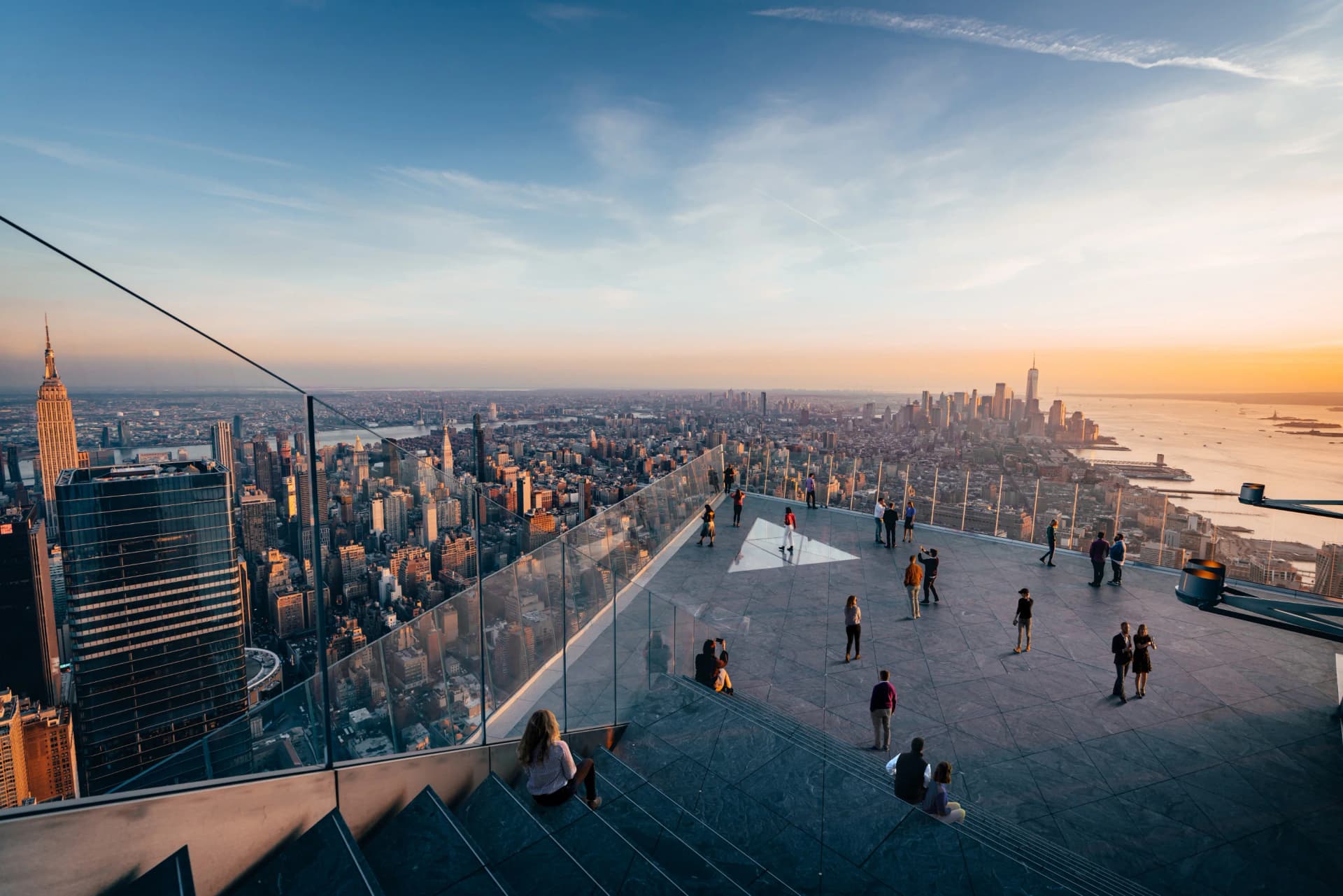
There is a reason photographers keep choosing this one. Stand on the open-air roof of 30 Rockefeller Plaza and the Empire State Building is right there in front of you, lit up and unobstructed, with Central Park spread out behind your shoulder. Go up the Empire State instead and you get a magnificent view with one thing missing from it, which is the Empire State Building.
That single fact explains most of what people eventually decide about the Rock observation deck NYC question, and it is worth getting out of the way early because almost every other comparison turns on it. The deck is not the tallest in the city and has not been anywhere close for years now, but what it holds onto instead is the best-composed view in New York along with a roof you can stand on with nothing whatsoever between you and the air.
This guide covers the lot: what the three levels actually are, what Top of the Rock tickets cost in 2026, whether the Beam and the Skylift are worth the money, the time slots that sell out first, how it compares with Edge and SUMMIT and the Empire State, and the practical business of bags, security and which entrance to use. If you just want to book tickets, the links are throughout.
Top of the Rock observation deck NYC: the short answer

If you are only going up one building in New York and you want the photograph everybody recognises, this is the one. General admission starts around US$45, it opens at 8am and runs to midnight with the last elevator at 11:10pm, as the official Rockefeller Center ticket page confirms, and it occupies the 67th, 69th and 70th floors of 30 Rockefeller Plaza at roughly 850 feet. You should book a timed slot in advance rather than turning up, because the sunset windows go first and they go early.
Where it loses is pure altitude. Edge sits at 1,131 feet, One World Observatory at 1,268, and the Empire State at 1,050, so if height alone is what you are buying then Top of the Rock is not the answer. Where it wins is the composition of what you see, the fact that the 70th floor has no glass at all, and that the crowding is more civilised than the Empire State manages on a summer evening.
Two things most guides bury. The Beam and the Skylift are both extra, neither is included in general admission, and only one of them is worth the money for most people. More on which, further down.
The view from the top, and why it is the one people remember

What makes the Rock observation deck NYC view work is position rather than height, because Rockefeller Center sits almost exactly in the middle of midtown Manhattan, which turns out to matter more than being tall. Turn south and the Empire State Building sits in the foreground with the entire downtown cluster stacked behind it, One World Trade included, and on a clear evening the way those two separate skylines layer against each other is genuinely startling. The northern side does something quite different, giving you Central Park as a near-perfect green rectangle with the Upper East and Upper West Sides framing it down both long edges, a shape nowhere else in the city shows you half so cleanly.
Compare that with what you get from the Empire State, which is a superb view in every direction except that the single most photogenic building in New York is the one you are standing on. From Edge and One World you are far enough downtown that Central Park becomes a distant smudge. SUMMIT does something clever with mirrors but it is further east and the park sits at an awkward angle.
The honest summary is that the Top of the Rock observation deck gives you the view a visitor pictures when they imagine looking at New York. That is not an accident of marketing so much as a consequence of the building happening to stand in exactly the right place.
The three levels explained: floors 67, 69 and 70

Something that confuses a lot of people at the point of buying a ticket is that this is not a single platform at all, but three distinct levels whose character changes considerably as you move between them, so it is worth knowing which is which before you go up rather than working it out on the way.
The 67th floor is indoor and glassed, with exhibits and the Radiance Wall, and it is where most people arrive and take their first look. It is the warm one, which in January is not a trivial consideration. The 69th floor is outdoors but set behind frameless safety glass, which sounds like a compromise and is actually the sweet spot for photography because the glass panels have no visible frames to crop around. The Beam sits on this level.
Floor 70, the open roof
The 70th floor is the reason to come. Completely open to the air, no glass, no mesh, nothing between you and midtown except a parapet, and it runs the full width of the roof. The wind up there is real and in winter it is bitter, but standing on an open roof 850 feet above Fifth Avenue is a different physical sensation from looking through a window, and the whole visit tends to reorganise itself around those ten minutes, which is why I would always leave the open roof until last rather than racing up to it first.
Nobody rushes you between them. There is no time limit once you are up, which separates this from a couple of the other decks, and you can go up and down between the three levels as often as you like.
Top of the Rock tickets and prices in 2026

Pricing at the Rock observation deck NYC is dynamic rather than fixed, which means the number you see depends on the date and the time slot you pick, and the sunset slots carry a premium precisely because everybody wants them. The figures below are the realistic starting points rather than promises.
| Ticket | Price from | What you get |
|---|---|---|
| General admission | US$45 | Timed entry, all three levels, no time limit at the top |
| Admission + the Beam | US$67 to US$73 | General admission plus a reserved Beam photo slot on floor 69 |
| Admission + Skylift | US$67 | General admission plus the open-air lift above floor 70 |
| RockMoMA combo | US$63 | Top of the Rock plus MoMA general admission, around 14 per cent off |
| VIP pass | US$201 to US$207 | Private guide, VIP elevator, private Beam, Skylift, photo pass, champagne |
| Rockefeller Center tour | US$29 | Guided art and architecture tour of the complex, deck not included |
Children under five go free. Booking through Top of the Rock tickets gets you the standard observation deck ticket with instant confirmation, and the Beam experience ticket bundles the photo slot in with free cancellation, which matters more than it sounds given how often New York weather ruins a sunset plan.
The Beam: the photo everybody comes for

If you have seen the 1932 photograph of eleven ironworkers eating lunch on a girder hanging over Manhattan, the Beam is the attraction built around recreating it. You sit on a replica steel beam on the 69th floor, it lifts and rotates out over the edge with the skyline behind you, and a photographer shoots the whole thing.
It is unapologetically a tourist set-piece and it is also, I think, the single best-value add-on here, because the resulting image is genuinely good and there is nowhere else in New York you can get it. Groups of up to eight can go on together, which makes it work for families. The combo ticket runs roughly US$67 to US$73 against US$45 for admission alone, so you are paying somewhere between twenty and thirty dollars for the experience and the photographs.
Two practical notes. Slots are timed and reserved, so booking the combo in advance is the only reliable way to get one rather than hoping on the day. And it sits on the glassed 69th floor rather than the open roof, so the wind is not a factor even in winter.
Skylift: the open-air platform above the roof

Skylift is a glass-floored circular platform that rises roughly thirty feet above the 70th floor, taking a small group up for a few minutes at what becomes the highest accessible point of the building. It costs US$35 per person as an add-on and the catch worth knowing is that it is generally bought on site rather than in advance, so it cannot be reliably pre-booked as a standalone extra.
Is it worth it? Less obviously than the Beam. You are already on an open roof with an uninterrupted view, and thirty extra feet changes the sightline far less than you might hope. What it does add is the glass floor and the sensation of being lifted clear of the parapet, which some people find genuinely thrilling and others come away describing as thirty-five dollars for two minutes of standing still while somebody photographs them doing it.
My own view, for what it is worth: if the budget is finite, put it into the Beam. If you are already buying the VIP pass then Skylift comes bundled and the question answers itself. And if you have a fear of heights that you are managing rather than conquering, skip it entirely, because the glass floor is the part that undoes people.
VIP pass, guided tours and combo tickets

At around US$201 to US$207 the VIP pass is a serious amount of money and it is not aimed at most visitors. What it buys is a private guide, a VIP elevator that bypasses the main queue entirely, a private Beam session rather than a shared slot, Skylift included, a professional photo pass and a champagne toast for over-21s, plus twenty per cent off in the gift shop. If you are marking an occasion, or if queueing with a restless family is the thing you are paying to avoid, it earns its price. If you simply want the view, it absolutely does not.
The RockMoMA combo at around US$63 is the quietly sensible one. It pairs the deck with general admission to the Museum of Modern Art, which is a five-minute walk away on 53rd Street, and saves roughly fourteen per cent against buying the two separately. For a rainy-day-and-clear-evening itinerary it is close to ideal.
There is also a Rockefeller Center guided tour at about US$29 covering the art and architecture of the complex, which does not include the deck and is a genuinely good hour if you care about Art Deco. It is worth putting that one up against the wider range of guided tours in New York before committing, since several of them cover the same ground for less. If you are stacking several attractions, the combo savings calculator and attraction pass calculator will tell you whether a multi-attraction pass beats buying individually for your particular list.
Best time of day to visit Top of the Rock

Of everything on this page, the hour you pick for the Rock observation deck NYC is the question that actually changes your experience, more than which ticket you buy, and the answer most people land on is not the one they book first.
Sunset is the obvious choice and the worst value. Those slots carry a price premium, they sell out furthest ahead, and the deck is at its most crowded precisely when the light is best. If you want it anyway, and plenty of people reasonably do, book a slot that puts you up there about forty-five minutes before sunset. You then get daylight, the golden half hour and the city lighting up, all on one ticket, which is three different views for the price of one.
Early morning is the sleeper option. Doors open at 8am and the first hour is the quietest the deck ever is, with clean light from the east and the 70th floor close to empty. If photographs without strangers in them matter to you, this is when to come.
Late evening is underrated too. The last elevator runs at 11:10pm, and from around ten o’clock the crowds thin dramatically while the skyline is fully lit. Midday is the one slot I would avoid, because the light is flat and harsh and the view loses all its depth.
Best time of year, and what each season changes

New York weather is not subtle and it changes this visit more than it changes most. The deck stays open year-round in essentially all conditions, but what you see from it varies enormously.
Autumn, late September through November, is the best of it. The air is clearest, humidity drops away so the long sightlines downtown actually resolve, and Central Park turns from green to gold which transforms the northern view completely. Anyone with the slightest flexibility in their dates should be aiming for that window rather than any other.
Winter is cold enough on the 70th floor to be genuinely uncomfortable, and you should treat that seriously rather than assuming you will tough it out. What you get in return is the Rockefeller Center Christmas tree and the rink below you from late November, crisp air and early sunsets that let you catch golden hour without staying up late. Come in spring instead and you get mild weather, longer evenings and a Central Park that has just greened up, which is pleasant without being spectacular. The problem with summer is haze: humidity flattens the long sightlines downtown and the crowds are at their heaviest all year, although I will admit the late evening slots in July are lovely and warm in a way January emphatically is not.
One thing that catches people out: on a genuinely overcast day you can end up inside the cloud base, and the observation deck does not refund you for weather. Free-cancellation tickets are worth the small premium in winter for exactly this reason.
Getting there, the entrance, and when to arrive

The observation deck entrance is at 50 West 50th Street, which is not the same door as the main Rockefeller Plaza entrance and is the single most common point of confusion. Look for the dedicated Top of the Rock signage on 50th Street between Fifth and Sixth Avenues rather than walking into the lobby of 30 Rock and asking.
By subway, 47-50 Streets Rockefeller Center on the B, D, F and M lines puts you almost at the door. The 1 train to 50th Street and the N, Q, R and W to 49th Street are both a short walk, and the MTA site is the place to check for weekend engineering works. Driving is a bad idea and parking rates in midtown are punitive enough that a taxi or the subway wins on every measure, so do not bring a car.
On timing, arrive about fifteen minutes before your slot rather than much earlier, since arriving far ahead does not get you up sooner and arriving late can cost you the reservation. Security screening applies to everyone and it adds a few minutes at busy periods. From the door to standing on the 70th floor is usually ten to fifteen minutes including the lift, and the elevator ride itself has a ceiling light show that people tend to enjoy more than they expect.
Bags, security, accessibility and the small print

Everyone goes through airport-style screening on the way in, so the rules about what you carry are worth reading before you leave the hotel rather than discovering at the door.
- Bags — small bags and handbags are fine. Large bags, backpacks and luggage are not permitted, and there is no cloakroom, so if you are arriving straight from a train you have a problem.
- Food and drink — not allowed through security. There is a café on site, and the Rockefeller Center concourse below has plenty more before you go up.
- Tripods and selfie sticks — generally not permitted on the decks, which is worth knowing if you had photographic ambitions. Handheld cameras of any size are fine, including proper DSLRs with long lenses, which is not true at every deck in the city.
- Accessibility — the venue is wheelchair accessible across all three levels, with lifts between them. The Beam has its own accessibility arrangements, so contact ahead if that matters.
- Children — under-fives go free. The 70th floor parapet is high and solid, and the 69th is behind glass, so it is a reassuring deck with small children compared with some.
- Weather — the deck stays open in rain and snow and tickets are not refunded for cloud, which is the single most common complaint you will read in reviews.
There is no time limit once you are up, so unlike a couple of the other decks you are not being quietly moved along after thirty minutes.
Top of the Rock vs the Empire State Building

This is the comparison everybody makes and it comes down to one question: do you want to look at the Empire State Building, or do you want to stand on it?
The Empire State is taller, at 1,050 feet for the 86th-floor deck with the enclosed 102nd floor above that, and it carries an iconography that Top of the Rock cannot match. It is the building in the films. Standing on it means something. The 86th-floor outdoor deck is also genuinely narrow, which on a busy evening means shuffling for position along a parapet with people three deep behind you.
Top of the Rock is 850 feet, considerably wider and less crowded, and gives you the skyline with the Empire State in it. The 70th floor is fully open-air with no glass at all, which the Empire State cannot offer above the 86th. Prices are broadly comparable, starting around US$44 to US$45 for either.
My recommendation, and this is a judgement rather than a fact: first-time visitors wanting the classic photograph should pick Top of the Rock, and anyone for whom the Empire State Building itself is the pilgrimage should go there and not feel talked out of it. If you are doing two decks, do both and skip the others. Compare current pricing across Empire State Building tickets before deciding.
Top of the Rock vs Edge and SUMMIT One Vanderbilt

The two newer decks have changed this conversation considerably, and both are doing something different rather than simply competing on the same terms.
Edge at Hudson Yards is the highest outdoor sky deck in the Western Hemisphere at 1,131 feet, and it juts out from the building with a glass floor panel and angled glass walls you can lean against. It is a thrill-first proposition. The trade-off is location: from that far west and that far downtown, Central Park is distant and the classic midtown composition is simply not available. Entry starts around US$34, often the cheapest of the five.
SUMMIT One Vanderbilt at 1,020 feet is less an observation deck than an art installation that happens to have a view, built around mirrored rooms, reflective floors and a glass lift that runs outside the building. Younger visitors tend to love it and it photographs unlike anything else. If you want to look at New York rather than at a very clever room, it is the wrong choice.
Top of the Rock sits between them as the traditional option: no gimmick, no glass floor, just the best-composed view of the five and an open roof. Which is right for you depends entirely on whether you came for a view or for an experience, and there is no wrong answer there.
All five NYC observation decks compared

For anyone weighing the whole field at once, here is how the five stack up on the things that actually differ. Prices are starting points and move with date and time slot.
| Deck | Height | Floors | From | Outdoor? |
|---|---|---|---|---|
| One World Observatory | 1,268 ft / 386 m | 100 to 102 | US$44 | Indoor only |
| Edge | 1,131 ft / 345 m | 100 | US$34 | Open-air, glass floor |
| Empire State Building | 1,050 ft / 320 m | 86 and 102 | US$44 | Open-air on 86 |
| SUMMIT One Vanderbilt | 1,020 ft / 311 m | 91 to 93 | US$43 | Open-air and mirrored rooms |
| Top of the Rock | 850 ft / 259 m | 67, 69 and 70 | US$45 | Fully open roof on 70 |
Read that table carefully and the pattern is clear enough: Top of the Rock is the shortest and roughly the priciest entry point, and it is still the one I would send a first-time visitor to. Height is the easiest thing for a building to sell and the least important thing about a view. One World Observatory is worth pairing with a 9/11 Memorial visit rather than treated as a skyline deck, since it is entirely enclosed.
Browse observation decks in New York to compare live pricing across all of them, or observation decks worldwide if New York is one stop on a longer trip.
Photography tips for the Rock observation deck

Given that most people are here to take a particular photograph, it is worth a few paragraphs on actually getting it, because the conditions are trickier than they look.
Shoot from the 69th floor if you want clean glass-free results without wind shake. The panels there are frameless, so if you put your lens close to the glass you get no reflections and no frame to work around, which is easier than fighting the parapet on 70. Bring a microfibre cloth; the glass carries fingerprints by mid-afternoon and nobody is cleaning it between visitors.
For the classic southern shot with the Empire State centred, stand toward the western end of the deck rather than dead centre, which lines the building up against the downtown cluster rather than losing it among nearer rooftops. For Central Park, the 70th floor north parapet is the only place that gives you the full rectangle without obstruction.
On settings, blue hour beats full darkness by a wide margin, meaning the twenty to thirty minutes after sunset when the sky still holds colour and the building lights are already on. Tripods are not permitted, so brace against the parapet, push your ISO up and accept a little noise rather than chasing a long exposure you cannot hold.
What else is at Rockefeller Center

You are standing on top of a complex that is worth time in its own right, and a surprising number of visitors ride up, ride down and leave without seeing any of it.
At street level there is the sunken plaza with the Prometheus statue, which becomes the famous ice rink from roughly October through April and hosts the Christmas tree from late November. Radio City Music Hall is a block away on Sixth Avenue and runs its own backstage tour. The Channel Gardens between Fifth Avenue and the plaza are free and lovely. And the Art Deco detail across the complex, particularly the Lee Lawrie reliefs above the 30 Rock entrance, repays ten minutes of looking up.
Within a short walk you have MoMA on 53rd Street, which is why the RockMoMA combo makes sense, St Patrick’s Cathedral on Fifth, Grand Central Terminal a few blocks east and Times Square a few blocks southwest. A sensible half-day is the deck first thing, MoMA mid-morning, lunch, then walking east. For everything else the city offers, things to do in New York and New York landmarks are the places to start, with New York cruises worth a look if you want the skyline from the water as well as from above.
Is Top of the Rock worth it?

People ask whether the Rock observation deck NYC is worth it, and it is worth answering plainly, because forty-five dollars a head adds up quickly for a family and New York is already doing its best to empty your wallet.
The case for yes is that this is the one view that matches the picture in your head before you arrive, there is no time limit so you can stay an hour if the light is changing, the 70th floor is properly open to the air in a way most decks are not, and the crowding is more manageable than the Empire State. For a first trip to New York I would put it ahead of almost any other paid attraction in midtown.
The case for no is real too. If you have already been up a tall building in the last day or two, the returns diminish fast and three decks in one trip is two too many. If the forecast is genuinely poor, there is no refund for cloud and you will have paid to stand inside a grey nothing. And if your budget is tight, the view from the Staten Island Ferry costs nothing, the Brooklyn Bridge walk costs nothing, and both give you a skyline you will remember.
So: yes for a first visit on a clear day, booked in advance at the right hour. Not otherwise. Ticket options and live pricing sit on the Top of the Rock tickets page if you want to check before committing.
Mistakes people make booking Top of the Rock

Reading through a few hundred Rock observation deck NYC reviews, the complaints cluster into a handful of avoidable errors rather than problems with the attraction itself. Worth knowing which ones they are.
- Booking the exact sunset minute. People reserve the slot stamped with sunset time and arrive to find they have missed the daylight view entirely and are queueing while the colour fades. Go up forty-five minutes earlier and you get all three phases.
- Walking into the wrong entrance. The deck entrance is on 50th Street, not the main Rockefeller Plaza doors, and people lose fifteen minutes to this constantly.
- Turning up with a backpack. There is no cloakroom and large bags do not come through security. Arriving straight from Penn Station with luggage is a genuine problem with no good solution on site.
- Assuming the Beam is included. It is not, and neither is Skylift. The combo has to be bought as a combo, and Beam slots are reserved in advance rather than joined on the day.
- Buying a non-refundable ticket in winter. Cloud is not refunded. Free cancellation costs a little more and is worth every cent between December and March.
- Doing three decks in one trip. The second is good and the third is money set on fire. Pick one, or at most two with a day between them.
- Ignoring the indoor levels. Plenty of visitors ride straight to 70, take their photos and leave, missing floor 67 entirely. On a cold night the warm level is also where you recover before going back out.
Top of the Rock observation deck FAQ

General admission starts around US$45, with children under five free. Admission with the Beam experience runs roughly US$67 to US$73, the Skylift add-on is US$35 bought on site, the RockMoMA combo is about US$63 and the VIP pass is around US$201 to US$207. Pricing is dynamic, so sunset slots cost more.
The observation deck is open 8am to midnight daily, with the last elevator at 11:10pm. On Christmas Eve and New Year’s Eve the last elevator moves earlier, to 10:10pm.
It sits at roughly 850 feet, or 259 metres, across the 67th, 69th and 70th floors of 30 Rockefeller Plaza. That makes it the shortest of the five major New York decks, though many people rate its view the best.
For most first-time visitors, yes, because the view includes the Empire State Building and gives you Central Park as a clean rectangle. The Empire State is taller at 1,050 feet and carries more iconic weight, but its 86th-floor deck is narrower and more crowded.
Timing, booking and the add-ons
Book a slot about forty-five minutes before sunset and you get daylight, golden hour and the lit skyline on one ticket. The 8am opening hour is the quietest of the day, and after 10pm the crowds thin considerably. Avoid midday, when the light is flat.
Yes. Entry is timed and sunset slots sell out furthest ahead, often days or weeks in peak season. Booking in advance also locks in a lower price than walk-up, and free-cancellation tickets protect you against bad weather.
A recreation of the 1932 photograph of ironworkers on a girder. You sit on a replica steel beam on the 69th floor, it lifts and rotates out over the skyline, and a photographer shoots it. Groups of up to eight can ride together, and slots are timed and reserved.
Skylift, the entrance and bag rules
Less clearly than the Beam. It lifts you about thirty feet above the 70th floor on a glass-floored platform for US$35, bought on site. You are already on an open roof, so the view changes little. Skip it if heights unsettle you, since the glass floor is the difficult part.
At 50 West 50th Street, between Fifth and Sixth Avenues, which is a separate entrance from the main Rockefeller Plaza doors. The nearest subway is 47-50 Streets Rockefeller Center on the B, D, F and M lines.
Small bags and handbags only. Large bags, backpacks and luggage are not permitted and there is no cloakroom. Food and drink cannot come through security, and tripods and selfie sticks are not allowed on the decks.
The bottom line on the Rock observation deck NYC

Buy the ticket, book the slot, and go about forty-five minutes before sunset if you can get it or at 8am if you cannot. Add the Beam if the photograph matters to you, skip the Skylift unless money is no object, and take the RockMoMA combo if there is any chance of a wet afternoon during your trip.
The thing worth holding onto is that this deck is not competing on height and has not been for years. Edge is three hundred feet higher and One World higher still, and neither of them can show you the Empire State Building standing in front of a downtown skyline with Central Park at your back. That composition is the whole product, and no amount of altitude elsewhere substitutes for standing in the right place in the middle of Manhattan.
When you are ready, Top of the Rock tickets has both the standard deck ticket and the Beam experience bundle, and New York observation decks lets you price it against the other four before you commit.