Rovaniemi northern lights trips have a way of becoming the one story people tell for years after a Lapland holiday, long after they’ve forgotten what they ate for dinner. There’s...
Rovaniemi northern lights trips have a way of becoming the one story people tell for years after a Lapland holiday, long after they’ve forgotten what they ate for dinner. There’s something about standing under an Arctic sky while green light ripples overhead that sticks.
Here’s what actually matters: when to go, how to stack the odds, and which kind of tour is worth paying for.
Quick facts: aurora season runs late August to early April, with late February through March offering the best mix of clear skies and dark nights. The Northern Lights Chase Small Group Tour runs USD 115 per person. You need far less geomagnetic activity than most guides suggest — a clear sky matters more than a big storm.
Right Now Is an Unusually Good Window
Worth knowing before you plan anything else: Solar Cycle 25 is at maximum through 2026, one of the most active in over a decade. That means brighter and more frequent displays, including in months that would normally be marginal.
The next maximum won’t arrive for another 11 to 15 years. If Lapland has been on your list, this is the window.
One practical consequence: operator demand is up 30 to 40 percent on pre-pandemic levels, so book four to eight weeks ahead for the February and March peak.
Why Rovaniemi Works
Rovaniemi sits almost exactly on the Arctic Circle, inside the auroral oval where aurora appears most reliably. What sets Finnish Lapland apart from Norway’s coast or parts of Iceland is weather.
Inland Lapland is shielded by the Scandinavian mountains and sits well away from Atlantic moisture, giving a drier, more stable climate with fewer cloudy nights. Since cloud cover rather than the aurora itself is usually what ruins a night, that matters more than people expect.
Even so, average cloud cover across aurora season runs around 60%. Which is the entire argument for staying more than one night.
Terrain helps too. No mountain ranges cut the view. Flat fell country and frozen lakes give an open horizon, so a faint arc can grow into a curtain across the whole sky rather than getting clipped by a ridgeline.
How Much Aurora Activity You Actually Need
This is where most guides mislead people. Rovaniemi sits at roughly 63.3° to 63.8° geomagnetic latitude, directly under the oval. You do not need a geomagnetic storm.
Kp index
What you’ll see from Rovaniemi
1–2
Faint glow, often visible to a camera before the eye
3
Defined green bands visible to the naked eye
4–5
Movement, structure, colour across the sky
5+
Strong displays overhead
Most visitors see good displays at Kp 2 to 4. A clear, dark Kp 2 night beats a cloudy Kp 5 night every time.
The moon matters as much as the Kp. A full moon washes out a weak aurora the same way city lights do. A crescent or new moon at Kp 3 outperforms a full moon at Kp 5.
Timing within the night: the aurora window runs roughly 21:00 to 02:00, with peak intensity often around magnetic midnight, typically 22:30 to 23:30 in Lapland.
Best Time to Visit
The aurora is visible from late August through early April, with Finnish Lapland seeing displays on well over a hundred nights a year. Not every month performs equally.
Period
What to expect
Late Aug–September
First sightings; short nights mean staying up past midnight. Equinox boosts activity
October–November
Longer darkness, generally clear, though November brings more fog
December–January
Longest nights, but the cloudiest and coldest stretch
February–March
The sweet spot: cold, clear, properly dark. March equinox lifts activity again
Early April
Tail end, milder, shrinking dark window
If you want one answer: late February through March. February typically has the least precipitation, and the March equinox triggers another peak in intensity.
How many nights? This is the single biggest lever you control. Historical data suggests three nights in the Rovaniemi area gives roughly a 92% chance of at least one clear, aurora-visible evening. Four or five makes a miss unlikely. One night is a gamble regardless of the forecast.
Reading the Forecast
The Finnish Meteorological Institute runs a dedicated aurora and space weather service tracking geomagnetic activity alongside cloud cover for the night ahead. It’s the reference serious aurora watchers in Lapland use.
For something more immediate, Aurora Alert uses ground sensors across Rovaniemi, Luosto, Pyhä and Ranua to push real-time notifications when activity is detected nearby — useful if you’re staying somewhere with a dark view and don’t want to stand outside all night on spec.
Neither replaces patience, but a check before committing to a cold night out saves a wasted evening more often than you’d think.
Fixed-Location Tours vs Aurora Chasing
Not all tours work the same way, and the difference decides your odds.
A location-based tour takes you to a fixed scenic spot, often by a lake, sometimes with a barbecue and campfire. Lovely if the sky is clear. It does nothing for you if the cloud rolls in, because the group stays put.
An aurora chase works differently. The guide checks live cloud and geomagnetic data through the evening and drives wherever the sky looks most promising — sometimes well outside the city, occasionally toward the Swedish border if that’s where the gap is.
More driving, more patience, meaningfully better odds on a night when conditions aren’t cooperating everywhere at once. Which is most nights.
Why a Small-Group Minibus Format
City light pollution washes out fainter displays, so a good tour drives you well clear of Rovaniemi, sometimes forty-five minutes or more, following gaps in the cloud as the night develops.
Doing that yourself means a rental car, unfamiliar roads in the dark on ice, and guessing where the cloud might thin. A guide who does it nightly knows which back roads clear first and which hillsides give an unobstructed view north.
Small groups matter practically, not just for comfort: at a viewing stop, everyone gets equal access to the good spot rather than queuing behind forty people.
The Northern Lights Chase Small Group Tour runs USD 115 per person with hotel pickup, which sits at the lower end of the Rovaniemi chase market — comparable tours commonly run €95 to €175.
On photographing it: most guides will help, but the settings defeat people’s instincts. Start around ISO 1600–3200, f/2.8 or wider, and an 8 to 15 second shutter on something steady. A phone in night mode captures more than your eye sees at low Kp, though it won’t hold a curtain in motion.
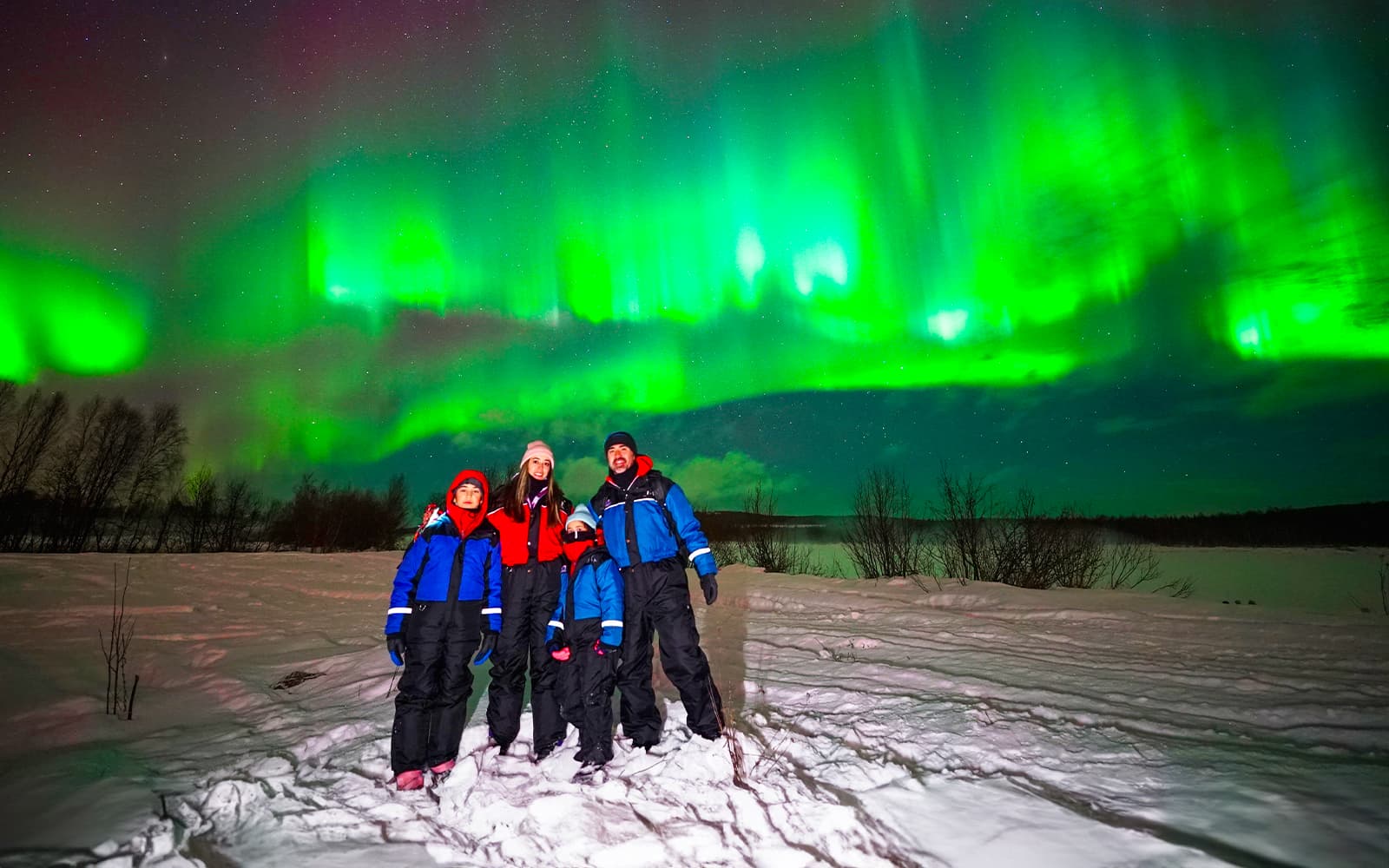
Most tours run three to four hours, timed around the darkest part of the night, with a stop for hot drinks. Thermal outer gear is typically provided.
Before You Book: The Refund Question
Read this before paying. Most Rovaniemi operators offer 100% rescheduling if a tour is cancelled for weather, but no refund for a “no aurora seen” outcome. That’s standard across the market and reasonable — nobody can guarantee a natural phenomenon — but it’s worth understanding rather than discovering afterwards.
The honest operators tell you upfront when a night looks weak and offer to move you rather than running a low-probability chase. That willingness is a better quality signal than any success-rate percentage on a website.
What a Chase Night Looks Like
Pickup from central Rovaniemi in the early evening once it’s fully dark. Your guide checks the latest data and picks a direction, sometimes changing partway through as conditions shift. You’ll typically stop at two or three locations rather than committing to one and hoping.
Between driving and waiting there’s usually a campfire or heated cabin to warm up, and most guides will talk through the science while you wait.
If your schedule allows, staying somewhere with its own dark view — a glass igloo or a cabin outside the city — gives you a backup on nights you’re not on a tour. A complement to a guided chase rather than a replacement, since a fixed location can’t outrun cloud.
Practical Tips
690f9beb17f64d5a193f66c2
Layer properly even if gear is provided. Thermal base layers, wool socks and waterproof boots matter over several hours outside. Standing still at -15°C is a different proposition from walking through it.
Cold kills batteries. Keep spares in an inside pocket.
Bring more memory than you think. RAW aurora files are large.
Use red-light mode on your phone to preserve night vision.
Patience. Some nights the display arrives in minutes. Others you wait two hours for a faint smudge that slowly brightens.
Booking
Give yourself three nights, aim for late February or March, check the moon phase as well as the Kp, and pick a chase tour over a fixed location.
The wider list of things to do in Rovaniemi covers Santa Claus Village, husky sledding and the reindeer farms.
FAQs
What is the best time to see the northern lights in Rovaniemi?
Late February through March offers the best balance — February typically has the least precipitation, and the March equinox lifts activity. The season runs late August to early April, with September’s equinox giving a second peak.
How much does a Rovaniemi northern lights tour cost?
Small-group chase tours generally run €95 to €175 including thermal gear and hotel pickup. The Northern Lights Chase Small Group Tour is USD 115, which sits mid-range for the format. Larger coach tours cost less but chase less effectively.
Is a Rovaniemi northern lights tour expensive?
Mid-range for what it involves — four hours of guided driving, thermal gear, hotel pickup and a guide reading live forecasts. Photography-specialist tours cost more at €170 to €220. Resort base-camp options are cheaper but don’t chase clear skies.
What Kp index do you need in Rovaniemi?
Less than most guides claim. Kp 1–2 gives a faint glow, often visible to a camera before the eye. Kp 3 brings green bands visible unaided. Most visitors see good displays between Kp 2 and 4.
How many nights should I book?
Three or more. Historical data suggests three nights in the Rovaniemi area gives roughly a 92% chance of at least one clear, aurora-visible evening. Average cloud cover across the season is around 60%, so one night is a gamble.
What’s the difference between a chase tour and a location tour?
A location tour stays at one fixed spot, which is fine if the sky is clear and useless if it isn’t. A chase tour drives toward gaps in the cloud using live data, stopping at two or three places.
What time of night is best for the aurora?
Roughly 21:00 to 02:00, with peak intensity often around magnetic midnight — typically 22:30 to 23:30 in Lapland. Most tours are timed around that window, which is why pickups run early in the evening once it’s fully dark.
Can you see the northern lights from Rovaniemi city?
Occasionally during strong displays, but city lights wash out fainter aurora. Driving even twenty minutes out makes a substantial difference, and good tours go forty-five minutes or more to reach a genuinely dark sky away from town.
Will I get a refund if we don’t see the aurora?
Usually not. Most Rovaniemi operators offer full rescheduling if a tour is cancelled for weather, but no refund for a no-sighting outcome. Check the policy before booking — honest operators state it upfront rather than after.
What should I wear on a northern lights tour?
Thermal base layers, wool socks, insulated boots and a warm mid-layer. Most tours provide an outer thermal suit, but what goes underneath is yours. Standing still at -15°C is very different from walking through it.