Paris Catacombs Entrance Guide: Everything You Need to Know
Before you book, please check first. The Catacombs are set to close in November 2025. This is for a major renovation to bring the ossuary back to proper condition. They...
Before you book, please check first. The Catacombs are set to close in November 2025. This is for a major renovation to bring the ossuary back to proper condition. They are expected to reopen in spring 2026. Look at the latest update on catacombes.paris.fr. Do this before you choose a visit date.
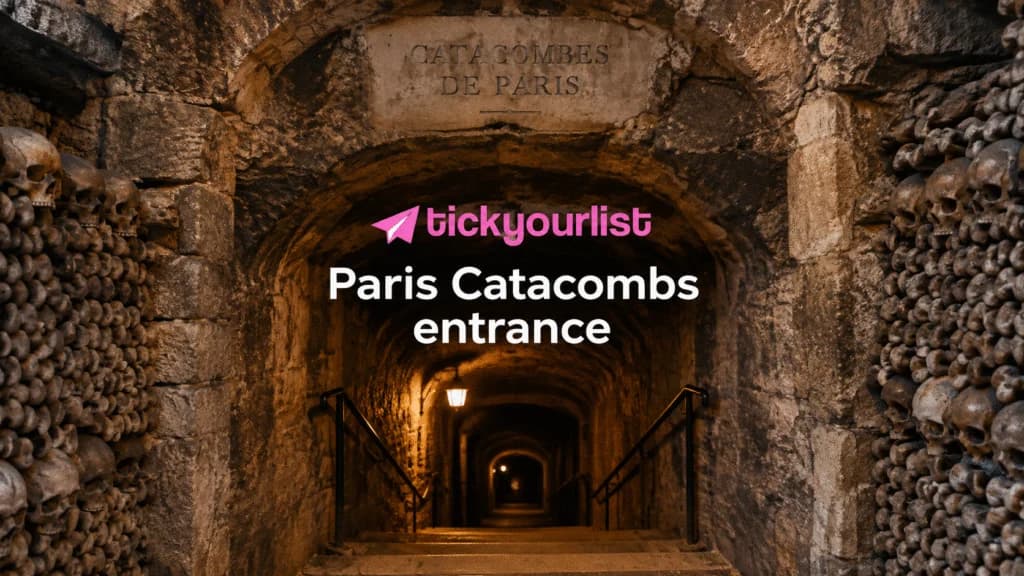
There’s only one door into the Paris Catacombs, and it’s easy to walk straight past. The official entrance sits at 1 Avenue du Colonel Henri Rol-Tanguy, on Place Denfert-Rochereau in the 14th arrondissement, served by metro lines 4 and 6 and RER B.
Everything else here is useful. That address is essential.
Quick Facts
Address
1 Avenue du Colonel Henri Rol-Tanguy, 75014 Paris
Nearest station
Denfert-Rochereau (metro 4 and 6, RER B)
Exit
21 bis Avenue René Coty, about 700 m away
Hours
Tuesday to Sunday, 09:45–20:30, last entry 19:30
Closed
Mondays, 1 January, 1 May, 25 December
Adult ticket
€31, audioguide included
Reduced
€25, audioguide included
Child
€12–15 depending on age band; under-5s free
Steps
131 down, 112 up — 243 total, no lift
Route
1.5 km one way, 45–60 minutes
Temperature
A constant 14°C
Capacity
Around 200 visitors underground at once
Paris Museum Pass
Not valid
Where the Entrance Is
Look for a small green pavilion on the edge of Place Denfert-Rochereau — one of two 18th-century tollhouses designed by Claude-Nicolas Ledoux. From outside it gives nothing away. You’d never guess that 20 metres below sit the remains of over six million Parisians.
By metro, lines 4 or 6 to Denfert-Rochereau, two minutes from the exit. RER B stops there too, useful for arriving from Charles de Gaulle. Buses 38, 59, 68, 92 and N21 all serve the square.
If you’re unsure you’ve got the right spot, find the bronze Lion of Belfort in the middle of the square. The pavilion is just across from it.
The exit is somewhere else entirely — 21 bis Avenue René Coty, roughly 700 metres away on a different street. Don’t arrange to meet anyone back at the entrance. If someone in your group is skipping the tunnels, arrange a meeting point near the exit.
One legal way in. Paris has a subculture of cataphiles who enter unmapped sections of the same quarry network through unofficial openings. That’s an unregulated and genuinely dangerous world with nothing to do with the visitor route. For the ossuary and the bone walls, Denfert-Rochereau is it.
What the Visit Is Actually Like
Past the ticket check, a spiral staircase takes you 131 steps down into tunnels holding a constant 14°C year-round. Bring a light jacket even in August.
You walk roughly 1.5 kilometres one way through old quarry passages before reaching the ossuary. This is the part everyone pictures: floor-to-ceiling walls of skulls and femurs, stacked with deliberate artistry by 19th-century workers who had both a great many remains to organise and some flair for arranging them.
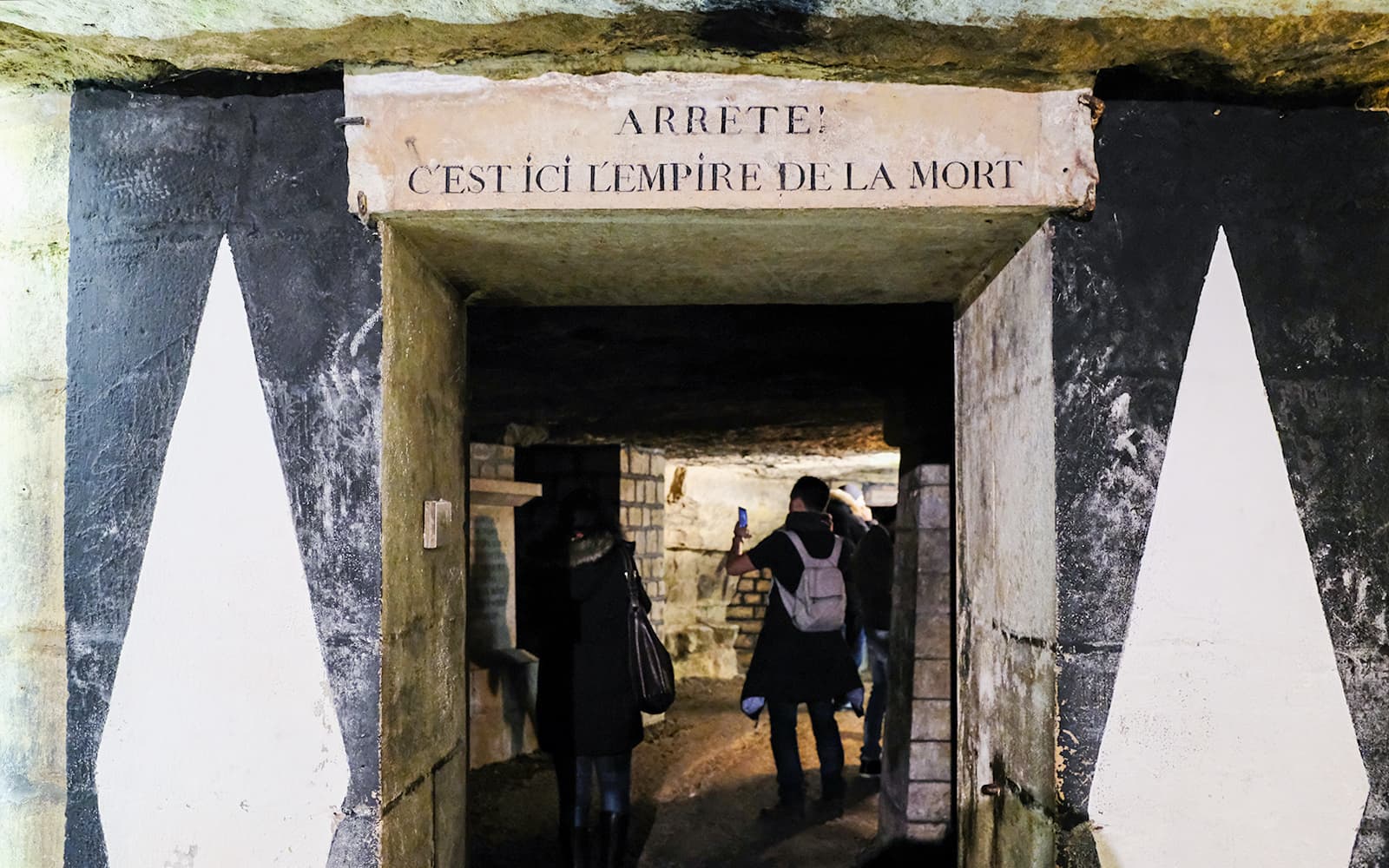
Above the ossuary entrance, carved in stone: Arrête, c’est ici l’empire de la mort — stop, this is the empire of death. Not subtle, and it doesn’t need to be.
Worth slowing down for: carved stone markers showing old quarry sections, a model of the Port-Mahon fortress carved by a quarryman in his spare time, and a well of unusually clear water once used by miners as a level gauge.
Then you climb 112 steps back out. There’s no lift, and the exit staircase is the part people forget to factor in.
Most visitors spend 45 to 60 minutes on the route.
Tickets, Prices and Booking
Official 2026 rates: €31 full, €25 reduced, €12 to €15 for children depending on the age band, free for under-5s. The audioguide is included in full and reduced tickets. It costs €5 separately for those on free or child rates.
The Paris Museum Pass is not valid here. Visitors who’ve bought one often assume it covers the Catacombs. It doesn’t.
Booking is online and timed. Tickets are released on the official site roughly seven days in advance, capacity is capped at around 200 people underground, and current guidance describes walk-up entry as unavailable. Slots sell out quickly in summer.
That changes the usual advice. It isn’t a question of booking ahead to skip a queue — it’s booking ahead because turning up without a slot may leave you with no way in at all.
Third-party sellers and guided tours cost more than the official rate — often considerably more. Be clear about what you’re buying.
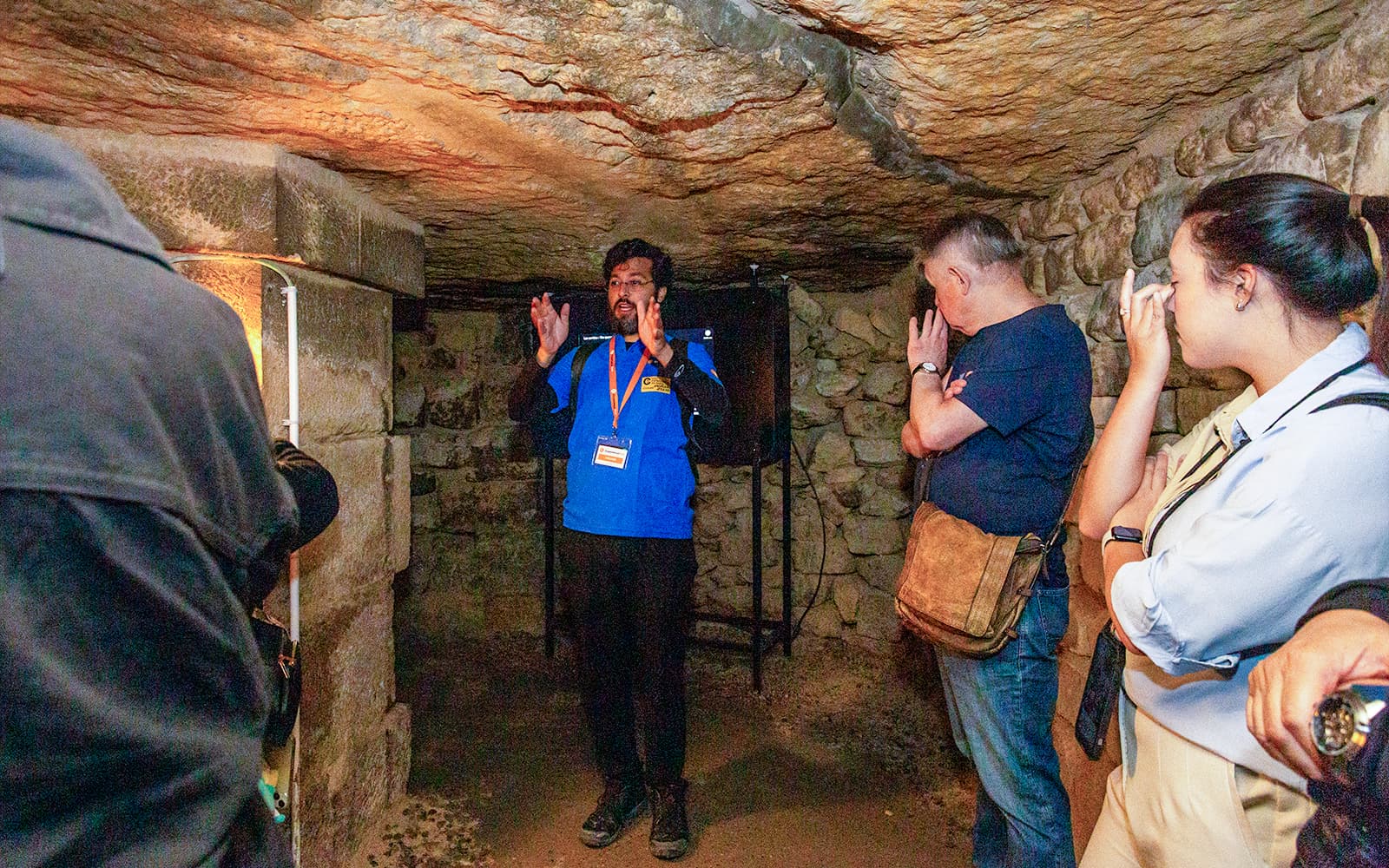
A small-group guided tour with special access is a different product, not a cheaper route in. These visit sections off the standard circuit with a guide, in a capped group, and they’re priced accordingly. Worth it if you want depth, restricted areas and someone to answer questions. Not worth it if you simply want to see the ossuary — the €31 official ticket does that.
What a paid tour does reliably offer is English-language booking and cancellation flexibility the official channel doesn’t. Compare against €31, not against a walk-up price that may no longer exist.
The Audioguide
Since it’s already in your ticket, the question isn’t whether to buy it — it’s whether to use it.
Use it. The tunnels carry almost no signage, so without context a wall of bones is just a wall of bones. The audioguide covers how the ossuary came to exist in the 1780s, who some of its residents are, and what the Latin and French inscriptions mean.
It runs in French, English, Spanish and German, takes about an hour at a comfortable pace, and you can bring your own wired earphones.
The history, briefly
By the 1780s, the central cemetery at Les Innocents was so overcrowded that basement walls in neighbouring buildings had begun collapsing under the weight. The solution was to move millions of bones into disused limestone quarries, under cover of night.
Decades passed before it looked anything like it does now. In 1810 Louis-Étienne Héricart de Thury, head of the Paris Mine Inspectorate, redesigned the ossuary — arranging bones into walls and columns and adding the carved inscriptions along the route. It opened to a wider public in 1874.
Among those said to rest here are Robespierre, Danton, the poet Jean de La Fontaine and, by legend, the Man in the Iron Mask. Treat those as tradition rather than documented fact — remains were transferred in bulk from closed cemeteries, and individual identification largely wasn’t possible.
Practical Notes
Bag limits are strict: maximum 40 × 30 × 20 cm, carried in front or at your side. No large bags or suitcases, and there’s no cloakroom. Travel light or you won’t get in.
Bags are checked twice — entering, to keep prohibited items out, and leaving, largely to ensure nobody departs with a souvenir bone.
Toilets at both ends, which matters given the 700-metre gap between entrance and exit.
Not accessible. Between 243 steps and narrow, uneven passages, the site isn’t suitable for wheelchairs or strollers. Think twice if you’re prone to claustrophobia.
Not recommended under 10, for the subject matter and the walking.
Photography allowed, though tripods and flash are restricted in places.
Comfortable shoes. The stone floors are uneven and damp in patches, and you’re on your feet throughout.
Timing and What’s Nearby
Early slots are noticeably quieter than midday. July and August afternoons fill fastest.
The Musée de la Libération de Paris sits right by the entrance if you want more than the Catacombs from the morning. Rue Daguerre is a few minutes away — a proper local market street with bakeries, useful once the underground chill has worn through.
Driving isn’t worth it. Street parking on the 14th is limited and public transport drops you at the door.
Booking
Make sure the site is open on your travel days. Grab a timed slot online right when tickets go live. Pack light so you can pass the bag check fast.
If you’re building out the rest of the trip, the wider list of things to do in Paris covers the Louvre, the tower and the day trips out to Versailles.
FAQs
Where is the Paris Catacombs entrance?
At 1 Avenue du Colonel Henri Rol-Tanguy on Place Denfert-Rochereau, in the 14th arrondissement. Look for the small green tollhouse pavilion opposite the Lion of Belfort statue. Denfert-Rochereau serves metro lines 4 and 6 plus RER B.
How many entrances to the Paris Catacombs are there?
One legal public entrance, at Place Denfert-Rochereau. The wider quarry network has many unofficial openings used by cataphiles across the city, but those are illegal, unmapped and genuinely dangerous, with no connection to the visitor route.
Is the Paris Catacombs entrance the same as the exit?
No, and this catches people out. You exit at 21 bis Avenue René Coty, roughly 700 metres away on a different street. Don’t arrange to meet anyone back at the entrance pavilion after their visit.
Are the Paris Catacombs open to the public?
Yes, 1.5 kilometres of the network is open on a ticketed circuit. Note the site closed in November 2025 for a major renovation with reopening planned for spring 2026, so confirm current status before booking a date.
How do you get into the Paris Catacombs?
Book a timed slot online — tickets release roughly seven days ahead and capacity is capped near 200 visitors underground. Arrive at Place Denfert-Rochereau for your window, clear the bag check, then descend 131 steps to the tunnels.
How much does the Paris Catacombs cost?
Official 2026 rates are €31 full and €25 reduced, both including the audioguide. Children pay €12 to €15 depending on the age band, and under-5s are free. The Paris Museum Pass isn’t valid here, which surprises many visitors.
Is the Paris Catacombs expensive?
At €31 it’s toward the higher end for a single Paris attraction, though the audioguide is included. Guided small-group tours with special access cost considerably more. If you simply want to see the ossuary, the official ticket is enough.
Is the audioguide included in the Paris Catacombs ticket?
Yes, in full and reduced-rate tickets. It costs €5 separately for visitors on free or child admission. Use it — the tunnels carry almost no signage, so without commentary a wall of bones is just a wall of bones.
How many steps are in the Paris Catacombs?
243 in total — 131 down at the entrance and 112 back up at the exit, with no lift. That climb out is the part most guides forget, and it’s why the site isn’t recommended for limited mobility.
How long does a Paris Catacombs visit take?
Forty-five to sixty minutes on the 1.5-kilometre one-way route, longer if you stop to read the inscriptions. Tunnels hold a constant 14°C year-round, so bring a light jacket even in a Paris August.