Somewhere between the snow-capped peaks and the lake towns that look faintly unreal, Switzerland has a way of making Swiss holidays feel like they were designed for a postcard rather than lived by actual tourists.
And yet millions of people do live it every year, which means booking a trip here isn’t guesswork. There’s a rhythm to it: when to go, how many days you actually need, which train routes are worth building a whole day around, and where your money goes furthest. Let’s get into it.
When Should You Actually Go?

Switzerland doesn’t have a bad season so much as it has different moods. Summer, roughly June through August, is when the country is at its most alive: long daylight, wildflowers up in the meadows, and every mountain railway running at full tilt. It’s also when everyone else has the same idea, so Zermatt and the Jungfrau region work out fast.
If you can be flexible, September quietly wins. Hotel prices tend to drop noticeably from August levels, the crowds thin out, and the weather usually holds steady well into the month, with most cable cars and cogwheel trains still running before their maintenance closures in October. It’s the month locals will tell you to visit, if you can get them to admit it.
Then there’s winter, December through March, which is a different trip entirely. Ski towns like St. Moritz and Verbier come alive, Christmas markets pop up in Zurich and Montreux, and even non-skiers get something out of it: thermal baths, sledding, snow-dusted old towns. Winter vacations here really do earn the hype.
So, How Many Days Do You Need?

This is the question almost nobody answers directly, so here it is straight: it depends on how much ground you want to cover, but there are some reliable benchmarks.
3 to 4 days works if you pick one region and stay there. Zurich paired with Lucerne, or Interlaken with a single mountain excursion, is realistic without feeling rushed.
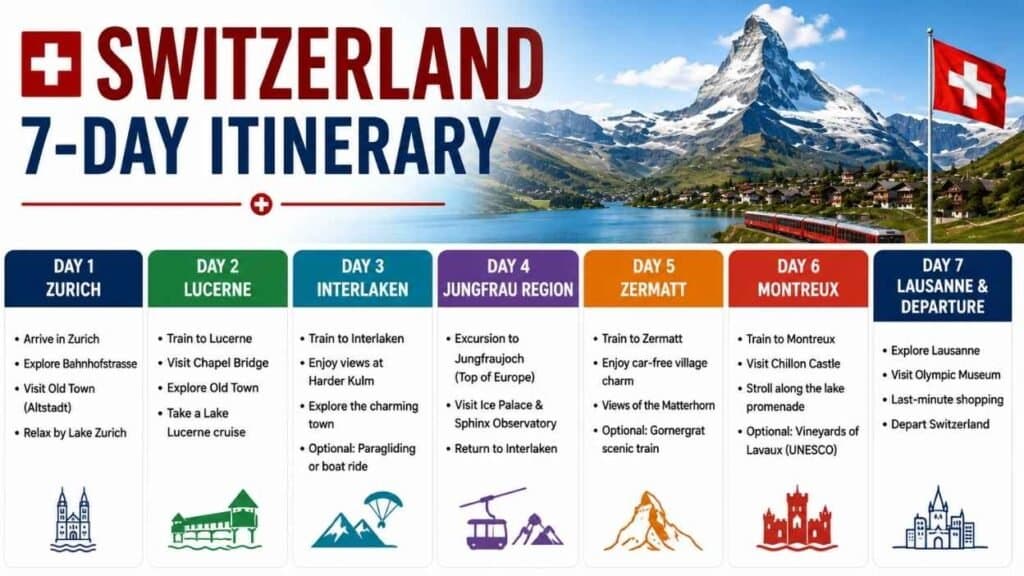
5 to 7 days is the sweet spot most first-timers land on. Two or three home bases, a couple of mountain excursions, and a mix of city time and nature. This is genuinely the most common length for a first Switzerland trip, and for good reason.
8 to 14 days lets you go further: the main regions, several scenic train rides, and time to wander into less-visited valleys instead of only hitting the famous stops.
Anything beyond that starts to feel less like sightseeing and more like actually living there for a while, which honestly isn’t a bad way to do it either.
Alps Tours Worth Building Your Trip Around

The Alps aren’t one experience, they’re several, and which one suits you depends on how much effort you’re willing to put in.
If you want the view without the workout, the mountain railways do it all for you. The Jungfraujoch, nicknamed the “Top of Europe,” takes you above 3,400 metres by cogwheel train, no hiking boots involved.
Near Zermatt, the Gornergrat Railway delivers a front-row seat to the Matterhorn from inside a heated carriage, which feels almost like cheating. Expect around CHF 66 in summer or CHF 48 in winter with a 50% discount applied.
If you’d rather earn the view, multi-day routes like sections of the Swiss Alpine Pass Route put you on foot, overnighting in mountain huts as you go. And if you’re somewhere in between, cable cars up to Schilthorn or Titlis get you to genuine summit views in minutes. This works well if you’re travelling with kids or simply don’t have a week to spare.
You can book most Swiss mountain railways and cable cars in advance, which matters more in summer than people expect. The popular ascents run to timed slots and the good weather windows fill first.
Scenic Trips That Are the Actual Point of the Trip

Ask anyone who’s been to Switzerland what they remember most, and there’s a decent chance it’s the train, not the mountain at the end of it. Swiss rail travel isn’t just how you get around, it’s frequently the main event.
The Glacier Express runs eight hours between Zermatt and St. Moritz, crossing 291 bridges and 91 tunnels along the way, with windows built specifically so you don’t miss any of it.
The Bernina Express does something almost stranger. It climbs to snowy alpine passes and then drops you down near palm trees close to Lake Como, all in one afternoon. The GoldenPass Line, connecting Lucerne and Montreux, cuts through some of the greenest valleys in the country.
One thing the guides gloss over. These don’t need a private tour, but they do need a compulsory seat reservation on top of whatever ticket or pass you’re holding. Peak-season reservations run around CHF 49 and they sell out months ahead, so book the seat before you book anything built around it. A pass gets you on the train; it doesn’t get you a seat.
Which Ticket Actually Works Out Cheaper
| Pass Option | Best For | Coverage | Approx. Price (2nd Class, Adult) |
| Swiss Travel Pass (3-day) | Short trips, city-hopping | Unlimited trains, buses, boats; free entry to 500+ museums | CHF 254 |
| Swiss Travel Pass (8-day) | Longer, multi-region trips | As above | CHF 439 |
| Swiss Half Fare Card | Mountain-heavy or flexible trips | 50% off most train, bus and mountain transport for a month | CHF 150 |
| Point-to-point tickets | One or two specific routes | Single journey only | Varies by route |
For travel from 1 January 2026, Swiss Travel Pass prices rose by roughly 5% on average, and the Half Fare Card jumped from CHF 120 to CHF 150 — a 25% rise.
Standard point-to-point tickets and day passes stayed flat, so if your trip really only involves one or two big scenic rides, individual tickets can work out cheaper than any pass.
Here’s the part that catches most first-timers. People assume the bigger pass is automatically the better deal on mountains. It usually isn’t.
The Swiss Travel Pass fully covers only three mountains — Rigi, Stanserhorn and Stoos. Everywhere else it gives you 50% off, which is exactly what the Half Fare Card gives you for CHF 150. And on Jungfraujoch, Switzerland’s most famous excursion, the pass gives less: around 25%, against the Half Fare Card’s 50%.
So the honest rule is this. If you’re riding trains nearly every day across multiple regions, the 8-day pass wins. If your trip is built around two or three big mountain excursions with rest days between, the Half Fare Card usually beats it. And sometimes by a lot.
A few discounts worth knowing: travellers under 25 get 30% off pass prices. Children under 6 travel free, and ages 6 to 15 travel free with a parent’s pass using the free Swiss Family Card. There’s also a Flex version of the pass, letting you pick travel days within a month, from around CHF 289 for three days.
One timing note: the Swiss Travel System extended its booking window in September 2026. So, most 2027 dates are already open if you’re planning far ahead.
What Does This Actually Cost?

Here’s a number worth having before you book anything: travellers to Switzerland spend an average of around CHF 280 a day, covering meals, local transport and typical activities, though that swings a lot depending on style.
A backpacker doing hostels and grocery runs will land well under it. Someone in four-star hotels taking every cable car in sight will land well above.
Season matters just as much. Peak summer hotel rates run highest, generally requiring booking three to four months ahead if you want a decent room in a popular town. Shoulder season, April to May or September to October, typically runs 20 to 30% cheaper for the same quality of stay, with weather that’s barely worse.
One easy way to stretch a budget: shop like a local. Switzerland’s two big supermarket chains, Coop and Migros, are everywhere and noticeably cheaper than eating out for every meal, which adds up fast in a country where restaurant prices can be genuinely eye-watering.
Entry Requirements: Do You Need a Visa?

Switzerland is part of the Schengen Area, so many visitors can enter visa-free for short stays depending on nationality. However, others need to apply for a Schengen visa in advance.
Requirements shift depending on where you’re travelling from and how long you’re staying, so check current rules on your government’s travel advisory site a few months before you go, especially if you’re combining Switzerland with other Schengen countries in one trip.
What If It Rains?

It will, eventually, and it doesn’t have to derail anything. Switzerland’s cities are full of backup plans: world-class museums in Zurich and Basel, thermal baths that are honestly better on a grey day, and enough fondue restaurants to make a rainy afternoon feel like the whole point of the trip rather than a setback.
Worth noting that a Swiss Travel Pass covers over 500 museums outright. This is precisely the kind of thing that turns a washed-out day into a good one.
A Few Honest Tips

Skip the rental car if the Alps are your main focus. Trains here are frequent, punctual, and usually more scenic than the roads running alongside them anyway.
Don’t try to see everything. Switzerland looks small on a map, but mountain roads and train connections take real time. Cramming five regions into one week usually means seeing all of them badly.
Look for the quieter cousins. If the famous spots feel overrun in peak season, there are often smaller valleys and villages nearby with the same scenery and a fraction of the foot traffic.
Book the seat before the trip. Scenic train reservations are the constraint that shapes everything else on a Swiss itinerary.
Ready to Plan Your Trip?
Switzerland has a habit of rewarding whoever plans a little ahead. Whether that’s locking in a Glacier Express seat early or picking the right pass for how many days you’re actually travelling.
Once your route is sorted, browse things to do in Switzerland to book the mountain railways, cable cars and scenic train experiences that hold a Swiss holiday together, all in one place, so the only real decision left is which window seat to fight for.
FAQs
How many days do I need for a Switzerland trip?
5-7 days covers the classic first-timer route well: two or three bases, a couple of mountain excursions, and a mix of cities and nature. Three to four works if you stay in one region.
Should I buy a Swiss Travel Pass or the Half Fare Card?
Depends on your pattern. Ride trains nearly every day across regions and the 8-day pass wins. Build the trip around two or three mountain excursions with rest days between, and the CHF 150 Half Fare Card usually beats it.
Does the Swiss Travel Pass cover mountain railways?
Only three outright: Rigi, Stanserhorn and Stoos. Elsewhere it gives 50% off, the same as the Half Fare Card, and on Jungfraujoch it gives around 25% — less than the cheaper card does.
Do I need a seat reservation on the Glacier Express?
Yes, it’s compulsory and costs extra on top of any pass, around CHF 49 in peak season. Reservations sell out months ahead, so book the seat before anything built around it.
What’s the best time for scenic train trips?
Late June through September gives the clearest mountain views. Though September often has fewer crowds for nearly identical scenery and noticeably cheaper hotels.
Is Switzerland expensive to visit?
It can be, averaging around CHF 280 a day, but shoulder-season travel and grocery-store meals bring that down considerably. Under-25s also get 30% off Swiss Travel Pass prices.
How much did Swiss passes go up for 2026?
The Swiss Travel Pass rose around 5% on average, and the Half Fare Card went from CHF 120 to CHF 150, a 25% increase. Point-to-point tickets and day passes stayed unchanged.
Do children need a pass?
Under-6s travel free. Ages 6 to 15 travel free alongside a parent holding a pass, using the free Swiss Family Card, which is worth requesting when you book.
Do I need a visa to visit Switzerland?
It depends on your nationality. Switzerland is in the Schengen Area, so some travellers enter visa-free while others need a Schengen visa arranged beforehand.
When should I book accommodation?
Three to four months ahead for peak summer in popular towns. Shoulder season gives you more room, and boutique properties in Zermatt and the Jungfrau region sell out earliest either way.