Quick Answer
Yes. Isla Holbox is a quaint, sandy car-free island. There are great opportunities to see whale sharks in the Summer, pink flamingos in Spring, bioluminescence in the evening and excellent seafood. However, if you are looking for crystal clear Caribbean blue water or large resorts and a lively atmosphere, you may be left disappointed. 3 days is ideal, and the cleanest beaches can be seen between November and April.
Isla Holbox at a glance
| Fact | Details |
| Location | Northern Yucatán Peninsula, Quintana Roo, Mexico |
| Nearest airport | Cancún (CUN), about 2.5-3 hours to Chiquilá |
| Ferry | Chiquilá to Holbox, 20-25 minutes, about every 30 minutes |
| Best time | Nov to Apr for weather; Jun to mid-Sep for whale sharks |
| Ideal stay | 3-4 nights (2 at a push) |
| Getting around | Walk, bike or golf cart; no cars for visitors |
| Currency | Mexican peso (MXN); carry cash |
| Top experiences | Whale sharks, bioluminescence, three-island boat tour, Punta Mosquito sandbar |
What Is Isla Holbox, and Who Is It For?
Isla Holbox (pronounced hol-bosh) is a narrow island located at the north end of the Yucatán Peninsula. It is part of a protected area (Yum Balam), meaning there are plenty of beautiful ecosystems to explore including mangroves, lagoons and wildlife, including pink flamingos.
The village itself is very small. You can walk around the centre of town in ten minutes. While the atmosphere can be described as ‘luxury with bare feet’, this is because there are lovely boutique hotels, wood-fired pizzas and hammock-laden beach bars. There are no skyscrapers or night-life strips.
Best for:
Couples looking for peace, beautiful beaches and great food. Nature lovers want to spot whale sharks, flamingos and bioluminescent plankton. Or, if you are visiting Cancun, Tulum or Playa Del Carmen, and just want to add a couple of relaxing days into your trip.
If none of these match you, keep reading. We will tell you who it may not be suitable for.
Is Holbox Worth Visiting? The Honest Answer
Sort of. It’s not as blue as you might expect. It is on the gulf coast of the peninsula, rather than on the Caribbean side like Tulum and Cancun. This means that the waters are much calmer, shallower and green. It’s beautiful but just not as blue.
So how does this match your expectations?
| What you want | Does Holbox deliver? | Why |
| Quiet, relaxed beaches | Yes | Wide, empty sand and shallow, calm water |
| Wildlife | Yes | Whale sharks, flamingos, dolphins, glowing plankton |
| Good food | Yes | Fresh seafood, lobster pizza, decent coffee for a village this size |
| Clear Caribbean blue | Not really | The Gulf is greener and can look cloudy after wind |
| Nightlife | Limited | Beach bars and live music, no clubs |
| Budget travel | Partly | Hostels exist, but food and rooms cost more than on the mainland |
| Easy access | Moderate | A 2.5-3 hour transfer, then a ferry |
What we like
Generally very peaceful. There aren’t too many cars or large hotels. The nights give a great view of the stars. It is a rare location to be able to go swimming with whale sharks during Summer and spot flamingos in Spring. The whole village is easily walkable, or can be cycled / golf carted around. Two nights is sufficient but 3-4 nights is preferable.
What gives us pause
Sargasso can be an issue. While less common than in the Caribbean Coast, seaweed can be seen (most commonly in Summer). Mosquito problems are rife between June and August. Prices for accommodation and food are quite high as everything must be transported by boat.
Ferries and tours may be cancelled very short notice due to bad weather/storms/hurricane season. If timing your trip to match the island’s schedule then this is one of the most enjoyable places to visit in this region of Mexico.
How to Get to Isla Holbox
Ferry services from Chiquilá port. It is most common to arrive at Cancun airport (CUN). Chiquilá is approximately 150-160km away from the airport and takes between 2.5-3 hours to reach via car. Once you arrive in Cancun, head to Chiquilá and catch the ferry.
Two companies operate the services, Holbox Express (red boats) and 9 Hermanos (blue boats). These are very similar in terms of service quality. When arriving in Holbox, a ‘golf buggy’ provided by your hotel should be able to take your bags to your accommodation.
Cancún to Chiquilá: your options
| Option | Best for | Notes |
| Private transfer | Families, late arrivals, lots of luggage | Door to pier, most flexible, highest price |
| Shared shuttle | Couples, solo travellers | Door to door from Cancún, Playa del Carmen and Tulum |
| ADO bus | Budget travellers | Runs from Cancún bus station and airport on fixed times |
| Rental car | Road-trippers | Parking in Chiquilá runs about 150-250 MXN per 24 hours |
The ferry, as of early 2026
Shuttles run approximately every half an hour. In the low season only once an hour may be available. If coming from Chiquilá, the first shuttle runs at ~6am and last at 9.30pm. If coming from Holbox, they run between ~5am and 8.30pm.
Adult tickets are roughly 330 MXN (~US$15-18). Children under 120cm will be cheaper and children under 2 travel for free. Prices and times do change unexpectedly so checking a day or two before is recommended.
Try to get into Chiquilá by early evening. Due to winds and possible rain delays, missing the last ferry due to a late bus could mean you sleep in Chiquilá.
By arranging transport to the airport in advance, you can remove some stress from the trip.
Best Time to Visit Holbox
The best time to visit for fine weather and clear beaches is from November to April. If you want to see whale sharks try visiting between June and mid September. If you are happy to visit for less busy conditions with calmer seas late November and early December can be very pleasant.
| Window | Weather and sea | Wildlife and activities | Crowds and prices |
| Nov to Apr (dry season) | Highs from high 20s to low 30s °C, low humidity, few mosquitoes; northern winds (“nortes”) Nov to Feb | Flamingos peak around Mar to May; kitesurfing runs about Nov to May | Busy at Christmas, New Year and Easter; moderate otherwise |
| May to Oct (green season) | 31-33 °C, humid, afternoon storms, more mosquitoes | Whale sharks, glowing night water | Peak in Jul and Aug; quieter and cheaper in Sep and Oct |
| Jun to Sep | Highest sargassum risk, hurricane season builds (late Aug to Oct) | Whale shark season peaks Jul to Aug | Book tours 3-4 weeks ahead in July |
A few timing details
Whale Sharks can be seen between June and mid September (Best in July and August). Bioluminescence can be seen between June to October, but the best conditions are on very dark nights (no moonlight). Please check the moon calendar.
Sargassum is best avoided between December to April. It is worst between June to September, with 2026 appearing to be a high year. The hurricane season runs from June 1st to November 30th. It tends to be at its worst between late August to October. Mosquitoes are at worst between June to August, and best between November to March.
In summary, if looking to see Whale Sharks then July/August would be best. If wishing to enjoy beaches, late November, February or March would be best. To save money, October and early November would be best to avoid peak holiday times. If you go kitesurfing, December to February would be best.
Holbox Mexico Beaches: Where to Swim, Walk and Watch Sunsets
Shallow waters make this great for families. You can easily wade out a long way into the water (up to knee-deep). The sea is very warm and tranquil. Depending on the wind, tides and time of year, the sea can be a pale blue or green.
| Beach | Best for | Worth knowing |
| Playa Holbox (town beach) | Beach clubs, easy access | The most exposed to sargassum when the wind shifts |
| Punta Coco (west) | Sunset, sandbars, bioluminescence at night | More sheltered; reported clear when the town beach wasn’t |
| Punta Mosquito (east) | Quiet, birds, flamingo spotting | A long way from town; go by bike or golf cart with water and shade |
| Isla Pasión | Sandbar picnic, shallow swimming | Short boat ride, often bundled into a bird-island tour |
Be sure to check the weather. Sargassum tends to come around after a change in wind direction, but won’t show up in southerly winds. Try to visit early in the morning or at the end of day.
The midday sun is very intense and shade is scarce outside of towns. Be sure to use reef safe sun cream. As the whole island is a protected reserve, try to give nesting sites and wildlife some space.
If you insist on crystal clear Caribbean waters, combine Holbox with a few days in Tulum or Isla Mujeres.
Things to Do in Isla Holbox
The best things to do in Isla Holbox are boat tours, wildlife and doing very little on a beach. Book the popular tours ahead, because whale shark trips can sell out weeks early in July and August.
Swim with whale sharks (June to mid-September)
Whale sharks come to feed in the waters offshore. Tours can be taken from the marina of Holbox. The tours last a full day (approx 8am to 4pm), with provision of boats, snorkelling equipment, lifejacket and lunch.
Prices range between 2500-3000MXN (roughly $125-$150). The number of people on board will vary between 6 to 12 people. Only 2 swimmers will be in the water with each shark at once. Choose an operator who will enforce the guidelines of no touching, no flashes and no chasing.
Glowing water at night
For some magical bioluminescent plankton action, head out on a guided Kayak/Snorkelling adventure or visit a dark stretch of coastline, such as Punta Coco, with a guide. The best times for this are between June and October.
The three-island boat tour
Isla Pájaros, Yalahau (freshwater lagoon) and Isla Pasión can be visited on a half day tour. The best time to see flamingos is between March and May. Don’t forget a hat, insect repellent and waterproof phone cover.
Punta Mosquito at low tide
A long, shallow sandbar stretches out into the sea here. It’s quiet, photogenic and good for birdwatching, so check tide times before you set off.
Wind and water sports
The shallow, warm water makes Holbox a friendly place for beginner kitesurfers and paddleboarders. Kite season runs roughly November to May and peaks from December to February.
Smaller pleasures
You can go horse riding along the beach in the late afternoon (check group sizes and horse care). Take your time exploring the wall art around the village and sample some local dishes such as seafood tacos or lobster pizza.
Some whale shark trips will include a stop at Cabo Catoche and Ixlaché on the mainland point. This part of the mainland is very beautiful with the wetlands and white sandy beaches. Make it a long day out.
Holbox Itinerary: 3 Days on the Island
3 days is ideal, 1 day to get there, 1 day doing larger tours/boat trips, and 1 relaxing day at the beach. If short on time just do the first 2 days. If it’s only 1 night there, take an early ferry and do a sunset tour to Punta Coco, then a bioluminescence tour. Depart the next day.
Day 1: Arrive and unwind
Catch an early bus to the village. Take the ferry across. Head around the village to find some murals. Eat some local seafood. Later in the afternoon, rent bikes or golf buggies and head west to Punta Coco for sunset. In the evening take a bioluminescence tour (only possible between June and October, and when it is moonless) or just relax on the beach and enjoy stargazing.
Day 2: Wildlife day
- Whale shark tours (8am-4pm) are available between June and mid-September.
- Three islands trip (flamingo, bird island and Yalahau spring) at all other times.
- In the evening enjoy wood oven pizzas and some live music at a beach bar.
Day 3: Beach and a slow goodbye
You can visit the sandbar and birdlife at low tide. Have a bite to eat in the village. If you still have energy left, head out on stand-up paddling, learn kite surfing, or relax with some time at the spa. Be careful, however, with leaving the island.
The last ferries to Holbox leave at around 8.30pm. Only take an evening ferry if you are set up to move on. Leave a bit of spare time on your first and last day of your trip. The ferry and excursions may be affected by weather and it’s more enjoyable to not rush around on the island.
Holbox Travel Planning: Getting Around, Costs and Safety
Getting around
There are no cars for visitors, so people walk, cycle or hire a golf cart. A cart is handy for Punta Mosquito and Punta Coco, though the sandy roads flood after heavy rain, so expect puddles in the wet season.
Where to stay
This is ideal for first time visitors, with many cafés and restaurants nearby. If you head east, along the beach, there is more tranquillity, broader sandy beaches and boutique hotels. On the Punta Coco side you can enjoy great sunset views in a very private setting.
Prices for average (3/4 star) hotels (excluding tax) are around US$94-US$103 in late October, increasing to US$120 in September. Prices will be higher over Christmas, July and August. More basic accommodation can be found at cheaper prices, starting from around US$68.
Please be aware that these are very rough prices and change quite a lot.
Where to eat
Try local seafood – there’s plenty of fresh fish, prawns, octopus and the famous lobster pizzas. Some restaurants close once a week, and many have an early closing time. Be sure to check times. Most small places will not take cards so bring Pesos.
How much does Holbox cost?
These are rough per-person daily budgets, excluding flights, and they’re our own estimates rather than quotes.
| Style | Approx. per day (USD) | Typical spend |
| Budget | 80-120 | Hostel or simple room, street food, walking |
| Mid-range | 150-250 | Boutique hotel, cafes, one tour |
| Luxury | 300+ | Beachfront suite, private tours, spa |
A few fixed costs to keep in mind: the ferry was about 330 MXN for adults at the latest published fare, and a whale shark day costs roughly 2,500-3,000 MXN.
Is Holbox safe?
Holbox is generally very calm compared to the rest of Quintana Roo. As with anywhere in the world, take care of your valuables on the beach. Always take official transport from the beach and keep money safe. Please check the current government advisory for Quintana Roo.
How many days do you need?
Two nights is the minimum and three or four is ideal. Add a day if you want a whale shark tour plus some slack for weather.
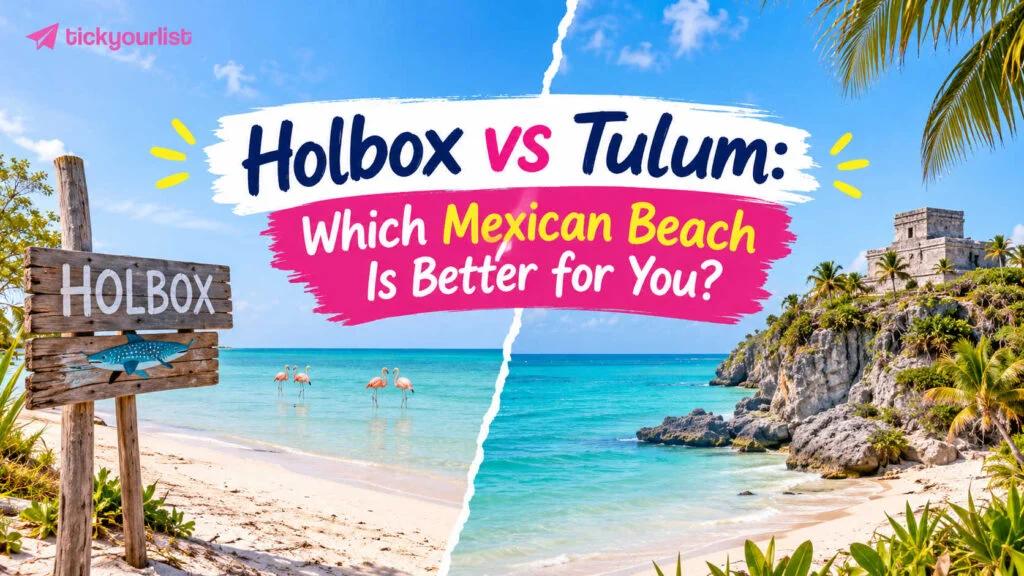
Holbox vs Tulum, Isla Mujeres and Cancún
| Holbox | Isla Mujeres | Tulum | Cancún | |
| Vibe | Quiet, barefoot, rustic | Relaxed, easier access | Trendy, ruins and cenotes | Resorts, nightlife |
| Water colour | Green-turquoise, calm | Clear turquoise | Clear Caribbean blue | Clear Caribbean blue |
| Access | Ferry from Chiquilá | Short ferry from Cancún | Road | Airport hub |
| Best for | Wildlife and slow travel | Comfort and snorkelling | Culture and beach clubs | Convenience |
Who Should Skip Holbox, and a Few Tips Before You Go
If you’re looking for everything included, clear turquoise waters, lively nightlife and easily transportable, then Playa del Carmen, Tulum and Isla Mujeres may be better for you.
For everyone else:
- To maximise your experience, consider:
- Pick the right time of year. Whale sharks pick summer. For calmer cleaner beaches, pick between December to April.
- Book whale shark and evening excursions well in advance; they get very busy in July and August.
- Check the lunar phase.
- Bring Pesos. Many small places still only take cash.
- Spray for bugs and reef safe sun cream. Between June and August you will want this.
- Packing light is best. The sandy roads and golf cars do not work well with heavy cases.
- Double check ferry times one or two days in advance and allow some weather contingency in your return flight.
Final Verdict: Is Holbox Worth Visiting?
If you are wanting a very natural, peaceful place to visit with great food, Holbox is perfect. The best time to visit spotless beaches is from November to April. For whale shark spotting, the best time is June to mid-September.
We recommend spending 3 nights here. Be sure to book boat tours in advance and arrange transfers from Cancún.
FAQs
Is Holbox worth visiting?
Yes, a peaceful island with lots of wildlife, great seafood and gentle shallow waters. Not ideal if you are looking for crystal clear Caribbean seas, large resorts or a vibrant nightlife.
How do I get to Isla Holbox?
Fly into Cancún, then take a shuttle, bus or private transfer to Chiquilá, about 2.5 to 3 hours. From there, a 20-25 minute ferry runs to Holbox roughly every 30 minutes.
What is the best time to visit Holbox?
Least amount of sargassum and dry conditions from November to April. Whale sharks can be seen between June and mid September, however it is very hot, busy and buggy during July and August.
When is whale shark season in Holbox?
Roughly June to mid-September, peaking in July and August. Exact start and end dates change from year to year, so confirm with your tour operator before you book.
How many days do you need in Holbox?
Two nights is the minimum, but three or four is better. That gives you time for a boat tour, a couple of beach days, a night activity and a buffer for bad weather.
Does Holbox have sargassum?
Less often than on the Caribbean coastline, but still occasionally (between June and September), seaweed can be a problem. For the cleanest beaches, visit between December to April.
Is Holbox expensive?
Prices are higher than on the mainland but it can still be cheap. Budget prices range from US$80-120 per person per day (without airfares) and mid-range prices from US$150-250. Boat tours can get expensive.
Are there cars on Holbox, and do I need cash?
You will need to walk, cycle or hire golf buggies. It is a good idea to have Mexican Pesos to hand as some small stores, and many ATMs, may be short of cash.
What should I pack for Holbox?
Pack light clothes, reef-safe sunscreen, bug spray, a hat, water shoes and a dry bag. A soft bag is easier than a hard suitcase on sandy streets.