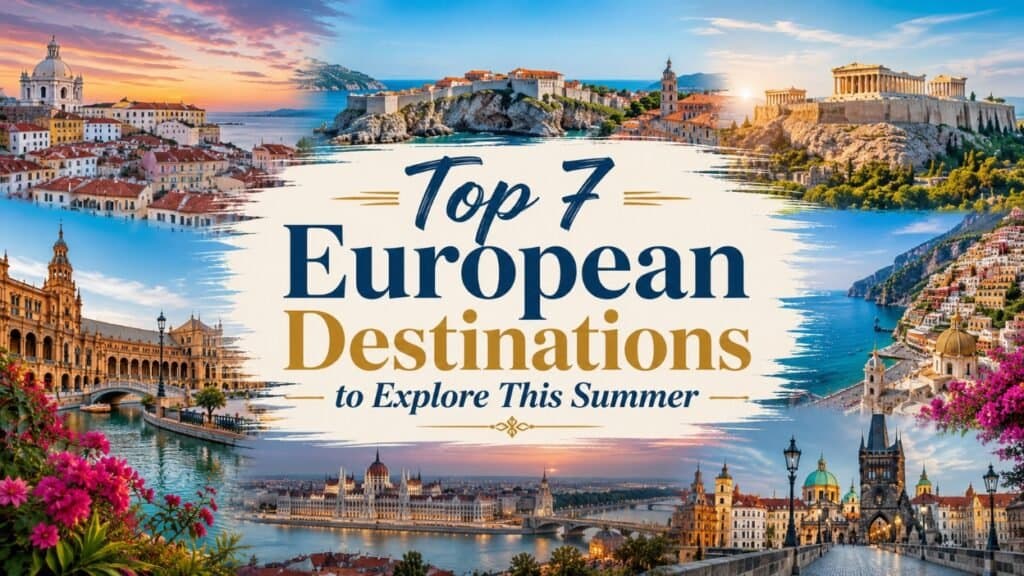
Choosing between European destinations is genuinely hard. Not because the options are bad — quite the opposite. Every city you shortlist has something that makes you think, yes, maybe that one. Ancient ruins in one tab, a Michelin-starred restaurant in another, coastal cliffs in a third. At some point you just have to commit.
We have done a lot of the narrowing down for you. At TickYourList, we spend our time connecting travellers with experiences that actually stick — the kind you are still describing to people six months later. So this list isn’t pulled from a generic travel index.
It’s built around places that deliver: on culture, on food, on the feeling of being somewhere that genuinely surprises you. Seven destinations. All worth it. Here’s where to go this summer.
1. Lisbon, Portugal — The Most Affordable European Destination

Lisbon keeps showing up on best-of lists, and it’s not hype. The city sits on seven hills above the Tagus River, all terracotta rooftops and mosaic pavements and that particular late-afternoon light that makes everything look slightly more beautiful than it has any right to.
It’s the kind of place you land in and immediately start calculating how long you could stay. What sets Lisbon apart as one of the most affordable European destinations is what you get for what you spend. The full package — remarkable food, natural wine poured generously, architecture that belongs in a film — at prices that genuinely surprise people used to Paris or Amsterdam.
A glass of vinho verde on a tiled rooftop costs less than coffee in London. A pastel de nata from a corner bakery costs almost nothing at all. Go to Alfama for the fado bars and impossible staircases. Take Tram 28 at least once (yes, it’s touristy — it’s also wonderful). Do the day trip to Sintra.
Wander the LX Factory on a Sunday when the market is running and the whole city seems to be there. Lisbon rewards slow walking and no particular agenda.
Pro tip: A guided Fado evening in one of the older Alfama venues is worth booking ahead — the difference between a tourist-facing show and an authentic one is significant.
2. Dubrovnik, Croatia — Yes, It Really Does Look Like That

Some places are overphotographed to the point where seeing them in real life feels slightly anticlimactic. Dubrovnik is not one of those places. Walk the old city walls at golden hour with the Adriatic below you and the terracotta rooftops spreading out in every direction, and you’ll find yourself thinking: so this is what all the fuss is about.
As one of the best European holiday destinations for anyone who wants history, swimming, and genuinely excellent seafood all in one place, Dubrovnik earns its reputation. The Old Town is UNESCO-listed for good reason — the limestone streets are extraordinary, the baroque churches are beautiful, and the restaurants tucked into courtyard spaces make it very easy to lose an afternoon.
Yes, it gets crowded in peak summer. Go early in the morning or after 7pm and you’ll find a different, quieter city. Cable car up Mount Srd for the view. Boat to Lokrum for the swimming. Kayak around the walls for the perspective you won’t get any other way — the city from the water is something else.
Pro tip: A sea kayaking and snorkelling tour around the city walls gives you a perspective of Dubrovnik that most visitors never see.
3. Seville, Spain — Hot, Yes. Worth It, Absolutely

Seville in summer gets a bad reputation for the heat, and look — it is hot. But it’s also when the city is most fully itself. Sevillanos don’t fight the temperature; they work around it. Lunch at two, a long afternoon rest, and then back out again after dark when the streets cool slightly and the whole city seems to exhale.
The evening paseo isn’t a tourist activity. It’s just how life works here. This is one of those European destinations where the atmosphere is the attraction as much as any individual sight. The Real Alcazar gardens in the shade of late morning. The Santa Cruz quarter’s warren of whitewashed alleys.
The Giralda tower at sunset. And then the food — Seville is one of the last places in Spain where tapas still come free with a drink, which makes it genuinely one of the more affordable European destinations for anyone who eats their way through a city.
The flamenco here is the real thing too — not a show put on for visitors, but a deeply local art form that has its home in Andalusia. Seeing it performed properly in an intimate space is one of those travel experiences that shifts something in you.
Pro tip: Seek out a private tablao experience that feels nothing like the tourist circuit — the kind of evening people write home about.
4. Athens, Greece — Ancient History, Modern Energy

People tend to use Athens as a jumping-off point for the islands. It’s an understandable instinct, but spending even three days in the city itself is one of the better travel decisions you can make. This is a place where the ancient and the contemporary sit right next to each other without any awkwardness.
You can have breakfast in a neighbourhood spot, walk to one of the most significant historical sites on the planet, and watch the sun drop behind the Parthenon from a rooftop bar before dinner. For anyone asking where is the cheapest European holiday destination without wanting to sacrifice quality, Athens is the honest answer.
Additionally, accomodation costs a fraction of what you’d pay in comparable Western European cities. Food is exceptional and inexpensive. The public transport works. And the cultural depth — museums, ancient sites, contemporary art — is world-class. Book your Acropolis tickets in advance and arrive at opening time.
Spend an afternoon in the National Archaeological Museum, which is far better than it’s given credit for. Get lost in Monastiraki. Eat in Psiri after dark. Athens has a way of revealing itself gradually, and the more time you give it, the more it gives back.
Pro tip: A street food tour through the neighbourhoods is one of the best introductions to the city — faster than a walking history tour and significantly more delicious.
5. Prague, Czech Republic — More Than the Postcard

Prague photographs so well it can feel almost unreal — like a set rather than a city. But spend more than a day here and you realise there’s genuine life underneath the medieval scenery. Jazz bars in basement spaces. Independent coffee shops that take the craft seriously.
A neighbourhood like Zizkov that has almost nothing to do with tourism and everything to do with how Prague actually lives. It’s among the best European destinations for the traveller who wants visual impact without the Western European price tag. The Charles Bridge at dawn is one of those sights that earns every cliche written about it.
Moreover, the castle district has a scale and grandeur that takes most people by surprise. And everywhere in between — the Old Town Square, the Jewish Quarter, the river at dusk is consistently, almost unfairly beautiful. As an affordable European destination, Prague is hard to overstate.
Excellent beer, proper food, museum entry, craft markets — the value is real, and it doesn’t feel like a trade-off. You get the full experience at roughly half the cost of equivalent cities further west.
Pro tip: A specialist-guided walk through the Jewish Quarter is quietly one of the most affecting historical experiences in all of Europe. Worth every minute.
6. The Amalfi Coast, Italy — One of the Best European Holiday Destinations

You have seen the photographs. Cliffs dropping straight into water so blue it looks edited. Pastel houses stacked on gradients that shouldn’t technically be habitable. Also, lemon trees somehow grow in the heat. The Amalfi Coast is one of those places that exists in your imagination long before you visit — and then you get there and it’s actually better than the pictures, which almost never happens.
It makes the list of best European holiday destinations not just for the scenery but for the complete experience: food that reflects the landscape (fresh seafood, local lemons, handmade pasta), villages with distinct characters, and that particularly Italian talent for making a slow afternoon feel like the most natural thing in the world.
Positano is the obvious base, but Praiano is quieter if you want fewer people, and Ravello — up in the hills above the water — has a stillness that’s almost meditative. The coast rewards water-level exploration. Seeing it from a boat — stopping at sea caves, pulling into small beaches inaccessible by road is a different experience entirely from driving the corniche road, however spectacular that is.
Pro tip: A private boat tour along the coast genuinely reframes how you see the whole place — sea caves, hidden beaches, and the town of Amalfi itself all look completely different from the water.
7. Budapest, Hungary — Grand, Strange, and Impossible to Forget

Budapest has a way of catching people off guard. They arrive expecting a pleasant central European city break and leave genuinely astonished. The scale of the place does it — the Hungarian Parliament alone, lit up on the Danube bank at night, is one of the most jaw-dropping pieces of architecture in Europe.
Then there’s the thermal bath culture, the ruins bar scene in the old Jewish Quarter, the food market at the Great Market Hall, the views from Castle Hill. Budapest doesn’t do things quietly. The thermal baths deserve special mention. The Szechenyi and Gellert bathhouses aren’t just nice places to relax — they’re extraordinary buildings, ornate and vast, the kind of spaces that make you feel like you’ve stumbled into something that exists in a different era.
Spending an afternoon in one is less like visiting a spa and more like visiting a cathedral that happens to be full of warm water. For the value question: where is the cheapest European holiday destination that still gives you quality — Budapest is where experienced travellers keep landing. Western European cultural richness, Central European pricing. It’s a combination that’s hard to find and even harder to argue with.
TickYourList tip: Pairing a thermal bath experience with a private evening cruise on the Danube makes for one of those days that becomes the defining memory of an entire trip.