Every few months, a destination quietly starts showing up everywhere — in travel groups, on reels, in conversations between people who clearly feel like they have discovered something. Mleiha is that place right now. And unlike most viral travel moments, this one actually holds up.
The UAE desert safari scene has been running the same playbook for years: Land Cruiser, dunes, camp dinner, fire show, repeat. There is nothing wrong with it, but there’s also nothing new. Mleiha is different — not because it’s trying to be, but because the place itself is just genuinely, uncomplicatedly special.
If you have been on the fence, this guide will help you figure out whether it’s worth the trip (it is) and what to do once you get there.
What Makes the Mleiha Desert Actually Different?

Most desert safaris in the UAE follow a formula. You get collected from your hotel, dune bash for a while, eat in a big Bedouin-style camp with fifty other tourists, and head back to the city. Fun? Sure. Memorable? Less so. Mleiha doesn’t really care about that formula.
About 65 km southeast of Sharjah, Mleiha National Park sits inside a UNESCO-nominated landscape stretching over 85 square kilometres of raw, untouched desert. The dunes here are red — not the pale gold you see in Dubai — and the terrain shifts in a way that keeps surprising you. But the real story isn’t the scenery. It’s what’s been buried beneath it.
This region has been inhabited for over 125,000 years. Bronze Age tombs, ancient fort ruins, and marine fossils that are 80 million years old are all here, sitting under those red dunes. Which means when you are out there dune bashing or watching the sunset, you’re on top of one of the oldest inhabited landscapes on the planet. That’s a different kind of desert experience.
Getting There: The Maliha Road Route

The main road into Mleiha is the Maliha Road — also written as Maleha Road — officially the E55, or Al Dhaih Maleha Road. From Dubai, you’ll take the E44 Dubai-Hatta Road and exit at Al Ghareef Square onto the E55. From central Sharjah, it’s the E102 Sharjah-Kalba Road, then off at E55 near the Mleiha mosque. Once you are on the Maliha road desert stretch, the exit for the Mleiha Archaeological Centre is only a couple of minutes ahead on your right.
Door-to-door, expect about 45 minutes from Dubai or 30 minutes from central Sharjah in normal traffic. If you are not driving yourself, most safari operators run hotel transfers from across Dubai, Sharjah, and Ajman — so the route becomes someone else’s problem entirely.
One thing worth knowing: the E55 signage is fine, but first-time visitors sometimes blow past the final turn. Use Google Maps or Waze and search “Mleiha Archaeological Centre” — it will get you there cleanly. Just ease off the speed once you are on the Maliha road desert section and keep an eye on your right.
What’s Actually on Offer in 2026?

The activity lineup at Mleiha has grown a lot, and that’s been a good thing. Here is what you can do:
Dune Buggy Rides and Dune Bashing
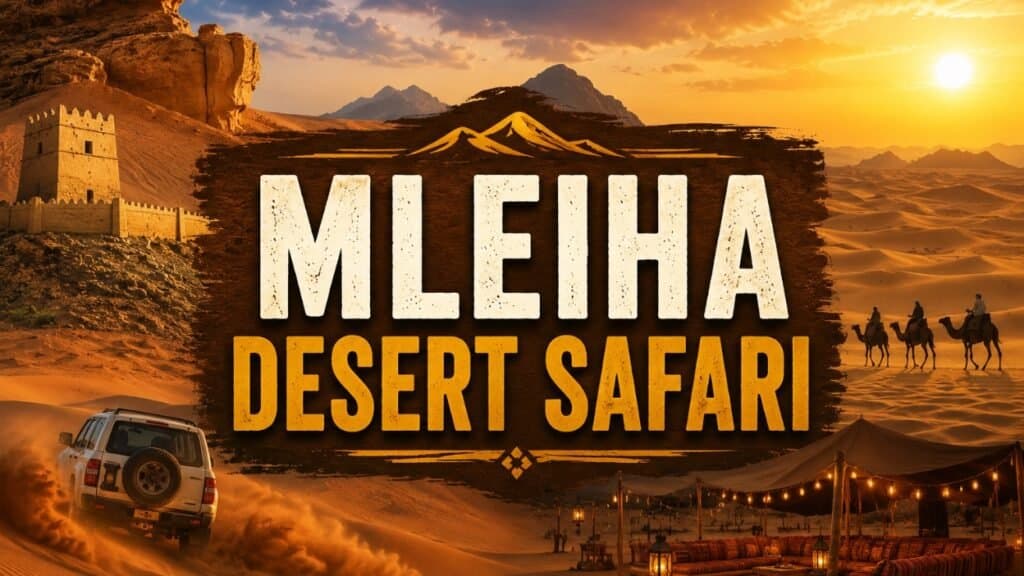
This is the one that gets people. You can either ride shotgun with a trained guide in a 4×4, or take the wheel of a dune buggy yourself. The buggies are automatic and genuinely easy to pick up — the safety briefing takes about ten minutes and then you are out on the red dunes. Most packages include stops at Fossil Rock and Camel Rock, two landmarks that are worth lingering at even if you’re not a “stop for photos” person.
Fossil Rock and the Archaeological Sites
The Mleiha Archaeological Centre is one of those places that surprises you. People arrive expecting a small museum and leave having spent an hour longer than planned. There are Neolithic-era artifacts, Bronze Age tombs, ancient forts, and exhibits that put the region’s history into real context. Even if history museums aren’t normally your thing, this one has a way of pulling you in.
Sandboarding, Camel Rides, and the Classic Desert Stuff
It’s all here — sandboarding, camel rides, henna, the Arabic robe photos. These usually happen in the last golden hour before sunset, which at Mleiha has a quality that’s hard to describe until you see it. Open desert, no city glows on the horizon, and that deep amber light settles across the red dunes. It photographs beautifully, but honestly it looks even better in person.
Maliha Desert Camping and Glamping
This is the biggest shift for 2026. Maliha desert camping used to mean roughing it in a basic setup. Not anymore. The park now runs proper glamping tents — real bedding, proper comfort, private setups among the dunes. Waking up in the Mleiha desert before anyone else is moving is a completely different experience from a city hotel, and the night skies out here, with no light pollution for miles, are extraordinary.
Some packages include guided constellation sessions, and on certain evenings, planetary viewing events run from the park’s panoramic lounge.
Motorbikes, Quad Bikes, and Paragliding
For people who want to push it further: guided dirt bike sessions, quad trails, and paragliding from the highest dune peaks. Packages cover different experience levels, so you don’t need to show up as a seasoned rider — though it helps to be comfortable with a bit of adrenaline.
Stargazing
Worth mentioning separately, because it’s become a genuine draw. The park organises proper stargazing sessions — guided ones, with staff who connect the stars to the ancient civilisations that once navigated by them in this exact landscape. It’s an unexpectedly moving way to end a desert evening.
Morning or Evening — Which Safari Should You Book?

They are genuinely different, and the right answer depends on what you are after.
A morning safari gives you the cooler hours, quieter dunes, and a soft sunrise light that sandboarders and photographers love. You will likely have the desert more to yourself, and most morning packages close out with an Arabic breakfast. It’s a calm, unhurried start to the day.
An evening safari is the more popular choice, and the light alone explains why. In the two hours before sunset, the red dunes go from beautiful to properly dramatic. The warmth of the day eases off, the colours deepen, and the transition from dusk into a fully starlit sky happens gradually over your visit. Most packages end with a traditional Emirati dinner under the open sky.
If it’s one or the other, go for the evening. But if you are overnighting with maliha desert camping, you don’t have to choose.
Before You Go: The Practical Stuff

When to visit: October to April. Evenings are cool, temperatures are comfortable, and overnight maliha desert camping actually feels like a treat rather than an endurance test. Summer months are hot — if you are visiting between June and August, stick to morning safaris and accept that you’ll be sweating.
What to wear: Light, loose clothing in neutral or pale colours. Closed-toe shoes matter — flip flops on a dune buggy or sandboarding slope aren’t fun. Hat, sunglasses, and SPF are non-negotiable at any time of day.
What to bring: A camera, obviously. The golden hour light at Mleiha is some of the best shooting you’ll find in the UAE. If you wear contacts, bring goggles for the dune bashing sections. A light scarf is useful if there’s a breeze kicking up fine sand.
Who can go: Broadly everyone. Buggy rides require a minimum age of 5 with a guardian. Families, couples, solo travellers, and large corporate groups all visit regularly — the park handles groups anywhere from 10 to 200+ people, with custom menus and dedicated facilities.
Booking: Most good operators offer instant confirmation and hotel pickups. Cancellations usually need 24 hours’ notice for a full refund, so don’t book and forget.
Why Mleiha in 2026 — Not Just Another Desert Safari?

Look, the UAE has no shortage of desert experiences. There are dozens of operators running polished, professional evenings out of Dubai and they mostly deliver what they promise. But Mleiha sits in a different category, and it’s not just about marketing.
Standing at Fossil Rock with 80-million-year-old marine fossils at your feet, on terrain humans first walked 125,000 years ago, looking up at a sky that hasn’t changed in all that time — that’s not an “experience” in the packaged sense. It’s the real thing.
The Mleiha Archaeological Centre is a UNESCO World Heritage candidate site. The park’s development has been careful — more activities, yes, but nothing that feels like it’s been dropped onto the landscape from somewhere else. Maliha desert camping now means genuinely sleeping inside that history, not driving past it on the way back to the city.
Some travel experiences leave you with a good photo. Mleiha tends to leave you with something closer to a memory — the kind you actually think about a few weeks later.
To Sum Up
Some places earn their reputation quietly, and Mleiha is one of them. The Maliha Road desert route is easier to navigate than most people expect, and the experience carries a depth that most desert packages in the region simply can’t match. In a part of the world where “must-do” gets overused to the point of meaninglessness, Mleiha is one of the rare places where the phrase actually holds up.
FAQs
What is Mleiha Desert Safari?
Mleiha Desert Safari is a desert adventure experience in Sharjah, UAE, featuring dune bashing, dune buggy rides, camel trekking, sandboarding, stargazing, and visits to archaeological sites within one of the region’s oldest inhabited landscapes.
How far is Mleiha Desert from Dubai?
Mleiha Desert is approximately 65 kilometers from Dubai and can be reached in about 45 minutes by car. Most safari operators also provide hotel transfers from Dubai, Sharjah, and nearby Emirates.
What activities are included in a Mleiha Desert Safari?
Popular activities include dune bashing, self-drive dune buggies, camel rides, sandboarding, stargazing, fossil site visits, archaeological tours, desert camping, and guided excursions to landmarks like Fossil Rock and Camel Rock.
Is Mleiha Desert Safari suitable for families?
Yes. Mleiha Desert Safari welcomes families, couples, solo travelers, and groups. Many activities are family-friendly, and children can join selected experiences when accompanied by a parent or guardian.
What is the best time to visit Mleiha Desert?
The best time to visit Mleiha Desert is from October to April when temperatures are cooler. Evening safaris are especially popular for sunset views, outdoor dining, and comfortable stargazing conditions.
Can you stay overnight in Mleiha Desert?
Yes. Visitors can book overnight camping or luxury glamping experiences in Mleiha Desert. Many packages include comfortable accommodation, dinner, breakfast, stargazing sessions, and sunrise views over the dunes.
Why is Mleiha Desert famous?
Mleiha Desert is famous for its red dunes, ancient archaeological discoveries, marine fossils, and rich history dating back over 125,000 years. It offers a unique blend of adventure, culture, and natural beauty.