

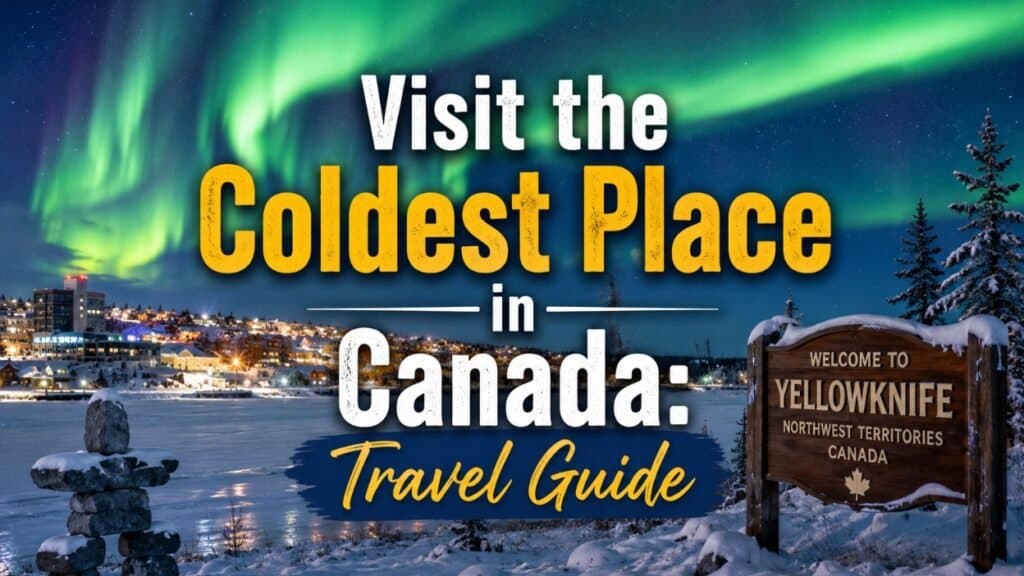
Most people assume the coldest place on Earth is somewhere in Antarctica, or maybe deep in Siberia. But on February 3, 1947, a tiny Yukon settlement called Snag hit -63°C — the lowest temperature ever recorded in North America. The kind of cold that freezes your breath before it leaves your mouth.
You don’t need to track down ghost towns to feel it, though. Canada has living, breathing destinations where the cold isn’t a problem to solve — it’s the entire reason you go.
This Canada travel guide is your starting point.
What Actually Qualifies as the Coldest Place in Canada?

It depends on how you measure it, and Canada has a few strong candidates.
By average annual temperature, Eureka, Nunavut takes the crown at a bone-chilling -19.7°C year-round. For the single coldest recorded moment, that’s Snag, Yukon again at -63°C. But if you want the coldest city you can actually fly into and explore like a real traveller — not a research scientist — Yellowknife, Northwest Territories is your answer.
January averages hover around -28.9°C, and it’s Canada’s officially recognised coldest capital. For most people who want to genuinely visit the coldest place in Canada without requiring military clearance, Yellowknife is where the story starts. It’s cold, yes. But it’s also strangely, unexpectedly alive.
Why Yellowknife? (Because the Cold Is the Point)

Here’s the thing about cold-destination travel that most people get backwards: the cold isn’t something to push through. In Yellowknife, it’s the whole infrastructure. It’s what turns Great Slave Lake into a road you can drive on. It’s what makes the Aurora Borealis so vivid the sky looks like it’s been set alight.
Remove the cold, and half the magic disappears with it. Yellowknife sits about 400 kilometres south of the Arctic Circle on the shores of Great Slave Lake. Around 20,000 people call it home — a mix of Indigenous Dene culture, diamond mining history, and a Northern grit that shapes everything about the place.
It’s genuinely one of the most unique places to visit in Canada, the kind of city where a conversation with a local tends to be more interesting than anything in the guidebook. Oh, and the Northern Lights are visible here up to 240 nights a year. Not a typo.
When to Go?

Any window between late August and April gives you a real shot at seeing the Aurora but winter is where the full experience opens up.
November through March is the deep freeze. Temperatures sit anywhere between -30°C and -40°C, sometimes colder. The lakes are locked solid, the skies stay dark, and the ice road to the Dene community of Dettah becomes driveable. If you want the complete winter activities in Canada experience, this is it.
March is the sweet spot if you want the best of both worlds. The days are getting longer so you have real light for outdoor activities, but the nights still deliver extraordinary Aurora displays. The Snowking’s Winter Festival also runs through March — more on that shortly.
September and October are a gentler introduction. Temperatures are cold but not punishing, the fall colours are remarkable, and on a still night you can watch the Aurora reflected in the open lakes before they freeze. Worth considering if the idea of -40°C is a dealbreaker.
Here is a quick breakdown to help you decide:
| Season | Months | Average Temperature | What You Get |
| Deep winter | November to March | -30°C to -40°C | Peak Aurora viewing, frozen lakes, ice roads, dog sledding |
| Late winter sweet spot | March | -20°C to -30°C | Longer daylight, strong Aurora odds, Snowking’s Winter Festival |
| Shoulder season | September to October | -5°C to -15°C | Milder cold, fall colors, Aurora reflected on open water |
| Peak daylight | May to August | Above freezing | Midnight sun, hiking, but little to no Aurora visibility |
Things to Do in Canada’s Coldest Place
Chase the Northern Lights
Everything else here is excellent. This is why you come. Yellowknife catches the Aurora Borealis roughly three nights a week during peak season, usually between 10 PM and 2 AM. Guided tours take you away from the city lights to dark-sky spots on the lakes, where the full display opens up above you.
Some operators run heated Aurora stations with hot drinks and reclining deck chairs. A few offer geodome viewing — you lie back under a glass ceiling and watch green and purple light move across the sky directly overhead. It sounds dramatic because it is.
Dog Sledding Through the Boreal Forest
There is nothing quite like being pulled across a frozen lake by a team of huskies in near-silence. Local operators introduce you to the dogs properly — you help harness the team, learn from the mushers, and then head out through the boreal forest on trails that feel like they belong to another century. The cold air, the sound of paws on snow, the sheer quiet of it. It’s the kind of thing that stays with you.
Drive — or Walk — an Ice Road
Driving on a frozen lake is one of those experiences that never stops being surreal, no matter how many times you’ve done it. The ice road from Yellowknife to Dettah across Yellowknife Bay opens around mid-December, stays solid until mid-April, and grows thick enough to carry trucks, host events, and hold concerts. At minimum, park the car and walk out onto it. Stand there for a moment. There’s a whole lake underneath your feet.
Snowking’s Winter Festival
Every March, a builder called Anthony Foliot — “Snowking” to the locals — constructs a full-scale snow castle on the frozen Great Slave Lake. Not a snow fort. A castle. Multiple levels, ice bars, craft markets, live music, slides, performances. It runs for several weeks and it’s genuinely one of the most distinctly Canadian things you can do anywhere in the country.
Snowshoeing and Cross-Country Skiing
Yellowknife’s trails around Frame Lake and Back Bay take you through Arctic landscapes that are almost aggressively beautiful — white, open, and completely quiet. Gear rentals are easy to arrange, routes suit all levels, and the light on the snow in winter is something photographers come from across the world to shoot.
Indigenous Dene Cultural Experiences
Yellowknife sits on the traditional territory of the Yellowknives Dene First Nation, and several operators run cultural experiences that are worth prioritising above almost anything else on this list. Think aurora viewing from a cabin on the land, traditional fish chowder and bannock, and elders telling stories about the Dene relationship with the Northern Lights. Not a packaged cultural moment — a real one.
Ice Fishing on Great Slave Lake
Head out onto the ice in a heated shack and fish through a hole in a lake that stretches to the horizon. Some operators include a demonstration of traditional Dene net-fishing, which adds a whole other dimension to what might otherwise just be a very cold afternoon. Good fun, genuinely interesting.
Planning a Bigger Canada Trip? Two More Experiences Worth Adding

Yellowknife stands completely on its own. But if you are building out a longer Canada itinerary, a couple of other experiences are worth putting on the list.
Cirque du Soleil ECHO — if you pass through any major Canadian city, this is a theatrical experience unlike anything else going. Visual, physical, and completely transporting.
Victoria whale watching — out on the Pacific off Vancouver Island, you are in genuine orca territory. Humpbacks, sea lions, and Dall’s porpoises too, if you are lucky. It’s about as far from the frozen north as Canada gets, and equally hard to forget.


